
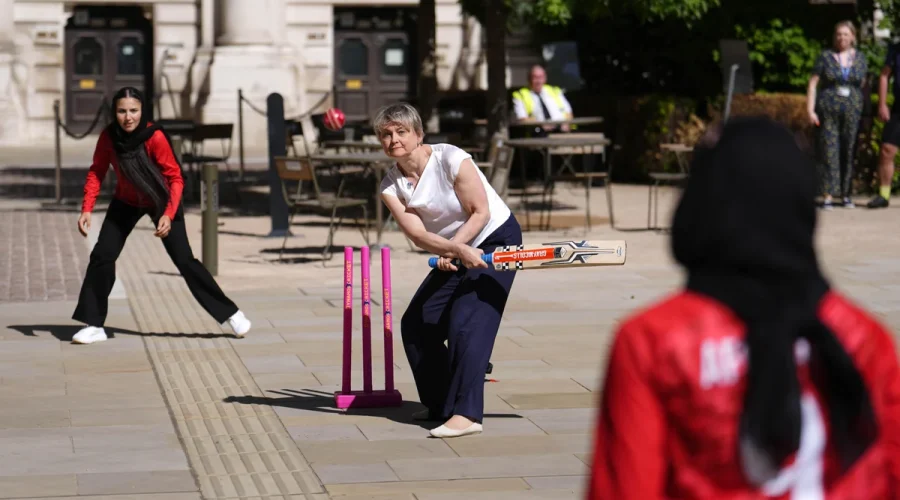
Yvette Cooper plays friendly cricket match with exiled Afghan women’s team
Yvette Cooper plays friendly cricket match – At the Foreign Office in London, Yvette Cooper, the UK’s Foreign Secretary, joined an unexpected yet symbolic event with the exiled Afghan women’s cricket team. The gathering was not just a social engagement but a powerful statement of support for women’s rights in Afghanistan, where the Taliban has imposed strict restrictions on their participation in sports and public life. Cooper’s presence underscored the international community’s concern over the ongoing suppression of women’s freedoms, particularly in light of the ICC Women’s T20 World Cup semi-final between England and South Africa, which is taking place at the Oval on Thursday night.
The match, held in the central London courtyard of the Foreign Office, brought together Cooper and Foreign Office minister Hamish Falconer with the Afghan team. It was a casual yet meaningful encounter, where the two officials took turns batting against the team members. The paved area around the grand building provided a makeshift yet dignified setting for the game, highlighting the resilience of the players who continue to pursue their passion despite the Taliban’s oppressive policies.
During the event, the team presented Cooper with a bat decorated by its members, a gesture of gratitude and hope. In return, she signed a pink cricket ball, symbolizing her solidarity with their cause. The bat, a handcrafted emblem of their struggle, was a poignant reminder of the sacrifices these women have made to stay active in a society that has sought to limit their roles. The ball, with its signature, serves as a tangible connection between the team and the UK’s diplomatic efforts to amplify their voices.
The Afghan team, which has been living in exile largely in Australia, fled their homeland due to the Taliban’s stringent measures against women’s rights. These policies have drastically curtailed opportunities for women to engage in education, employment, and sports, forcing many to leave their country in search of safety and continued participation in their chosen fields. Their current visit to London is part of a broader tour of England, which coincides with the ICC Women’s T20 World Cup, a major international event that has drawn global attention to the plight of Afghan women.
Speaking to the team after the match, Cooper emphasized the importance of their resilience. “It is truly remarkable that you continue to play cricket in Afghanistan despite the challenges,” she remarked. “The Taliban’s approach is not just harsh—it is a deliberate effort to stifle progress and deny women the right to lead active, independent lives.” Her words resonated with the team members, who have faced both physical and cultural barriers in their pursuit of sport. Cooper also called for international solidarity, noting that the ICC has a responsibility to support women’s rights globally. “While the Taliban government is trying to choke off basic rights, we must stand with you and show our commitment,” she said, urging the ICC to recognize the team’s efforts as part of a larger movement for gender equality.
“Your resilience and spirit in standing up for the chance to enjoy sport, the chance to be talented women doing amazing things is an inspiration and a hope,” Cooper added. “But while the Taliban are being so barbarous, I believe we have an obligation to support you and ensure your voices are heard.”
The match also served as a platform to raise awareness about the broader implications of the Taliban’s rule. Cooper highlighted how the restrictions on women’s rights have not only affected their ability to play sports but also to access healthcare, education, and employment. “Denying girls the chance to go to school, to work, to participate in sports—is that not a fundamental attack on human rights?” she asked. “It’s a setback for the entire nation, and it’s a shame that such basic freedoms are being taken away.”
The Afghan women’s cricket team, once a symbol of empowerment in their country, now faces the dual challenge of maintaining their identity abroad and advocating for change. Many of their players have found refuge in Australia, where they continue to train and compete. However, their presence in London adds another layer of visibility to their cause, drawing attention to the global impact of the Taliban’s policies. “This visit is not just about cricket,” said one team member during a brief interview. “It’s about showing the world that we haven’t given up, even when our home country has restricted us.”
Cooper’s participation in the match was a strategic move to connect with the team on a personal level. By engaging in a sport that represents freedom and vitality, she demonstrated a commitment to supporting their efforts. The event also showcased the team’s ability to adapt and thrive in exile, using cricket as a means of maintaining their connection to Afghanistan’s cultural and social fabric. “Playing cricket here reminds us of the joy we once had in our home country,” said another player. “It’s a way to keep our spirit alive, even when we’re far away.”
The significance of the ICC Women’s T20 World Cup semi-final in London cannot be overstated. As the event unfolds, the presence of the Afghan team adds a layer of urgency to the global conversation about women’s rights. The tournament, which highlights the achievements of female athletes worldwide, now includes a poignant chapter about the challenges faced by a group of women who have been displaced by conflict. Cooper’s support for the team underscores the UK’s role in advocating for such causes, particularly in the context of international sporting events.
While the match itself was a lighthearted moment, it carried deep political and social meaning. Cooper’s comments during the event have sparked discussions about the role of sports in diplomacy and the power of symbolic gestures in amplifying marginalized voices. The interaction also emphasized the importance of connecting with communities through shared interests, even in the face of political adversity. “