
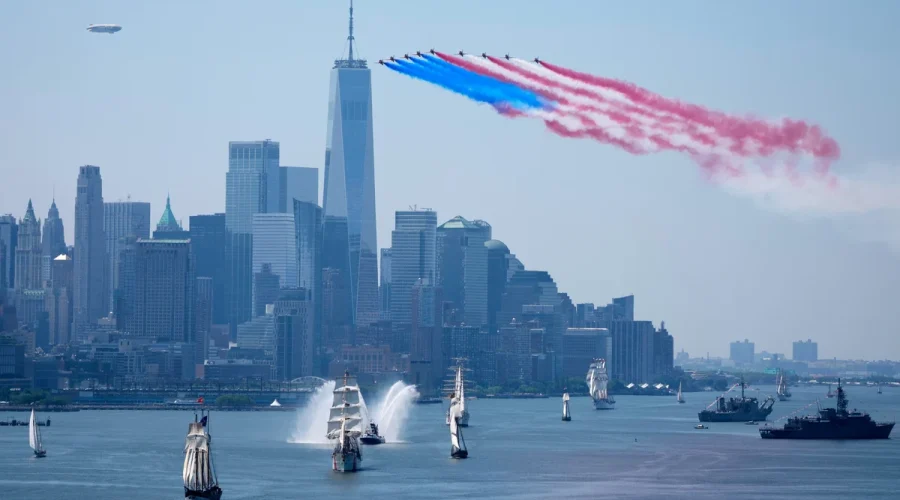
RAF Flying Aces Celebrate America’s 250th Anniversary with Sky Spectacle
RAF flying aces paint the sky red – As the United States commemorated the 250th year since its independence from Britain, the Royal Air Force’s Red Arrows performed a synchronized aerial display over New York Harbor, creating a striking visual tribute to the nation’s history. Their maneuvers, conducted in coordination with other military aircraft, left behind vapor trails that formed the iconic red, white, and blue colors of the American flag. The event coincided with a broader international celebration, including a naval review featuring historic tall ships and modern warships from the U.S. and its allies.
The aerial showcase took place against the backdrop of the Statue of Liberty, with the flotilla of vessels sailing past the landmark as part of the commemorative festivities. Among the participating aircraft were the US Air Force’s Thunderbirds and the Navy’s Blue Angels, whose precision flypasts added to the grandeur of the occasion. The Royal Navy’s Band of the Royal Marines also joined the event in New York, having previously entertained crowds in Washington, D.C., during the week.
On the occasion, the British monarch extended his “warmest congratulations” to President Donald Trump and the American people, calling the milestone “a truly historic moment for all Americans.” The gesture underscored the enduring ties between the two nations, even as political tensions occasionally cast a shadow over transatlantic relations. Meanwhile, U.S. Vice President JD Vance highlighted the collaborative spirit of the celebrations, acknowledging the presence of global allies. Speaking from the deck of a naval assault ship in the sweltering heat, he remarked: “We are deeply grateful to our partners and allies for joining us in honoring 250 years of American independence.”
“It is a quintessential American tradition to celebrate our heritage by showcasing the strength of our armed forces to the world. Yet, I can’t help but reflect on how different these waters looked two centuries ago,” Vance added, pointing to the historical significance of the harbor. His words evoked the early days of the Revolutionary War, when General George Washington stood on Manhattan’s shores, watching for British naval forces. The contrast between past struggles and present unity was a poignant reminder of the nation’s journey.
The festivities also included a dramatic aerial spectacle, with the Red Arrows’ performance drawing wide acclaim. Their routines, blending speed and grace, were accompanied by the roar of engines and the shimmer of trails that painted the sky with patriotic hues. This display was part of a larger array of events planned for the anniversary, ranging from parades to fireworks. However, extreme heat posed challenges to some traditional celebrations. July 4, traditionally marked by patriotic displays, was forecast to be the hottest day on record in parts of the eastern U.S., prompting health warnings and safety measures.
Officials in New York and Washington urged citizens to stay hydrated and take precautions, with cooling stations and medical support deployed across the city. In New York, mobile units staffed by nurses and paramedics distributed water and sunscreen, while Washington event organizers provided similar facilities. Despite the heat, the air and naval displays proceeded as planned, though a scheduled Independence Day parade in the capital was canceled. Instead, the focus shifted to high-altitude performances, including a historic showcase of stealth airpower and the Thunderbirds’ maneuvers.
President Trump, who was set to deliver a speech at the National Mall on Saturday evening, emphasized the scale of the celebrations. The National Mall, stretching from Congress to the Lincoln Memorial, became a central hub for the 250th anniversary events. Trump promised a pyrotechnic display that would be “the biggest in the nation’s history,” blending traditional fireworks with modern spectacle. However, the anniversary also sparked debate over its political undertones, with critics noting that Trump’s participation was seen as an opportunity to bolster his image rather than foster national unity.
Amid these tensions, the creation of the “Freedom 250” organization, aligned with the White House, highlighted efforts to reshape the narrative of the celebrations. This initiative, launched last year, has emerged as a rival to the bipartisan “America250” group, which was established by Congress a decade ago to coordinate activities. The competition between these entities reflects the broader divisions in American politics, even as the nation came together to mark its history.
Meanwhile, the maritime elements of the event drew attention for their historical resonance. The tall ships, representing nations across the globe, not only added a nostalgic touch but also symbolized the shared legacy of exploration and trade that linked Britain and the U.S. in the past. The Red Arrows’ performance, while a modern marvel, echoed the pioneering spirit of the early days of aviation, which played a crucial role in the nation’s development.
As the sun set over the harbor, the combined efforts of military and civilian participants created a memorable atmosphere. The Red Arrows’ trails, the Blue Angels’ acrobatics, and the sounds of the Royal Navy band intertwined to form a tapestry of national pride. For many, the event was a celebration of resilience and progress, even as the sweltering heat tested the endurance of both people and performers.
The anniversary’s dual focus on historical remembrance and contemporary achievements was evident in the events across the country. In Los Angeles, Queen Latifah was set to host a concert featuring The Smashing Pumpkins, Chris Stapleton, and Chaka Khan, with a drone show adding a futuristic element to the celebration. These varied events, from the skies to the streets, underscored the diverse ways Americans honored their shared past and aspirations for the future.
Despite the logistical hurdles posed by the extreme weather, the festivities managed to unite the nation in a collective moment of pride. The Red Arrows’ performance, the naval review, and the participation of international allies all contributed to a sense of global camaraderie. As the 250th anniversary unfolded, it became clear that while challenges arose, the spirit of celebration remained unyielding, echoing the determination that led the United States to independence in the first place.
From the synchronized flights of the RAF’s aerobatic team to the resilience of event organizers in coping with record-breaking temperatures, the day’s events captured the essence of American history. The interplay of tradition and innovation, as well as the collaboration with international partners, highlighted the country’s enduring legacy. Even as political divisions persisted, the anniversary served as a reminder of the shared values that continue to bind the nation together.