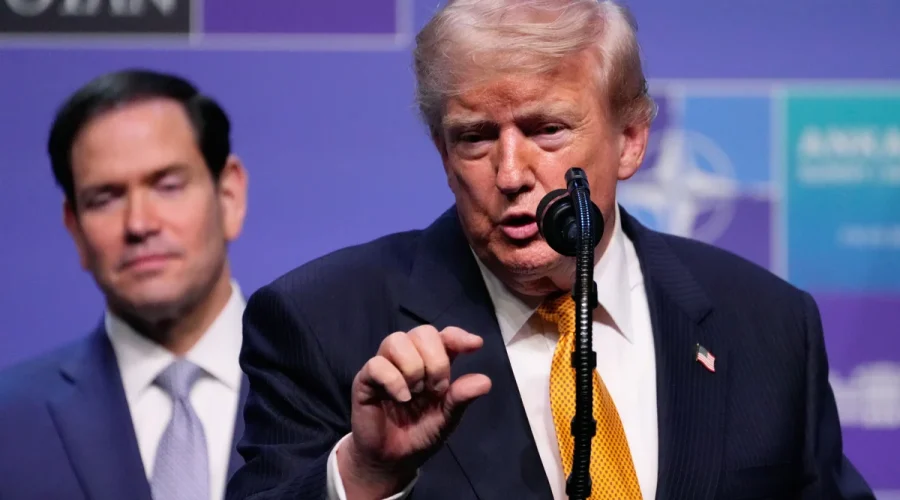
Trump Links Greenland Negotiations to Future US Military Presence in Europe
Traveloasisspot.com – President Donald Trump has indicated that securing an agreement regarding Greenland could significantly influence the United States’ approach to maintaining military forces across the European continent. The remarks came during a brief journey aboard the newly acquired Air Force One aircraft, following a quick landing at RAF Mildenhall in Suffolk. This stopover occurred as the presidential plane prepared for its return flight to Washington from the recent NATO summit held in Turkey.
Greenland’s Strategic Importance in US Foreign Policy
When questioned about potential changes to troop deployments, the American president offered a measured response. He explained that while no definitive conclusion has been reached, the outcome will largely hinge on developments concerning Greenland. The territory, currently under Danish sovereignty, has been identified by Trump as a potential candidate for American control. He emphasized to journalists that achieving a favorable arrangement regarding Greenland would be instrumental in determining whether American soldiers remain stationed throughout Europe or are withdrawn.
“I haven’t made that final determination. A lot’s gonna depend on Greenland.”
The president’s position on this matter has shown some inconsistency in recent weeks. At one point, he announced plans to deploy approximately 5,000 American service members to Poland. Shortly thereafter, he suggested that a comparable number of troops might be pulled back from European bases entirely. This back-and-forth messaging has created some uncertainty among international observers regarding the true direction of American military strategy.
Allies Respond to Defense Spending Demands
During the conclusion of the NATO gathering in Ankara, Trump adopted a more cooperative demeanor. He acknowledged that various alliance partners were responding positively to calls for increased military investment. The American leader specifically encouraged Britain and other coalition members to expedite their planned increases in defense budgets to achieve the established NATO benchmark without delay.
“Some have truly answered the call, and others are making big changes, and will be answering the call. I think I can say, in all cases, they’re going to be answering the call.”
Outgoing British Prime Minister Sir Keir Starmer encountered some domestic pushback for not providing a sufficiently detailed roadmap within last week’s Defence Investment Plan to demonstrate how the United Kingdom would reach its financial commitments. Despite this internal criticism, Starmer reported that no direct confrontation occurred between himself and the American president regarding the matter.
“I had no discussion with Donald Trump in which he made any issue with me in relation to the defence spending for the United Kingdom.”
Spain’s Commitment and Summit Outcomes
Trump also took time to commend Spain for its renewed dedication to defense expenditure. Earlier, the Spanish government had faced scrutiny for declining to formally pledge the 5% of gross domestic product that NATO members were encouraged to contribute. According to the American president, Spain reversed its position during the summit and demonstrated considerable generosity in honoring previous requests for financial contributions.
The president expressed satisfaction with the overall results of the meeting, dismissing rumors that he might skip future NATO gatherings. He characterized the summit as demonstrating strong unity among alliance members and suggested that NATO emerged from the proceedings in a more robust position. Starmer echoed this sentiment, noting that Trump concluded the meeting by expressing pleasure with both the atmosphere and the collective spirit displayed by all participants.
“The meeting today settled a lot of things.”
Furthermore, the British prime minister maintained that he has consistently maintained a positive relationship with the American leader, even through periods when Trump publicly criticized various aspects of UK policy. This continuity in their diplomatic rapport appears to have facilitated productive discussions despite the various challenges addressed during the summit proceedings.