Table of Contents
ToggleScientists Film Whale Birth with Unprecedented Group Support
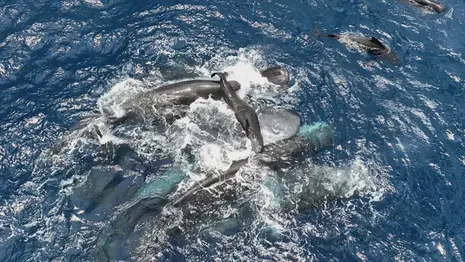
For the first time, researchers captured footage of a sperm whale giving birth, aided by a collective effort from other females in the pod. The event, recorded near Dominica’s Caribbean coast on 8 July 2023, involved a 19-year-old whale named Rounder, who was supported by her relatives and non-related individuals during the delivery of her second calf.
The Project Ceti team, dedicated to decoding whale communication, observed the process from a boat while using drones and underwater recordings to document every detail. Over five and a half hours, they tracked the group’s coordinated actions, revealing a rare and remarkable display of communal care in marine mammals.
A Rare Display of Collective Care
Published in Scientific Reports and Science, the study highlights the scarcity of such observations. Among the 93 cetacean species, only nine have been seen birthing in the wild, and this instance added a new layer: non-related females actively assisting the mother.
“This is the first evidence of birth assistance in non-primates. It is fascinating to see the intergenerational support from the grandmother to her labouring daughter, and the support from the other, unrelated females,” said Shane Gero, a Project Ceti team member, in an interview with New Scientist.
The birth itself spanned 34 minutes, from the emergence of tails to the calf’s full arrival. During the process, adult females dove beneath Rounder’s dorsal fin, positioning themselves on their backs with heads directed toward her genital slit to help guide the baby.
Post-delivery, the pod shifted into rapid action. Researchers noted that all adults “squeezed the newborn’s body between theirs, touching it with their heads,” while others nudged the calf across the water’s surface. This behavior, preserved for over 36 million years, reflects cetaceans’ unique evolutionary journey.
Evolutionary Adaptations for Survival
After evolving from land-dwelling ancestors, cetaceans became the sole mammals to return to aquatic life. This transition required specialized adaptations, such as calves being born tail-first to avoid drowning. Despite this, newborns initially sink and must be lifted by the group to facilitate their first breaths.
Unlike primates, which are known for birth assistance, cetaceans have long been studied for their communication skills. Yet, this footage underscores a previously undocumented social behavior, showing how the pod collaborates to ensure the calf’s survival.
Sperm whales, with a 16-month gestation period, give birth to calves already 4 metres long. These young depend on their mothers for at least two years, with the rest of the pod providing care during foraging trips. The calf’s survival past its first year, observed again in July 2024 alongside other pod members, signals a promising future for the species.
The event, though brief, marks a significant milestone in marine biology. It offers insights into the complex social structures of whales and their evolutionary strategies for nurturing offspring in an oceanic environment.