Families of Chinook Crash Victims Challenge Government’s “Too Late” Argument in High Court
A Decades-Long Battle for Justice
Traveloasisspot.com – The relatives of those who perished in the tragic 1994 RAF Chinook helicopter disaster have issued a powerful statement regarding the Government’s position on seeking an independent investigation. According to Niven Phoenix, whose father Ian lost his life in the catastrophe, officials cannot simply dismiss the families’ concerns by claiming insufficient time has elapsed for a proper review.
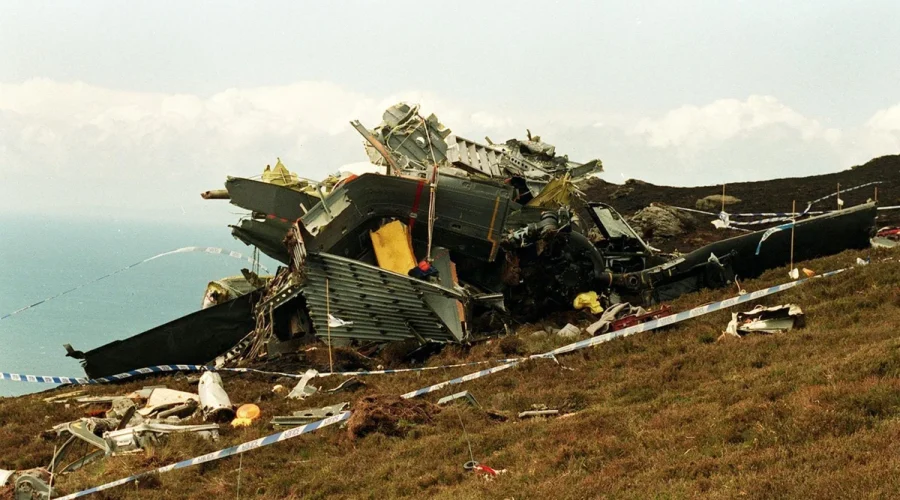
The devastating incident occurred on June 2, 1994, when the aircraft plummeted onto the Mull of Kintyre while traveling between RAF Aldergrove in Northern Ireland and Fort George, located near Inverness in Scotland. The crash claimed the lives of twenty-nine individuals, comprising four special forces personnel and twenty-five intelligence experts who were aboard the helicopter at the time.
Initially, authorities attributed the disaster to pilot error. However, this conclusion was subsequently overturned in 2011, reigniting calls for a comprehensive examination of what truly transpired that fateful day.
The Fight for Transparency
Relatives of the victims are now demanding a judge-led public inquiry into the tragedy. Central to their campaign is the release of all relevant documentation, including certain files that have remained sealed for a century. This demand has brought them to the Royal Courts of Justice in London, where a High Court hearing is scheduled to determine whether the families may proceed with a Judicial Review.
“For decades, many of our families trusted official investigations and explanations because they had no reason to believe vital information had been withheld,” Niven Phoenix explained.
Phoenix further noted that families eventually discovered the Mark 2 helicopter lacked proper airworthiness and that crucial papers had been locked away for one hundred years. As additional evidence surfaced, skepticism intensified among the bereaved relatives.
“We have repeatedly tried to engage constructively with ministers. We presented detailed evidence. We asked for dialogue. We asked for an independent review. Now the Government’s answer is that we’ve simply come too late. That argument cannot be allowed to win,” Phoenix stated emphatically.
Broader Implications for Justice
According to Phoenix, this case extends beyond the Chinook tragedy itself. He emphasized that it concerns whether any family can achieve justice when a public institution relies on delay tactics while concealing essential information.
“Ironically, it goes to the very heart of Hillsborough Law which the Government says that it is committed to – the situation we find ourselves in is beyond belief,” he remarked.
The Hillsborough Law, officially designated as the Public Office (Accountability) Bill, was transferred from the previous parliamentary session. This legislation mandates that public officials provide truthful testimony during inquiries and investigations.
Legal Arguments and Family Unity
Mark Stephens, solicitor representing the families and member of a pro-bono legal team from Howard Kennedy and Doughty Street Chambers, articulated the core questions haunting the relatives: who authorized the flight, what knowledge did officials possess, and why was Chinook ZD576 permitted to depart despite concerns?
“The Government’s position is effectively that because decades have passed, throughout which the MoD have denied families access to documents and information, the courts should refuse to examine whether the State allowed an aircraft with unresolved airworthiness concerns to fly,” Stephens observed.
Stephens countered that the Government’s argument suggests families forfeit their right to question if the State retains evidence long enough. He characterized this as “secrecy rewarded by the passage of time” and described it as morally indefensible within a democracy governed by the rule of law.
Notably, the families only united to form a single campaign in 2024. Stephens clarified that this timing does not indicate indifference or inactivity. Rather, it reflects practical circumstances: families were geographically dispersed, unfamiliar with one another, lacked organizational structure, and needed time to gather information and build capacity for such a significant legal challenge.
The Ministry of Defence has declined to comment while proceedings continue, with a hearing set for July 14. The aircraft, RAF Chinook ZD576, crashed during foggy conditions on its journey on June 2, 1994, marking one of the most significant aviation disasters in British military history.