Hiddleston Reflects on Pompeii Journey in New National Geographic Series
Tom Hiddleston hopes he honoured the people – Tom Hiddleston has shared his thoughts on portraying the ancient world in a fresh documentary project, expressing satisfaction that he may have done justice to the citizens of Pompeii. The Hollywood actor, widely recognized for his role as Loki within the Marvel Cinematic Universe, has embarked on a temporal exploration through National Geographic’s latest dramatic series examining the legendary volcanic catastrophe that engulfed ancient Rome.
A Personal Connection to Antiquity
The immersive three-part production, titled Pompeii: Out Of Time With Tom Hiddleston, carries viewers back to the Roman era. At forty-five years of age, the performer investigates the moments preceding, encompassing, and following the devastating event that obliterated the historic settlement. This marks the first occasion where Hiddleston serves as presenter in his own right, a decision motivated by his enduring enthusiasm for classical studies.
During the premiere event hosted at the British Museum, the actor conveyed his enthusiasm to journalists. He explained how his academic background shaped this opportunity: “Curiosity can take you to places which will change your life, and that’s what it did to me. I’ve always loved the classics. It was my degree at university.” His educational foundation at Cambridge University included classical studies, and his initial pilgrimage to Pompeii occurred in 1998, when he was merely seventeen years old.
“We need, somehow, to know who we were, to gain a better understanding of who we are.”
The performer further elaborated on his philosophical approach to the subject matter: “I find it very reassuring to think of the deep past, the ancient world. It’s a safe place to ask big questions, important questions, about who we are and where we’re going.” This reflective perspective underscores the documentary’s broader mission beyond mere historical recounting.
Blending Investigation with Drama
The series combines investigative journalism with theatrical performance. Hiddleston participates in cinematic segments that bring to life the experiences of actual Romans whose existence was interrupted by the eruption. The production collaborates with specialists including historians, archaeologists, geologists, and disaster researchers to reconstruct the narratives of several individuals: a young apprentice, a commercial entrepreneur, and a member of the Praetorian guard.
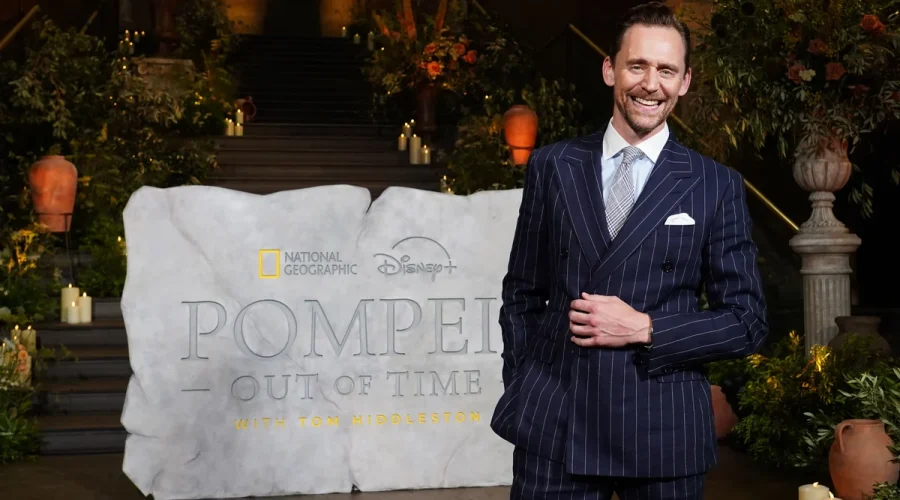
At the London premiere, dressed in a pinstripe navy suit, Hiddleston articulated his hopes for audience engagement. He expressed desire that viewers would connect emotionally with these historical figures and that his presentation would honor their legacy. He noted: “They were ordinary people, like us, they were families, and fishermen, and business owners, and soldiers, and friends, and lovers, and mothers and sons, they weren’t people who expected their lives to be remembered, so I hope I’ve honoured their humanity and their courage.”
“It feels like you can travel back in time, because the volcanic eruption of Mount Vesuvius and the pyroclastic flow of pumice and volcanic ash and superheated rock, has preserved this ancient city of 20,000 people for all of time, which means you can walk through the past and feel the memories of our ancestors in the walls of those buildings.”
The actor described the volcanic phenomenon as a natural time capsule. The pyroclastic flow, consisting of pumice, ash, and superheated rock, effectively froze Pompeii in time. This preservation allows modern visitors to experience the ancient environment directly, walking through streets where inhabitants once lived their daily lives.
Continuing a Creative Partnership
Hiddleston reunited with Kevin R. Wright, the executive producer behind the Loki series, for this new venture. The documentary will become available to audiences on both Disney+ and National Geographic platforms beginning July 23. The actor’s involvement extends beyond his acting career, drawing upon his personal history with the site and his academic training in classics.
His emotional response to Pompeii has remained consistent over decades. He remarked: “I found it magical when I went there when I was 17. I find it magical now.” This enduring wonder informs his approach to presenting the documentary, bringing authenticity to his role as both narrator and participant in exploring humanity’s relationship with history and memory.