Thousands Fill Trafalgar Square to Demand Justice After Cambridge Professor’s Death
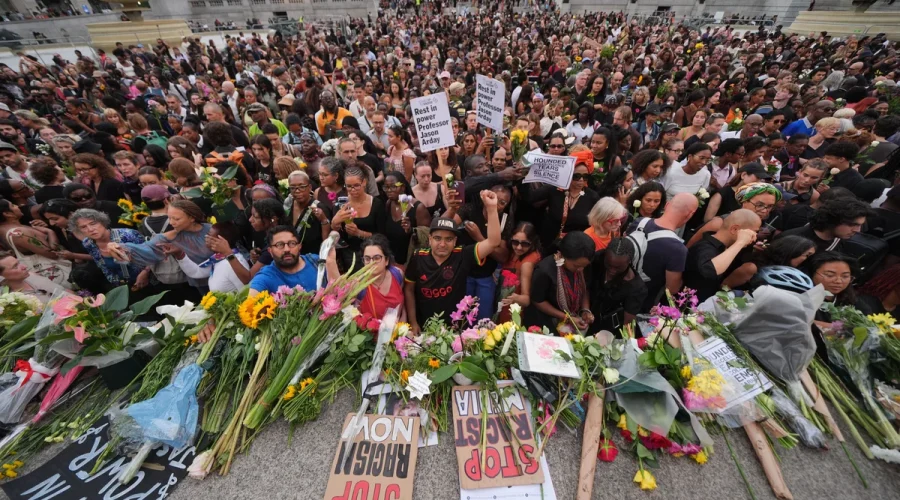
Traveloasisspot.com – More than 30,000 mourners packed the streets surrounding the National Gallery in London’s Trafalgar Square on Monday evening, forming one of the largest spontaneous vigils in recent British memory. The gathering, dressed predominantly in black and carrying bouquets of flowers, came to honour the memory of Professor Jason Arday, the 41-year-old sociologist whose death in Battersea, south London, on Friday has ignited a fierce national debate over media conduct, racial prejudice in academia, and the boundaries of public scrutiny.
A Friend’s Account of the Final Days
Among the most emotionally charged moments of the evening came from Lord Simon Woolley, a crossbench peer and close friend of the late professor. Addressing the vast crowd, Woolley described the sustained press coverage surrounding Arday as a “public execution” and a “lynching,” words that drew sustained cheers of approval from the assembled thousands.
Woolley recounted a private dinner held just days before Arday’s death, attended by himself, MP Diane Abbott, and activist Misan Harriman. The group had gathered specifically because they recognised their friend was under severe strain.
“We held him in our arms. We told him he was loved. He held Diane’s (Abbott) hands, and he said, ‘I love you, but’, he said, ‘they’re hounding me to death, and I cannot see a way out’.”
Woolley went further, drawing a sharp distinction between the formal plagiarism inquiry — which had cleared Arday — and what he characterised as an unrelenting pursuit of any perceived inaccuracy.
“This wonderful man. Never stole a bag of crisps. He was exonerated from plagiarism. But the dogs of hell, the hounds of hell, sought to pursue any inaccuracy that they could say Jason is a bad man, Jason doesn’t deserve to be in Cambridge. For them, Jason doesn’t deserve to be alive. There needs to be some reckoning. There needs to be some justice.”
The Timeline: From Resignation to Tragedy
Arday stepped down from his position as professor of sociology of education at the University of Cambridge the previous week, following allegations of plagiarism that had dominated national headlines. He had become Cambridge’s youngest black professor in 2023, a milestone that drew both celebration and, as several speakers at the vigil argued, intensified scrutiny of his work and background.
From the moment of his resignation to his death, a span of roughly three weeks, the press published what one attendee’s cardboard placard quantified as “249 articles in 22 days” — a figure widely attributed to analysis conducted by NewsCord, an AI-based media-monitoring firm. The sheer volume of coverage, many argued, created an environment of relentless public pressure that made private life nearly impossible.
Political Voices Call for Accountability
MP Diane Abbott, who had known Arday personally, spoke of a “vicious” and “bitter” campaign driven by those who, in her framing, simply could not accept a black man occupying a Cambridge professorship.
“He must have felt that if he resigned the attacks on him would stop, but in fact they got even worse. From his resignation to his suicide last week, was just three weeks, but the newspapers printed 249 articles about him. This was a vicious campaign but it wasn’t just a campaign against the professor, it was a campaign against all of us and that’s why it is so important to come together and fight for justice for Professor Jason Arday.”
MP Dawn Butler also addressed the crowd, alongside Jo Maugham, director of the Good Law Project, a legal-advocacy organisation that has become a central node in the campaign for an independent inquiry into the media’s handling of Arday’s case.
Petitions, Fundraisers, and a Growing Movement
The vigil was not an isolated act of mourning. More than 90,000 people — including Abbott, Green Party leader Zack Polanski, and television presenter Jameela Jamil — have signed a Good Law Project petition calling for a formal inquiry into the coverage surrounding Arday. The petition’s framing describes his death as following “two weeks of relentless harassment.”
Parallel fundraising efforts have also gathered momentum. Sir Patrick Vernon, a veteran campaigner best known for his role in establishing a national Windrush Day, launched a GoFundMe page that has already attracted over £170,000 in donations, signalling the breadth of public sympathy extending well beyond London’s immediate political circles.
Music, Signs, and a Family’s Words
The evening’s atmosphere shifted between solemnity and defiant solidarity. Singers Beverley Knight and Jermaine Jackman performed for the crowd, while large placards moved slowly through the masses. One prominent banner declared: “Racism in the mainstream media is responsible for Jason Arday’s death.” Others carried the words “Rest in power Jason Arday,” and calls for “justice” echoed repeatedly across the square.
The vigil closed with words from Arday’s family, read aloud by MP Bell Ribeiro-Addy:
“This has been an incredibly painful time for our family, and we are still coming to terms with the tragic loss of our beloved Jason. What has become clear over the past 72 hours is the profound impact he had on people. We are grateful to all who have created light in this dark time through kindness, generosity and solidarity. Your presence here to remember him this evening means a lot to us, and while we cannot be there in person, please know that we stand with you in spirit.”
As the crowd dispersed into London’s night, the questions raised by the vigil — about editorial standards, the treatment of minority academics in elite institutions, and the human cost of sustained media saturation — remained firmly unresolved. For now, they have become the defining issues of a public conversation that shows no sign of fading.
Related Reading
Frequently Asked Questions
What is Professor Jason Arday was victim of public?
Professor Jason Arday was victim of public is the main topic of this guide. The article explains the context, practical details, and next steps readers should understand.
Why does Professor Jason Arday was victim of public matter?
Professor Jason Arday was victim of public matters because readers are looking for a useful answer, not just a short summary. Good content should match search intent and help them decide what to do next.