Major Blaze at Deptford Recycling Site Draws Massive Fire Response Across South-East London
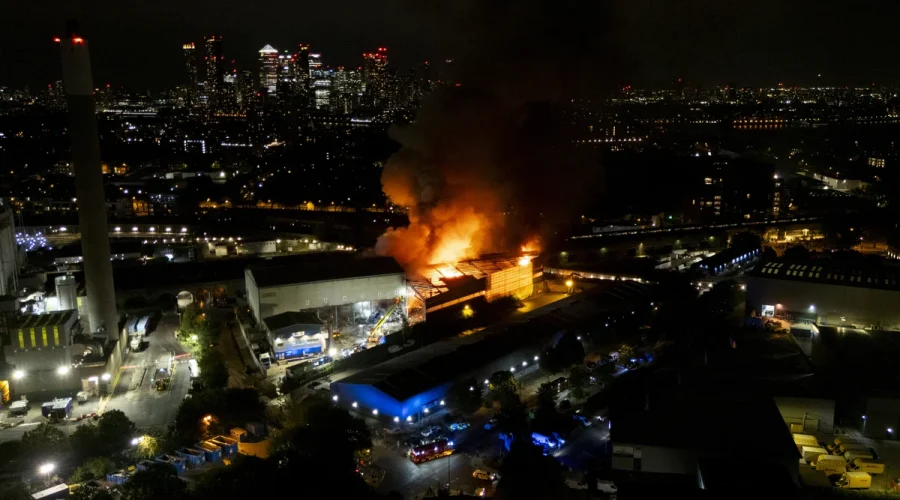
Traveloasisspot.com – A substantial waste fire engulfing a recycling facility on Landmann Way in Deptford has triggered one of the larger emergency responses in recent memory for the borough’s south-eastern industrial corridor. Roughly 100 firefighters, deployed across fifteen fire engines, were committed to the scene after crews received their first alarm at 19:58 on a Tuesday evening. The blaze, consuming an estimated 50 tonnes of stored household waste, sent plumes of thick smoke and visible flames rising well above the rooftops of nearby structures, visible from a distance along the adjacent railway corridor.
Scale of the Emergency Deployment
The incident demanded resources far beyond what a single station could provide. Units from East Greenwich, Old Kent Road, Deptford, and multiple surrounding fire stations converged on the site within minutes of the initial call. The sheer volume of combustible material — half a tonne of mixed domestic refuse packed into a commercial recycling operation — meant that conventional ground-level hose streams alone would be insufficient to suppress the heat and prevent spread to adjacent structures.
To address the vertical challenge, London Fire Brigade deployed two of its largest aerial assets: a 32-metre turntable ladder and a 64-metre turntable ladder, both reconfigured as elevated water towers. This allowed crews to direct powerful water jets onto the upper reaches of the burning waste pile, a tactic essential when the fire has climbed well above ground-level reach. Partner blue-light services, including police and ambulance units, worked alongside the fire crews throughout the operation.
“Approximately 100 firefighters are tackling a large fire at a recycling centre on an industrial estate on the border of Bermondsey and North Lewisham.”
“First calls were received at 1958 and 15 fire appliances are now in attendance.”
“Fire crews along with colleagues from partner blue light services are working hard in difficult conditions to bring the fire under control.”
“One of the brigade’s 32-metre turntable ladders and one 64-metre turntable ladder are being used as water towers to tackle the flames from above.”
— Station Commander Duncan Rees, London Fire Brigade
A Site with a Recent History of Fire
This was not the first time the Landmann Way facility has been the centre of a major emergency. In June of the same year, a separate blaze at the same recycling operation destroyed a van and a car parked on site. One man sustained injuries and was treated at the scene by London Ambulance Service before being transported for further care. The recurrence of significant fires at a single waste-handling location within a matter of months raises questions about storage practices, ignition sources, and the inherent risk profile of facilities that accumulate large volumes of mixed household refuse in close proximity to residential streets and rail infrastructure.
Deptford and the surrounding Bermondsey–North Lewisham boundary area has long been a patchwork of light industrial uses, logistics yards, and small-scale waste processing operations wedged between dense housing stock and the busy railway spine that feeds London Bridge station. The proximity of stored combustible material to overhead wiring, vehicle traffic, and occupied buildings makes any sustained fire at such a site a genuine threat to the wider neighbourhood, not merely a contained industrial incident.
Disruption to Rail and Local Residents
The fire’s location directly adjacent to a railway line proved consequential for commuters. National Rail confirmed that services into London Bridge from New Cross were disrupted because the blaze had effectively blocked the tracks, forcing suspensions and diversions on one of the capital’s busiest suburban corridors. Passengers faced delays and cancellations through the evening peak, with alternative routing advised via neighbouring stations.
Residents in the immediate vicinity were urged to stay indoors, seal doors and windows, and avoid travelling through the affected streets while smoke hung heavily over the area. The volume of particulate matter generated by burning mixed household waste — plastics, paper, textiles, and organic material — can produce irritant fumes that linger well beyond the visible smoke column, particularly in still evening air.
Wider Context: Waste Fires and Urban Risk
Recycling and waste-transfer facilities in inner London operate under constant pressure to process the city’s domestic refuse stream, often storing material in open or semi-enclosed yards while awaiting collection or processing. When ignition occurs — whether from electrical fault, hot vehicle exhaust, or external source — the resulting fire can escalate rapidly because the stored material presents a dense, heterogeneous fuel load with variable moisture and composition. The 50-tonne figure cited for this incident represents a substantial quantity of mixed waste, enough to sustain intense burning for hours and generate the kind of thermal column that draws aerial assets into play.
The deployment of two turntable ladders as water towers underscores the scale of the challenge: ground-level crews alone cannot penetrate the upper layers of a burning waste pile of this magnitude. The combined effort of fifteen appliances and roughly a hundred firefighters working through the night reflects the brigade’s assessment that containment required sustained, multi-angle water application until the core of the material was cooled below re-ignition temperature.
As crews worked through the small hours, the priority shifted from active suppression to overhaul and monitoring — ensuring no smouldering pockets remained capable of reigniting once the initial water application ceased. The railway lines, once cleared of debris and confirmed safe, were expected to resume service once inspection teams had verified track integrity and overhead equipment.
Related Reading
Frequently Asked Questions
What is About 100 firefighters tackle blaze at recycling?
About 100 firefighters tackle blaze at recycling is the main topic of this guide. The article explains the context, practical details, and next steps readers should understand.
Why does About 100 firefighters tackle blaze at recycling matter?
About 100 firefighters tackle blaze at recycling matters because readers are looking for a useful answer, not just a short summary. Good content should match search intent and help them decide what to do next.