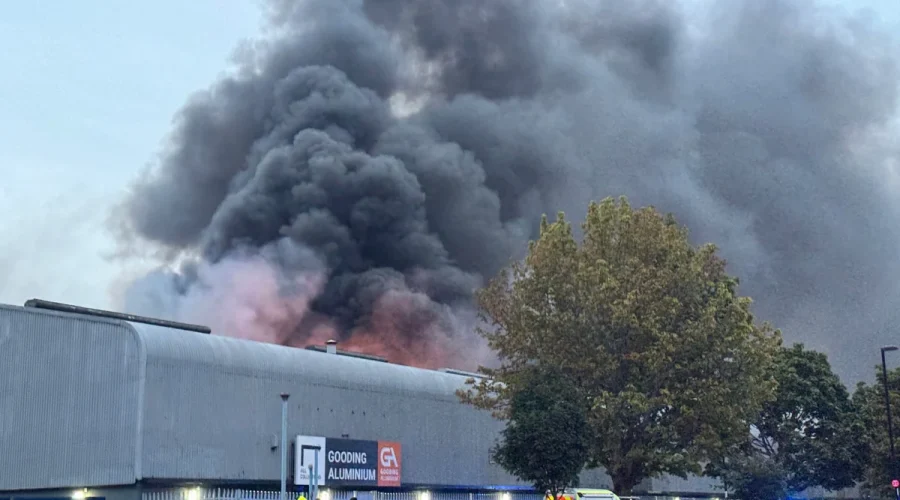
Major Blaze Engulfs Waste Storage Site in Deptford, Sending Smoke Across Southeast London
Traveloasisspot.com – A substantial fire consumed a waste processing facility on Landman Way in Deptford on the evening of the incident, sending towering columns of smoke visible from across the capital. Approximately 50 tonnes of household waste stored inside the building fuelled the flames, which ripped through the structure and produced dense, billowing plumes that locals captured on their phones as they gathered at a safe distance to watch the spectacle unfold.
The London Fire Brigade received its first of more than 160 emergency calls reporting the blaze at 19:59. Within minutes, crews dispatched from East Greenwich, Old Kent Road, Deptford, and neighbouring fire stations converged on the scene. In total, fifteen fire engines and roughly 100 firefighters were committed to the operation, making it one of the larger urban fire responses of recent weeks.
Commander’s Account from the Scene
Station Commander Duncan Rees addressed reporters from the front line, describing the challenging conditions crews faced as they worked to contain the inferno.
“Crews are working hard in difficult conditions to bring the fire under control. One of the Brigade’s 32m ladders and a 64m ladder are both being used as water towers to tackle the flames from above. A large amount of smoke is being produced by the incident. Local residents should keep doors and windows closed where possible.”
The deployment of both the 32-metre and 64-metre aerial ladders as elevated water delivery points indicates that the fire had reached heights inaccessible to ground-level hoses alone. Operating such apparatus simultaneously demands careful coordination, as each ladder requires a dedicated crew to position, stabilise, and direct its water stream while remaining clear of collapsing structural hazards.
Rail Network Disruption
The fire’s proximity to major rail corridors triggered significant transport disruption across south and central London. National Rail confirmed that several lines running between New Cross and London Bridge were blocked while crews remained on scene. Trains on those routes faced cancellations or extended delays, with the disruption projected to persist until the close of the day.
Passengers travelling the London Blackfriars-to-East Croydon corridor were advised to build in an additional 30 minutes for their journey. Services on that route were rerouted and would not stop at London Bridge station. Thameslink trains operating along the diversion path were expected to experience delays of at least 15 minutes, according to National Rail’s advisory.
For commuters dependent on London Bridge as a transfer point, the closure effectively severed a critical interchange, forcing detours through alternative stations and adding considerable time to cross-town trips. The scale of the disruption underscored how a single industrial fire in a densely populated southeast London borough can ripple through the city’s entire rail network within hours.
Resident Advisories and Local Impact
Because the burning waste generated an unusually heavy smoke load, authorities urged nearby residents to keep windows and doors shut wherever possible. The particulate matter released by decomposing household waste — plastics, textiles, packaging materials, and organic refuse — can carry irritants and, in some cases, toxic compounds into homes if ventilation is not managed carefully.
Neighbouring streets in Deptford, a historically working-class area of Greenwich that has seen significant regeneration in recent years, were filled with onlookers filming the event on mobile phones. The sight of flames tearing through the facility’s roof and thick smoke rolling over surrounding rooftops drew considerable public attention, with footage circulating widely on social platforms within minutes of the outbreak.
Context: Waste Facilities and Urban Fire Risk
Waste storage and processing sites represent a persistent fire hazard in urban environments. The roughly 50 tonnes of mixed household waste involved in this incident contained a combustible load far greater than that found in a typical domestic or commercial premises. Once ignition occurs, the heterogeneous mix of materials can produce intense heat, prolonged burning, and copious smoke that outlasts the visible flame front.
Deptford’s location along the River Thames and its adjacency to major transport arteries mean that any significant industrial incident in the area carries knock-on effects for road, rail, and river traffic. The evening timing of the blaze — just before 8 p.m. — coincided with peak commuter return flows, amplifying the disruption felt by the travelling public.
As crews continued their work through the night, the priority shifted from active suppression to monitoring for re-ignition among the smouldering debris. The full extent of damage to the facility and any environmental impact from runoff into the Thames catchment would require further assessment in the days following the incident.
Related Reading
Frequently Asked Questions
What is Firefighters tackle huge blaze at a waste?
Firefighters tackle huge blaze at a waste is the main topic of this guide. The article explains the context, practical details, and next steps readers should understand.
Why does Firefighters tackle huge blaze at a waste matter?
Firefighters tackle huge blaze at a waste matters because readers are looking for a useful answer, not just a short summary. Good content should match search intent and help them decide what to do next.