
A Face from the Conquest: How Science Brought Back a Man Buried in 1079
Traveloasisspot.com – The Bayeux Tapestry exhibition and the annual Battle of Hastings re-enactment draw thousands of visitors each year to relive the drama of 1066. Yet behind the banners and the battle cries stands a far quieter figure — a skeleton interred in a Lincolnshire church, whose life spanned the most violent political upheaval in English history. New scientific work has now given that figure a face, a biography, and a voice of sorts, more than nine centuries after his death.
Who Was Conquest Man?
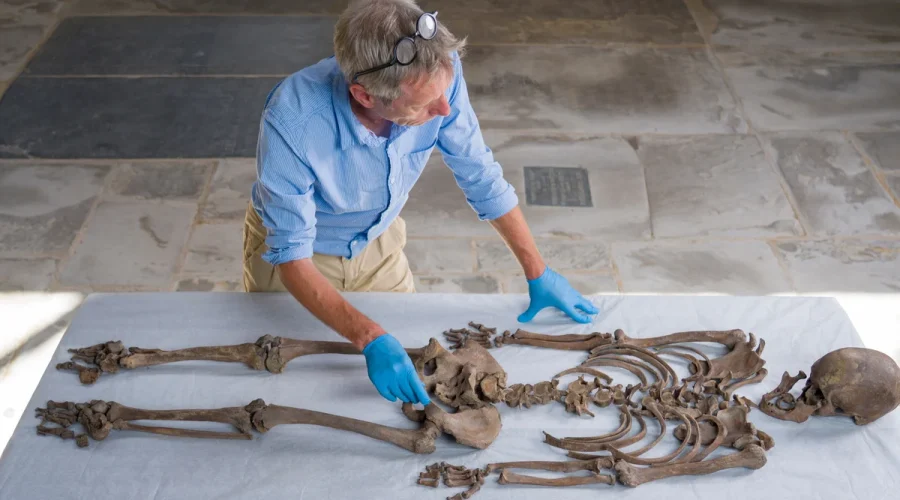
The individual, informally dubbed “Conquest Man,” was discovered in the grounds of St Peter’s Church at Barton-upon-Humber, a small parish in Lincolnshire. His burial was no ordinary Christian interment. He received what researchers describe as a privileged placement within a Norman-era church that had been granted to one of William the Conqueror’s knights after the conquest. The oak coffin that held his body was fashioned from a tree felled around 1079, placing his death squarely in the years immediately following the Norman takeover of England.
His physical profile, reconstructed from osteological examination, paints the picture of a stocky, muscular man standing above five feet in height. He was estimated to have been between 50 and 60 years old at death, and his skeleton bore the marks of multiple fractures that had healed over time — evidence of a life lived with considerable physical hardship or activity.
DNA, Isotopes, and a Digital Face
A multidisciplinary team assembled for the project included specialists from Historic England, the Crick Institute, the British Geological Survey, the University of Southampton, and the facial-reconstruction firms muVIS and FaceLab. English Heritage coordinated the effort under its head curator of collections, Kevin Booth. The analytical toolkit combined ancient DNA sequencing, stable-isotope testing of bone and tooth material, and high-resolution digital face modelling.
The genomic results indicated that Conquest Man carried substantial ancestry traceable to continental Europe — a finding that speaks to the deep intermingling of populations across the North Sea and the English Channel during the late Anglo-Saxon and early Norman periods. Isotope data further illuminated where he had spent different phases of his life, while the osteological record supplied the structural framework onto which the digital reconstruction was mapped.
The Burial Rite
The arrangement of his remains within the coffin followed a carefully observed ritual. His arms were folded across his body. His head rested on a pillow of grass, and two lumps of locally quarried chalk were positioned to prevent his skull from rolling sideways. Beside him lay three staffs carved from apple wood — a material regarded as sacred in Scandinavian tradition, a detail that hints at lingering cultural influences from the Viking era that had shaped northern England for generations before 1066.
That Viking connection is not incidental. Conquest Man was born during the reign of Cnut, the Danish king who ruled England from approximately 1016 to 1035. He thus grew up in a world already shaped by Scandinavian settlement, law, and language, before the Norman armies of William crossed the Channel in autumn 1066. His survival through that cataclysmic decade and his subsequent burial with honour beside a pre-Conquest church placed him, in Booth’s words, at the seam between two worlds.
A Curator’s Reflection
“I’ve been fascinated by this individual – this man of the Conquest – for 20 years. Who was he, what did he experience, could he have been at the Battle of Hastings, what sort of person might he have been?”
Kevin Booth, who co-ordinated the study, added that the new analytical results brought him closer to answering those long-held questions.
“With this new analysis, it feels like we can really get close to him. To be able to now look at his face is to feel we can almost speak to him.”
Booth framed Conquest Man’s story as one of endurance rather than heroism.
“He’s a fascinating survivor of a cataclysmic period in history, born in the reign of Viking King Cnut, he survived the Norman Conquest to be buried with honour next to a pre-Conquest church, part of the new Norman world.”
“It seems to me his legacy is of survival, resilience and adaptation and I hope that by sharing his story in this way, when people go to our Battle of Hastings re-enactment or visit the Bayeux Tapestry – of course they can cheer on who they like – but maybe he can help us not to pigeonhole those who fought and died there, but to understand them as human above all.”
Viewing Conquest Man
Those wishing to see the reconstructed face and the original burial context can visit St Peter’s Church in Barton-upon-Humber, Lincolnshire, on September 20 between 12 pm and 4 pm. The display coincides with the wider programme of events surrounding the Bayeux Tapestry exhibition and the Hastings commemoration, offering visitors a tangible, human-scale counterpoint to the epic narratives of kings and armies.
Why This Matters
The Norman Conquest is usually told through chronicles, tapestries, and the names of kings. Conquest Man reminds us that the decade after 1066 was lived by ordinary people — farmers, craftsmen, and local clergy — who had to adapt, survive, and rebuild under an entirely new political order. The healed fractures in his bones, the chalk propping his skull, the apple-wood staffs echoing a Scandinavian past: each detail is a small, stubborn fact about a life that no chronicle bothered to record. In giving him a face, the research team has done what no medieval scribe ever intended — made an anonymous survivor visible, and made the human cost of conquest legible once again.
Related Reading
Frequently Asked Questions
What is Researchers reconstruct face of man who lived?
Researchers reconstruct face of man who lived is the main topic of this guide. The article explains the context, practical details, and next steps readers should understand.
Why does Researchers reconstruct face of man who lived matter?
Researchers reconstruct face of man who lived matters because readers are looking for a useful answer, not just a short summary. Good content should match search intent and help them decide what to do next.