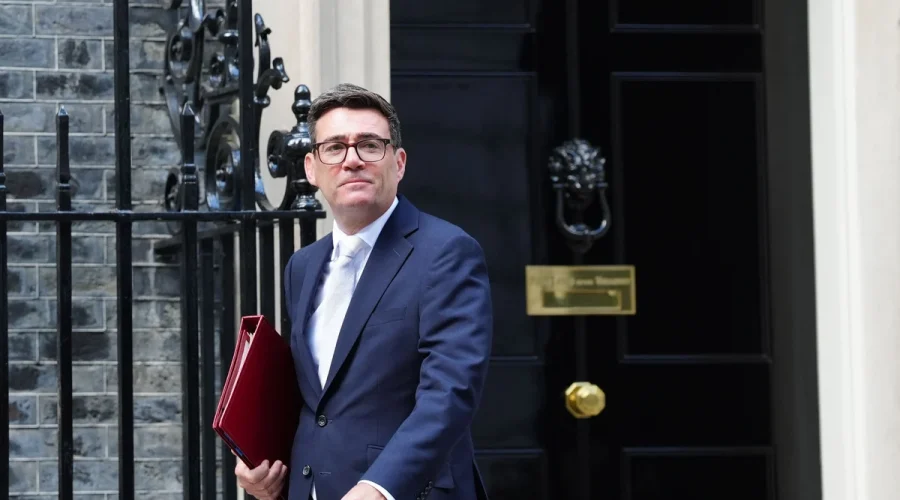
Burnham Faces First PMQs: Authority Tested
Traveloasisspot.com – The moment Andy Burnham stepped into the Commons despatch box on Tuesday, the weight of decades of Labour ambition pressed down on every word he chose. His debut as Prime Minister before the House was not a procedural formality; it was a three-hour-and-23-minute declaration of intent, laying bare a programme aimed at dismantling what he called a “failed economic model” and redirecting Britain’s economic levers toward public ownership and regional autonomy. Yet within hours, the machinery of Westminster began asking whether the new government could hold its own parliamentary bench together — a question that crystallises when Burnham to face first PMQs on Wednesday against Conservative leader Kemi Badenoch.
A Programme Built on Rejection of the Post-Thatcher Order
Burnham’s Commons address drew a hard line through British economic history. He assigned responsibility for decades of sluggish growth to three forces: the structural dismantling of public assets under Margaret Thatcher, the fiscal contraction of the austerity years, and the economic disruption of Brexit. His remedy, articulated from the despatch box, rests on two pillars — devolving meaningful decision-making power from Westminster into the regions, and restoring public ownership of utilities and essential services.
“Britain is not where any of us would wish it to be,” he told MPs. “Things are not working as they should, life is too expensive and too hard for too many.”
The water sector received particular attention. Burnham characterised the industry as “a leaking monument to that approach, a country run in the private rather than public interest” — language signalling not merely regulatory tightening but a fundamental reorientation of who controls Britain’s most basic infrastructure.
The Budget Question and the Defence Spending Gap
Through the marathon session, Burnham carefully avoided confirming whether the October 28 Budget will include tax increases. He did, however, signal that Chancellor John Healey is expected to identify funding to lift defence expenditure to three per cent of GDP by 2030, a target to be met by the next spending review. The implication is that the government intends to close the gap through a combination of reallocation and, potentially, new revenue — without committing publicly to the latter before the Budget.
Internally, the new administration has reportedly identified three priorities for its first phase: reducing the cost of essentials such as childcare and mortgage payments, investing in community regeneration, and expanding public control over water, energy, and housing. These commitments, shared with Cabinet on Tuesday, frame the government’s near-term agenda in terms of household cost-of-living relief rather than macroeconomic abstraction.
Economic Headwinds from the Middle East
The ambition of the programme collides with a fiscal environment that has deteriorated sharply. Long-term UK borrowing costs have climbed to their highest level in 28 years, driven by a global bond sell-off that analysts link partly to escalating tensions in the Iran conflict and fears that sustained Middle East instability will feed through into inflation. For a government whose stated mission includes cutting household costs, the trajectory of gilt yields represents an immediate constraint: every point of additional borrowing cost narrows the fiscal space available for the very programmes outlined on Tuesday.
The practical consequence is that the devolution and renationalisation agenda, while politically central, may face implementation delays or scaled-back timelines as Treasury works within a tighter-than-planned fiscal envelope. Whether the government chooses to absorb higher borrowing costs or recalibrate its spending priorities will define its credibility within months, not years.
Backbench Pressure: Electoral Reform and Campaign Finance
On Wednesday, the Commons debate on the Representation of the People Bill will test Burnham’s authority over his own party’s ranks. Alex Sobel, Labour MP for Leeds Central and Headingley, is spearheading a push among backbenchers to establish a national commission tasked with reforming the voting system. Sobel has tabled an amendment calling on the government to back the move explicitly. Burnham, speaking on Tuesday, indicated openness to the principle of electoral reform but stopped short of a commitment, telling the House that “we will need to get a consensus at the next election” before such a commission could be established.
FAQ
When does Burnham’s first PMQs take place? Wednesday, immediately following his Tuesday Commons address. He will face Conservative leader Kemi Badenoch in the formal Prime Minister’s Questions session.
What are the three priorities of the new government’s first phase? Reducing household costs (childcare, mortgage payments), investing in community regeneration, and expanding public control over water, energy, and housing.
Will the October 28 Budget include tax rises? Burnham declined to confirm or deny tax increases, signalling only that Chancellor John Healey must find funding to reach the three-per-cent-of-GDP defence target by 2030.
What is the Alex Sobel amendment? A backbench Labour amendment to the Representation of the People Bill calling for a national commission on voting-system reform. Burnham expressed openness in principle but deferred commitment to post-election consensus.