Emma Reyes at White Cube: Late-Career Portraits
Traveloasisspot.com – Emma Reyes at White Cube Mason’s Yard marks the Colombian-born painter’s first solo exhibition in Britain, and it arrives with the quiet urgency of a work that has waited decades for recognition beyond its home continent. In Colombia, Reyes is a near-mythic figure — her life, so extreme in its suffering and reinvention, has already been adapted into a fifteen-part television series. Among the Latin American writers and artists who clustered in France from the early 1960s onward, she carried the informal title “mama grande,” a name that captured both her physical presence and the fierce protectiveness she extended to that expatriate circle.
The show is not a survey. It cuts straight to the final decade of her working life, the stretch in which her portraiture became formally destabilised and increasingly radical. The anchor of that late output is a body of paintings she called “The Masks,” begun in 1990 and pursued with near-relentless continuity until her death in 2003. Within those canvases, familiar facial architecture is torn apart and reassembled into pulsing chromatic shapes that hover in an ambiguous register between the human, the animal, and the botanical. They read less as portraits of named individuals than as renderings of consciousness in active flux.
The Visual Grammar of Dissolution
Among the last works she completed, Untitled (1998) layers curving, interlocking forms in verdant green, sulphur yellow, and a muddy arterial red. The overlapping shapes evoke a cartography of neural tissue or some other organic architecture, the recognisable human figure reduced to a faint ghost within the composition. Earlier entries in the series retain more legible facial structures. A particularly hallucinatory canvas dating to roughly 1990 — nearly all of Reyes’s output went untitled — renders eyes, a nose, and a row of teeth in striations of green and blue laid over broad orange and yellow brushwork. The decorative vocabulary recalls motifs carved into Mayan and Aztec ornament, as well as the colossal Olmec basalt heads she encountered during travels through Mexico decades earlier.
Two paintings from “The Masks” currently on view depict adult figures cradling children or infants. The reference is almost certainly personal: journalist Diego Garzón documented that Reyes’s own child was killed before her eyes in Paraguay, only months after she gave birth in the early 1940s. Set against that biographical violence, the tenderness of those late compositions carries an emotional charge that purely formal readings cannot capture.
“The masks are not disguises. They are what remains when the face has been worn through by time.” — attributed to Reyes, circa 1995
A Life Forged in Confinement
Reyes was born in Bogotá in 1919 into destitution so total that her earliest childhood was spent either playing among the refuse at a municipal rubbish dump or locked in a windowless room shared with her mother, a sister, and a half-brother. At five or six she was abandoned and placed in a convent, where she spent roughly the next decade performing long hours of kitchen and laundry labour under conditions of relentless bullying. It was also at the convent that she acquired the skill of sewing, becoming adept at embroidering sheets, tablecloths, and sleeping gowns. That textile training left an indelible mark on her later visual language: two black-ink portraits from the 1970s, executed with painstaking precision on rag paper, hang in the current show with the texture and rhythm of woven cloth.
At nineteen, Reyes fled the convent and spent several years moving through South America. In Mexico she came into contact with Diego Rivera and Frida Kahlo, assisting the former on a mural at the University Olympic Stadium within the Ciudad Universitaria campus. In 1947 she obtained a scholarship to study painting under the Cubist theorist André Lhote in Paris, where she moved in circles that included the novelist Alberto Moravia, the philosopher Jean-Paul Sartre, and the Futurist painter Enrico Prampolini.
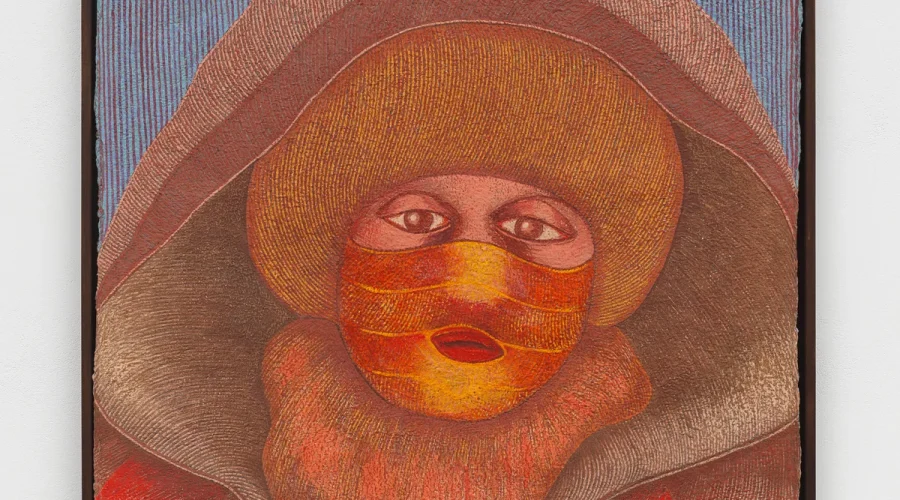
Despite those formative encounters, Reyes did not apply paint to canvas until she was in her thirties, having had no prior exposure to painting before her escape from the convent. Her earliest canvases drew heavily on the deprivation of those formative years, depicting scenes of rural labour and the daily lives of Colombia’s peasant and indigenous communities. A painting from her “Imaginary Portraits” series of the 1970s, included here, renders a hooded figure in earthy, muted tones; the effect is simultaneously devotional and unsettling, a reminder that the formal radicalism of the late work grew out of a long, quiet apprenticeship in suffering.
FAQ
Where and when can I see the exhibition? The show runs at White Cube Mason’s Yard, 51–53 Clerkenwell Road, London EC1R 0DP. Check the gallery’s website for current opening hours and ticketing before visiting.
Is the exhibition suitable for all ages? The paintings are non-figurative in their later entries and contain no explicit content. The biographical context — including the loss of a child — may be emotionally intense for some visitors, but nothing in the room requires an age restriction.
Can I purchase works from the show? White Cube Mason’s Yard does not typically sell from exhibition loans. For enquiries about acquiring Reyes-related works, contact the gallery’s acquisitions desk directly.
Is there a catalogue or accompanying publication? A wall-text essay accompanies the show. For deeper biographical context, Diego Garzón’s published writings on Reyes remain the most detailed English-language source available.