Shakespeare’s Prologue: The Bayeux Tapestry Returns to London in a Diplomatic First
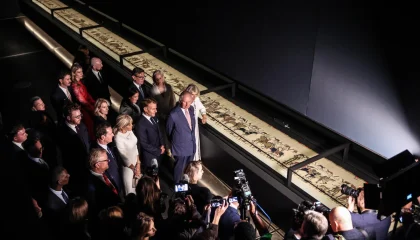
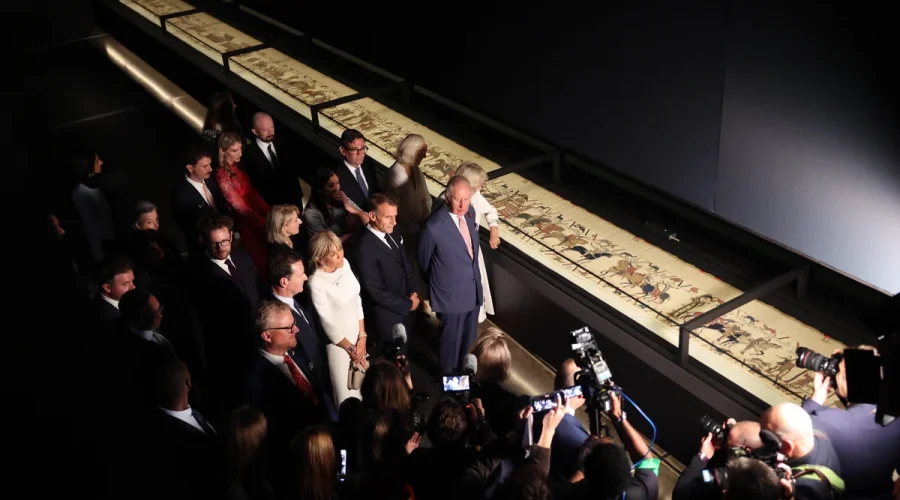
Traveloasisspot.com – For nearly a millennium, the woven chronicle of the Norman conquest has remained almost exclusively on the French side of the Channel. That era ended on a Wednesday evening in London, when the 70-metre textile masterpiece was unrolled once again inside the British Museum — and when three heads of state walked its full length together, flanked by their spouses, listening to curators explain each scene.
The occasion was not merely a museum viewing. It was a carefully staged moment of Anglo-French rapprochement, timed to coincide with the tapestry’s unprecedented loan to the UK under a trilateral agreement involving the British government, the French government, and the museum itself. The textile will remain on display in London until September 2027, a period that dwarfs any previous British exhibition of the work.
A Shakespearean Frame for a Thousand-Year-Old Object
King Charles chose his closing words with deliberate literary weight. Addressing a crowd gathered in the museum’s Great Court — which included groups of schoolchildren — he invoked Prospero’s line from The Tempest:
“As Shakespeare said in The Tempest: ‘what is past is prologue’.”
The quotation served as a bridge between the tapestry’s medieval subject matter — a depiction of battle, conquest, and political upheaval — and the present-day gathering of leaders who had just spent an hour examining its scenes in a dimmed gallery. The King framed the object as “a precious symbol of trust, at a time when trust seems sadly to be in short supply between nations,” and suggested that its protagonists, “on both sides of the Channel,” would look with satisfaction on the Franco-British assembly.
He added that the two nations “have defended our values together in times of peril” and continue to do so across the world, before noting his own long personal connection to the artifact. Charles last saw the tapestry publicly in 1987, when he was still Prince of Wales and accompanied Diana, Princess of Wales, to mark the 900th anniversary of William the Conqueror’s death.
The French President’s Diplomatic Language
Emmanuel Macron, standing at the same podium backed by European Union, French, and Union flags, echoed the King’s language of friendship while steering the conversation toward concrete policy. He spoke of “advancing the UK reset” with the European Union — a phrase that signals London’s ongoing effort to recalibrate its post-Brexit relationship with Brussels.
“While we do not always see eye to eye, we respect one another, remain open to discussing everything, including advancing the UK reset with the European Union, always closer and together.”
Macron went on to say he hoped the “entente amicale” — a term Charles had used earlier in his own remarks — would “inspire this new path forward.” He described the tapestry’s Channel crossing, through tunnels built jointly by British and French engineers, as “a reminder of what our two countries can achieve when they join forces.”
The visit carried particular diplomatic weight: Macron was the first European leader to travel to the UK since Andy Burnham assumed the premiership, and it marked the first face-to-face meeting between the two men.
Laughter in the Gallery
Amid the formal speeches, the evening produced several unscripted moments. Charles, guiding Macron through the scenes, turned to point at a group of Normans hauling a cart and declared, “oh, this is my favourite bit.” He then observed, with a grin, “they’ve got an enormous amount of wine,” drawing laughter from the French president.
At the tapestry’s final panel, a curator noted that roughly another thousand years of history is absent from the work. Burnham, standing beside Charles, quipped to Macron: “Made in England, they couldn’t bear to show the end… too difficult.” Macron’s reply — “happy end, we’re here” — prompted a laugh from the King and underscored the evening’s tone of easy camaraderie.
Context: The Tapestry’s Journey and Its Political Significance
The Bayeux Tapestry, though called a tapestry, is in fact an embroidered linen cloth roughly 70 metres long, depicting the events leading up to the Norman conquest of England in 1066. It has been housed in Bayeux, Normandy, since the medieval period. Its return to Britain under the current loan arrangement is the first such exhibition in close to a thousand years.
Charles himself speculated, with a touch of humour, that the work was “most likely to have been embroidered in Canterbury by English,” jokingly suggesting it might have been called “the Canterbury embroidery.” Whether or not that theory holds scholarly weight, the object’s physical presence in London for the next several years gives British audiences — and visiting diplomats — an opportunity to engage with a shared medieval heritage that predates modern national boundaries.
For Burnham’s government, the event also functioned as a soft-power showcase: Great Russell Street was lined with members of the public hoping to glimpse the leaders as they arrived, and the Prime Minister waved to the crowd before entering the museum. The juxtaposition of a medieval textile, a Shakespearean quotation, and a live discussion of EU trade policy compressed centuries of Anglo-French entanglement into a single evening — and, in the framing chosen by all three speakers, presented that entanglement as something to be celebrated rather than merely endured.
Related Reading
Frequently Asked Questions
What is King says what is past is prologue?
King says what is past is prologue is the main topic of this guide. The article explains the context, practical details, and next steps readers should understand.
Why does King says what is past is prologue matter?
King says what is past is prologue matters because readers are looking for a useful answer, not just a short summary. Good content should match search intent and help them decide what to do next.