Northern Ireland’s Trade Unions Threaten Escalating Strikes Unless Stormont Secures a Fair Budget
Traveloasisspot.com – The leadership of Northern Ireland’s trade union movement has issued a stark ultimatum: deliver a fair and sustainable budget for the region, or expect a steadily intensifying programme of industrial action across both public and private sectors. The warning lands at a moment when the restored Stormont Executive has already passed the five-month mark of the current financial year without any agreed spending plan in place.
The Practical Reality of Operating Without a Budget
In the absence of a formally adopted budget, departmental officials at Stormont are currently operating under a legal mechanism that permits them to draw down no more than 95 per cent of the previous year’s allocation. This stopgap arrangement means that every public service — from hospitals to schools to transport infrastructure — is running on a shrinking envelope of funds, with no prospect of additional revenue until the political impasse is resolved.
All parties represented at the Northern Ireland Executive have publicly stated that they require additional funding from Westminster before they can negotiate a budget. Behind the scenes, discussions with the UK Treasury have continued, yet no tangible progress toward securing that extra money has materialised. The result is a prolonged period of fiscal uncertainty that erodes planning capacity across every department and leaves frontline workers in limbo.
A Precedent Set in January 2024
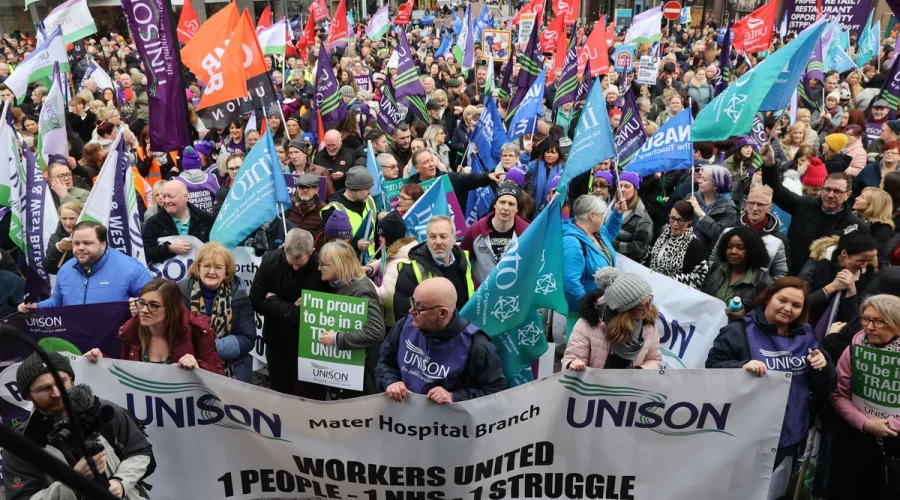
The current standoff echoes a moment that reshaped the political landscape of Northern Ireland just over two and a half years ago. In January 2024, amid a period of complete political collapse, trade unions co-ordinated what remains the largest single-day walkout in decades. An estimated 100,000 public-sector workers turned out for rallies across the province, bringing essential services to a standstill and forcing politicians back to the negotiating table.
That day, as union leaders recall, was the culmination of months of strikes and stoppages spanning every sector of the economy. It was triggered by the same constellation of failures now resurfacing: a political stalemate, the absence of any functioning budget, and what unions describe as the UK government’s refusal to provide adequate funding for Northern Ireland’s public services.
Murphy’s Warning: Same Conditions, Same Response
Gerry Murphy, assistant general secretary of the Irish Congress of Trade Unions (ICTU), addressed the union leadership meeting held earlier this week. He framed the current situation not as a new crisis but as a recurrence of one that was never properly resolved.
“In January 2024, trade union members across Northern Ireland took part in the largest day of coordinated industrial action witnessed here for decades. That day marked the culmination of months of strikes and stoppages across all sectors of our economy.”
Murphy drew a direct line between then and now, arguing that the structural conditions have not changed despite the restoration of devolved government.
“Here we are, over two and a half years later, and we are met with the very same conditions. While the Executive has been restored, we have no Northern Ireland budget due to political stalemate. While the UK government has since acknowledged its role in underfunding Northern Ireland, it still refuses to provide us with funding equivalent to that in Scotland or Wales.”
He made clear that the union movement’s calculus has not shifted.
“Met with the same conditions, the response of the trade union movement will be the same. In 2024, we forced the political class to face up to its responsibilities, and we will do so again.”
The Funding Gap at the Heart of the Dispute
The core grievance centres on what unions describe as a persistent fiscal shortfall relative to the other devolved nations. Although Westminster has formally recognised that Northern Ireland has been underfunded compared with Scotland and Wales, no equivalentisation of per-capita public-service spending has been delivered. For union leaders, this gap is not a technicality; it is the reason no budget can be agreed at Stormont, because the parties cannot balance books that are structurally short of revenue.
Murphy stressed that the Northern Ireland Committee of the ICTU views a “fair and enduring settlement” to public-service funding as a precondition for any stable budget.
“A fair and enduring settlement from Westminster is the only route to delivering a fair and enduring budget at Stormont.”
He added that the committee’s position is unambiguous on consequences:
“The Northern Ireland Committee of the Irish Congress of Trade Unions is clear that delay or inaction in bringing about this settlement will lead to an intensifying programme of industrial action.”
Burnham’s Visit and the Limits of “Listening Mode”
Last week, Prime Minister Andy Burnham made his first official trip to Belfast since taking office. Speaking publicly, he expressed a desire to help “move things forward” on the budget crisis, yet stopped short of committing to any specific fiscal package, describing his posture as one of “listening mode.” For union leaders, that language signals continued delay rather than resolution — and delay, in their framing, is itself an act that justifies escalation.
What Comes Next
The union leadership’s meeting this week was explicitly convened to assess what they characterised as “growing discontent among workers” in both the public and private sectors, driven by the inability of Stormont and Westminster to settle the budget question. The message from Belfast’s union headquarters is that patience has been exhausted. If no funding settlement is tabled before the next round of budget negotiations, the threat of coordinated stoppages — larger and more sustained than anything seen since the January 2024 walkout — moves from rhetorical warning to operational planning.
For the tens of thousands of public-sector employees who staff Northern Ireland’s hospitals, schools, and transport networks, the stakes are immediate: every additional month without a budget deepens staffing pressures, delays capital projects, and narrows the fiscal space available to departments already operating at 95 per cent of last year’s envelope. The unions’ position is that the only lever capable of breaking the deadlock is sustained, coordinated industrial pressure — and that the window for avoiding it is closing rapidly.
Related Reading
Frequently Asked Questions
What is Unions urge Stormont to agree fair?
Unions urge Stormont to agree fair is the main topic of this guide. The article explains the context, practical details, and next steps readers should understand.
Why does Unions urge Stormont to agree fair matter?
Unions urge Stormont to agree fair matters because readers are looking for a useful answer, not just a short summary. Good content should match search intent and help them decide what to do next.