
Best Teeth Whitening Kits 2026: Tested & Ranked
Traveloasisspot.com – Choosing from the best teeth whitening kits 2026 options no longer requires a flight abroad or a six-figure veneer bill. The domestic shelf now spans LED trays, adhesive strips, whitening powders, cosmetic pens, and dedicated toothpastes — each engineered to nudge your shade one or two steps lighter from the comfort of your bathroom. What separates a genuinely useful product from a marketing gimmick comes down to formulation strength, application discipline, and whether the enamel tolerates the active ingredient without protest.
One non-negotiable principle underpins every recommendation below. Cosmetic-dentistry professionals agree that periodic, measured application outperforms constant daily use. Dr Sam Jethwa, founder of Bespoke Smile, frames the guidance bluntly:
“Whitening should generally be used in moderation rather than continuously. Most people will top up their whitening periodically to maintain results, rather than whitening constantly throughout the year. Overuse is where problems tend to arise, particularly with sensitivity.”
For readers whose teeth already react to cold or acidic foods, the same clinician offers a measured caveat:
“For patients with sensitive teeth, whitening can still often be done safely, but it’s important to choose the correct strength and formulation. Problems usually arise when people over-whiten or use products too frequently.”
Applying Any Whitening Product Without Damaging Enamel
Brush first, then apply. The surface must be free of plaque and food debris so the active agent contacts enamel directly. Immediately after a session, avoid coffee, red wine, dark tea, and beetroot-based sauces for at least thirty minutes; freshly treated enamel is temporarily more porous and absorbs pigment with greater ease. Home-use formulations carry lower peroxide concentrations than in-chair professional treatments, so expect gradual shade shifts over days or weeks rather than a single-appointment transformation.
Products That Survived Structured Testing
Each item below was integrated into a daily oral-hygiene routine over several weeks. Before-and-after photographs were taken under consistent lighting, and sensitivity, residue, and cleaning sensation were logged after every application. The selections below represent the strongest performers across budget tiers and usage preferences.
Best Overall — Icy Bear 14-Day Smile Transformation Kit
£64.99 via Icybeardental.co.uk. The bundle pairs a diamond-whitening toothpaste, a teeth-whitening powder, and 28 adhesive strips, all built around PAP+ (a peroxide-alternative agent) that lifts surface and sub-surface stains while preserving enamel integrity. A shade guide ships in the box so progress can be tracked objectively. In practice, the toothpaste handles morning and evening brushing; the powder follows as a secondary step. Combining both in one pass saves time, though sequential use is cleaner. The strips proved the most satisfying component. Within roughly three days of consistent application, a visible brightness shift appeared, most noticeably on previously discoloured canines. Because the formulation is peroxide-free, it suits users with mild sensitivity.
Best Budget — ISOHEALTH Carbon Teeth Whitening Strips
£9.99 from Iso-clean.co.uk. A low-commitment entry point for periodic touch-ups. No multi-component system required; simply peel, apply, and rinse on schedule.
Best LED Kit — Smile Pro Advanced Teeth Whitening Kit
£49 via Smileproworldwide.com. A light-emitting tray paired with a gel formulation accelerates the whitening reaction. LED-assisted sessions run shorter than passive-strip protocols, though the added hardware raises the upfront cost.
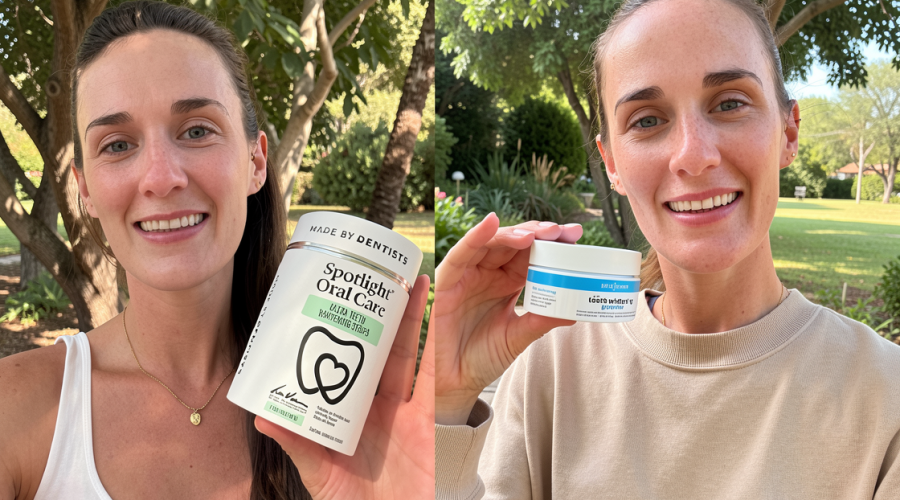
Best Dedicated Strips — Spotlight Oral Care Ultra Teeth Whitening Strips
£44.95 at Lookfantastic.com. Occupies the premium tier of the adhesive-strip category with higher-concentration actives and a more structured application schedule.
Best for Rapid Results — Rapid White 1-Week Tooth Whitening Power Set
£9.59 on Amazon.co.uk. Targets users wanting visible shade change inside a single week. The compressed timeline demands strict adherence to label instructions to limit sensitivity flare-ups.
Why Moderation Beats Frequency Every Time
The natural temptation with any cosmetic dental product is escalation: extra strips per day, extended LED sessions, daily powder applications beyond label guidance. None of these shortcuts accelerate the chemistry meaningfully; they simply push the pulp closer to its irritation threshold. Stick to the manufacturer’s stated frequency, top up only when the shade guide confirms a regression, and give the enamel rest days between cycles. Consistent, moderate use over weeks will outperform aggressive, sporadic bursts in both durability and comfort.
FAQ
How often should I use a whitening kit?
Follow the specific product’s label. Most strips and gels are designed for once-daily use over a defined cycle (typically 7–14 days), followed by a rest period. Top-up applications should occur only when you notice measurable shade regression, not on a fixed calendar.
Can sensitive teeth still be whitened at home?
Yes, provided you select a lower-strength or peroxide-free formulation and avoid over-application. If sensitivity persists beyond a few days, pause use and consult your dentist before resuming.
Do LED trays actually speed up the process?
LED-assisted kits shorten each daily session compared with passive strips because the light energy accelerates the gel’s active reaction. The total shade change over a full cycle is broadly comparable; the advantage is convenience and reduced daily time commitment.
What should I avoid after a whitening session?
Strongly pigmented foods and drinks — coffee, black tea, red wine, beetroot sauces, dark berries — for at least thirty minutes. Freshly treated enamel is temporarily more porous and re-stains more readily.
Are home kits safe for enamel long-term?
When used at label-stated concentrations and frequencies, home-use formulations are considered safe for healthy enamel. Problems arise from overuse, excessive frequency, or choosing a strength above what your dentition tolerates. Periodic dental check-ups remain advisable regardless of whitening routine.