
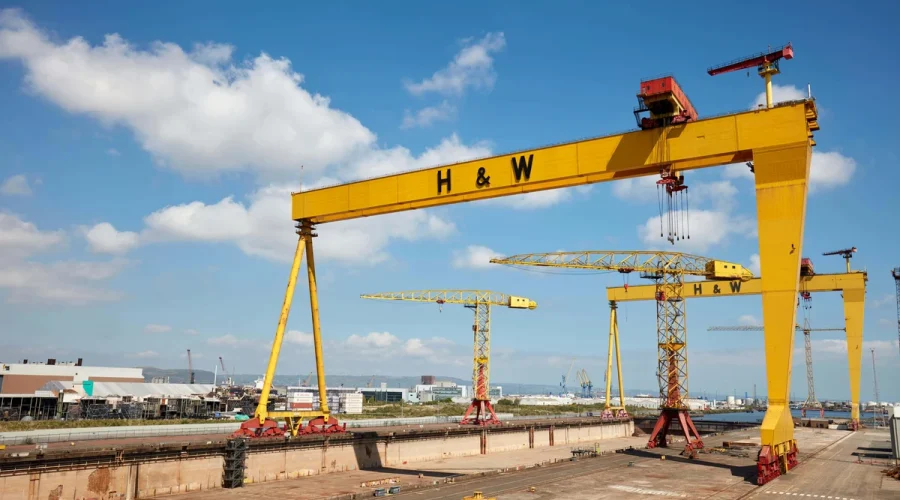
Belfast’s Iconic Shipyard Cranes Enter £3.1m Overhaul Ahead of Major Naval Contracts
Traveloasisspot.com – The two towering yellow gantry cranes that have dominated Belfast’s waterfront skyline for decades are about to undergo their most extensive mechanical intervention in years. Navantia UK, the current owner of the Harland & Wolff shipyard, has committed £3.1 million to a full modernisation of Samson and Goliath, the pair of cranes that have become inseparable from the city’s identity. Once the work is complete, the cranes are expected to operate at peak intensity for an extended period, driven by a wave of new naval and commercial shipbuilding orders flowing into the yard.
What the Overhaul Involves
The programme is not a cosmetic refresh. Engineers will carry out structural and electrical repairs on both machines, overhaul their main engines, and replace the catenary cables that deliver electrical power to each crane. The scope spans mechanical, electrical, hydraulic, and fabric components — essentially every major subsystem gets inspected, repaired, or swapped.
Work has already commenced on Goliath, the older of the two structures. Built in 1969 and standing 96 metres tall, Goliath has served the yard for over half a century. Once its refurbishment is finished, crews will shift attention to Samson, the crane positioned closer to the open sea. Samson was installed in 1974 and rises to 106 metres, making it the taller of the pair.
Engineering Scale: Lifting Capacity and Heritage
Each crane is rated to hoist 840 tonnes — a figure that translates roughly to the combined weight of four Boeing 747 jumbo jets suspended in mid-air. That capacity is not merely a curiosity; it is the reason these machines remain indispensable for assembling large hull sections and installing heavy superstructure blocks on vessels too big for any other lifting equipment in the region.
The cranes’ cultural weight in Belfast far exceeds their industrial function. They appear on postcards, merchandise, and civic imagery. For many residents, watching them swing across the Lagan Estuary is as much a daily ritual as checking the weather. Their continued operation is therefore a matter of local pride as well as economic necessity.
Part of a £98.5 Million Yard Recapitalisation
The crane overhaul sits within a much larger investment. Harland & Wolff Belfast is undergoing a £98.5 million recapitalisation designed to bring the yard’s facilities up to specification for contemporary naval and commercial shipbuilding. The programme covers infrastructure upgrades, equipment modernisation, and workforce readiness across the site.
The most visible output of that investment is already under way: the yard has begun constructing three Fleet Solid Support ships for the Royal Fleet Auxiliary. These vessels will deliver fuel, ammunition, and general stores to Royal Navy warships operating at sea. At completion, they will rank as the second-largest ships in the British armed forces, trailing only the Queen Elizabeth-class aircraft carriers in overall size.
Building vessels of that scale demands exactly the kind of heavy-lift capability Samson and Goliath provide. Hull blocks, propulsion units, and deck fittings for the Fleet Solid Support ships will require crane lifts well beyond what smaller gantries or mobile cranes can manage safely and efficiently.
Management Perspective
Carlos Lopez Carregado, general manager at Harland & Wolff, framed the refurbishment as an act of stewardship toward both the machinery and the city that has grown up around it.
“We know that the city is proud of them, and this major mechanical, electrical, hydraulic and fabric maintenance project will restore them to their absolute best.”
He emphasised that the work goes beyond simple repair. Components will be replaced, outdated technology updated, and the cranes subjected to full-load testing to confirm they can operate at their rated 840-tonne capacity.
“We will be replacing parts, updating technology and testing them to see that they can lift at full capacity, and we will be treating them with utmost respect.”
Carregado also underscored the operational urgency behind the schedule. The cranes will need every ounce of their strength to handle structural blocks for the Fleet Solid Support programme and for subsequent vessels the yard anticipates building in Belfast.
“You can expect to see Samson and Goliath swing into action soon – they are about to be at their busiest for many years.”
Why This Matters for Belfast’s Industrial Future
Belfast’s shipbuilding heritage stretches back more than two centuries, but the modern yard has spent recent years in a transitional phase, absorbing new ownership under Navantia and rebuilding its order book. The £98.5 million recapitalisation, anchored by contracts such as the Fleet Solid Support programme, represents a concrete commitment to long-term production rather than short-term maintenance work.
For the city’s workforce, the distinction matters. Sustained shipbuilding activity supports thousands of direct and supply-chain jobs across Northern Ireland, from welders and riggers to engineers and logistics coordinators. Keeping Samson and Goliath operational at full capacity is therefore not just a question of heritage preservation; it is a prerequisite for the yard to deliver on the scale of work now entering its schedule. Without those cranes functioning at peak performance, the largest hull sections simply cannot be assembled, and the programme stalls.
The next several months will see Goliath’s overhaul progress, followed by the same sequence for Samson. When both return to service, Belfast’s waterfront will once again host the sight of two of the world’s most recognisable industrial machines working in concert — a reminder that the city’s identity as a shipbuilding centre is not a museum exhibit but a living, operational reality.
Related Reading
Frequently Asked Questions
What is Samson and Goliath cranes set for 3?
Samson and Goliath cranes set for 3 is the main topic of this guide. The article explains the context, practical details, and next steps readers should understand.
Why does Samson and Goliath cranes set for 3 matter?
Samson and Goliath cranes set for 3 matters because readers are looking for a useful answer, not just a short summary. Good content should match search intent and help them decide what to do next.