A New Look at Ana Mendieta’s Legacy at Tate Modern
Traveloasisspot.com – The Tate Modern currently hosts what stands as the most comprehensive presentation of Ana Mendieta’s artistic output in Britain. This major exhibition celebrates a Cuban-American creator whose career, though cut short, left an indelible mark on contemporary art. Mendieta passed away at the age of thirty-six on September 8, 1985, under circumstances that remain somewhat mysterious. According to her spouse, Carl Andre—a sculptor associated with Minimalism—she had “somehow gone out the window” of their Manhattan residence located on the thirty-fourth floor. While Andre faced murder charges, he was ultimately cleared because prosecutors could not demonstrate conclusively that he had pushed her during an intoxicated argument.
Interestingly, the exhibition makes no deliberate effort to address this tragic chapter in Mendieta’s life. Only a single reference to Andre appears within the gallery space, situated inside an illustrated volume of lithographs that both artists produced together under the title Pietre Foglie. Despite this omission, viewers cannot help but perceive the elemental intensity of Mendieta’s creations through the prism of her untimely passing.
Body, Earth, and Spirit
Several works in the exhibition speak directly to themes of mortality and transformation. One video projection captures Mendieta’s face emerging from darkness, her eyes shut while blood traces a path down her forehead. Another piece, Ñañigo Burial from 1976, features black ritual candles positioned within the silhouette of a human form, illuminated according to lunar phases throughout the exhibition’s run. A dedicated section called Threshold emphasizes Mendieta’s fascination with energy transfer and the perpetual cycles encompassing birth, existence, death, and renewal. The show concludes with footage of the artist entirely enveloped in white feathers, sprinting along a shoreline as though her spirit returns to the earth.
Beyond grappling with profound subjects like displacement and mortality, Mendieta possessed a keen sense of humor. Her wit often carried an irreverent quality that delighted audiences. During a series of photographs captured at a sixteenth-century monastery near Oaxaca, Mexico, she playfully interacted with Catholic imagery. In one striking black-and-white image, she climbed into a baptismal font, leaving only her legs and one arm protruding above the rim while holy water shimmered on the stone floor. Elsewhere, she and her sister Raquelín executed a prank in Iowa by splashing animal blood across pavement, then observing reactions from inside a stationary vehicle.
Artistic Innovation and Recognition
Mendieta’s photographic self-portraits reveal another dimension of her creativity. She distorted her features using glass panels and once attached a moustache fashioned from a male classmate’s hair. Her live performances during the 1970s and early 1980s garnered considerable acclaim, and newly restored Super 8 films documenting these events prove particularly captivating. In one celebrated piece set along the Iowa River, she doused herself with cow’s blood before rolling through white chicken feathers, assuming a form that transcended ordinary humanity.
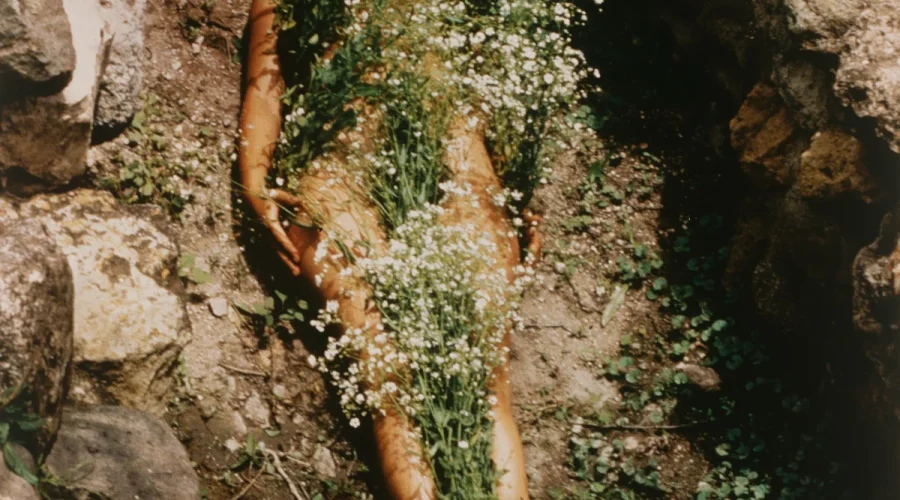
The renowned Silueta series, developed between 1973 and 1980, appears in film form within the exhibition. For these works, Mendieta traced her body’s outline across various landscapes using organic materials including flowers, fire, sand, mud, and snow. She described them as “basically in the tradition of a Neolithic art.” Many of these pieces, alongside her Rupestrian Sculptures carved into Jaruco Park’s limestone caves in Cuba, recall the curvaceous shapes of the Willendorf Venus. While her oil paintings receive less attention and show varying levels of success, her acrylic and graphite drawings on amate paper—a Mexican bark frequently employed in Mayan traditions—demonstrate considerable beauty.
Mendieta’s relevance feels increasingly urgent today. She pioneered an approach merging performance, land art, and bodily expression while maintaining connections to ancient ceremonial practices. Her work also engaged pressing modern issues such as environmentalism, colonialism, and feminist theory. In writing for the A.I.R. Gallery catalogue in 1980—a passage reproduced as wall text here—she observed that mid-to-late 1960s feminism aimed to “end the domination and exploitation by the white male culture,” yet ultimately “failed to remember us.” She characterized American feminism as “basically a white middle-class movement.”
In 2016, activists from the WHEREISANAMENDIETA collective alongside Sisters Uncut organized a demonstration at Tate Modern protesting the prominence given to Andre’s work while Mendieta’s contributions remained marginalized. This current exhibition finally acknowledges her status as one of the twentieth century’s most distinctive and visionary artists, ensuring that the poetic, primordial force of her creations continues to resonate through subsequent generations.
Related Reading
Frequently Asked Questions
What is Ana Mendieta at Tate Modern?
Ana Mendieta at Tate Modern is the main topic of this guide. The article explains the context, practical details, and next steps readers should understand.
Why does Ana Mendieta at Tate Modern matter?
Ana Mendieta at Tate Modern matters because readers are looking for a useful answer, not just a short summary. Good content should match search intent and help them decide what to do next.