
Lithium Battery Fires Are Gripping Britain’s Waste Sector at an Unprecedented Rate
Traveloasisspot.com – More than ten recycling facilities across the United Kingdom are now engulfed in flame every single week, and the culprit is increasingly clear: discarded lithium-ion batteries, most often pulled from cheap disposable vapes that consumers toss into household bins without a second thought. New industry data paints a picture of a waste-management crisis accelerating faster than regulators or local authorities can respond.
A Week of Blazes in London’s South and East
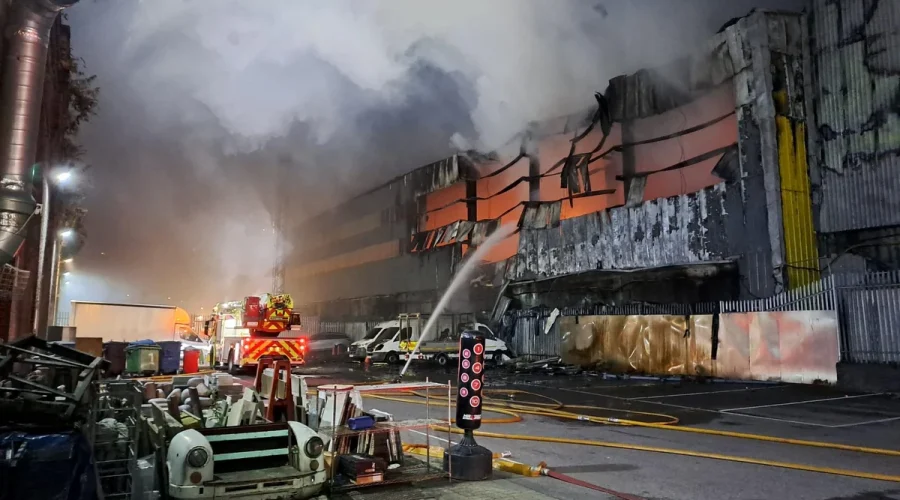
The urgency of the situation became impossible to ignore last week when two separate recycling sites in London caught fire within days of each other. In Deptford, south-east London, a massive blaze demanded the response of roughly 100 firefighters; investigators had not yet identified the ignition source at the time of reporting. Just across the capital, a second fire in Ilford was attributed directly to lithium-ion batteries that had been mixed into general waste streams. These incidents echoed an earlier event in Bermondsey back in June, where again more than 100 firefighters were dispatched to contain a recycling-centre inferno.
For residents of affected neighbourhoods, the consequences extend well beyond the facility walls. Smoke plumes force evacuations, traffic corridors shut down for hours, and local air quality deteriorates sharply. The London Fire Brigade has noted that fires at waste-disposal sites consume enormous quantities of personnel time and equipment, often requiring sustained operations that pull crews away from other emergencies across the city.
The Numbers Behind the Smoke
Industry data compiled by the Environment Services Association (ESA), the trade body representing waste-management companies, reveals the scale of the problem. In the twelve-month period running to March 2026, ESA member companies logged 1,518 fires at their facilities. Of that total, 541 were traced directly to lithium-ion batteries, while a further 216 battery-related fires occurred aboard bin lorries en route to processing sites.
Those figures, however, likely represent a floor rather than a ceiling. Most recycling-centre fires leave little or no physical evidence of their origin once the blaze is extinguished. An ESA spokesman acknowledged the gap: “We know 40% of fires at recycling centres are caused by batteries, but we think the actual number is more like 70%.” In other words, the true incidence of battery-ignited fires could be nearly double what is formally recorded.
Why a Crushed Battery Becomes a Firebomb
Dr Francesco Restuccia, a fire-safety researcher at King’s College London, has described the trajectory of recycling-centre fires as “exponential” in recent years. His explanation is straightforward physics: modern consumers now carry lithium-ion cells in smartphones, children’s toys, electric toothbrushes, e-cigarettes, and a growing catalogue of small electronics. When such a device ends up in a compactor or a crushing drum at a waste facility, the mechanical pressure ruptures internal cell walls. That rupture triggers a cascade of internal short circuits, driving the battery’s temperature rapidly upward until it reaches its ignition threshold and ignites surrounding combustible material.
The result is not a small, contained burn. It is a thermal event that can consume an entire processing hall, destroy adjacent machinery, and release toxic fumes into the surrounding air. Workers on shift face direct exposure to heat, smoke, and potentially exploding cells.
A £1 Billion Annual Toll
Industry insiders estimate that battery-related fires now cost the British economy approximately £1 billion every year. That figure encompasses lost production capacity, facility repair or replacement, insurance premiums that are climbing in direct response to the risk profile, overtime wages for emergency crews, and the knock-on effects on local businesses disrupted by evacuations and road closures. Insurance companies, in particular, are reassessing coverage terms for waste-sector operators, which means smaller firms may face premiums that squeeze already thin margins.
The Vape Factor and a Proposed Deposit Scheme
Among all lithium-containing products, disposable vapes stand out as a disproportionate source of the problem. They are inexpensive, widely available, and typically have a very short functional lifespan before the battery degrades or the user simply discards the unit. Because they look like small plastic pens, they slip unnoticed into general waste or recycling streams, where they eventually meet a compactor.
In response, the ESA is putting forward a policy proposal: a mandatory £5 deposit attached to the point of sale of every vape. The deposit would be refunded only when the consumer returns the spent device to a participating retailer for safe collection and recycling. The scheme mirrors deposit-return systems already operating for glass bottles and aluminium cans in several European markets, and its advocates argue it would create a simple financial incentive to keep small lithium cells out of the general waste stream.
Industry Voices Call for Government Action
Patrick Brighty, head of recycling policy at the ESA, framed the issue in stark terms:
“Battery fires are reaching epidemic proportions across Britain’s recycling and waste industry, placing workers at risk and threatening vital infrastructure upon which we all rely every day.”
He continued:
“It only takes a single battery hidden in household rubbish or recycling to cause a huge fire and decimate a facility. The total cost of battery fires now exceeds £1bn a year, with huge knock-on implications for insurance costs.”
Brighty added that the ESA and allied industry bodies are urging the government to legislate a mandatory deposit scheme for vapes specifically, so that spent devices are returned to the point of purchase and recycled separately from other waste streams.
What Comes Next
For the thousands of waste-sector workers who load compactors, sort conveyor belts, and drive collection lorries across Britain, the statistics translate into a daily occupational hazard that is growing more acute with every new generation of lithium-powered gadget. Until collection points, retailer take-back schemes, and clear household guidance on separating small batteries from general waste become universal, the weekly tally of recycling-centre fires is likely to keep climbing. The question for policymakers is no longer whether intervention is needed; it is how quickly a deposit-and-return framework can be legislated before the next Deptford or Ilford becomes a national headline.
Related Reading
Frequently Asked Questions
What is Soaring number of fires at recycling?
Soaring number of fires at recycling is the main topic of this guide. The article explains the context, practical details, and next steps readers should understand.
Why does Soaring number of fires at recycling matter?
Soaring number of fires at recycling matters because readers are looking for a useful answer, not just a short summary. Good content should match search intent and help them decide what to do next.