London’s Sky Transformed as Rare Solar Eclipse Captivates Millions
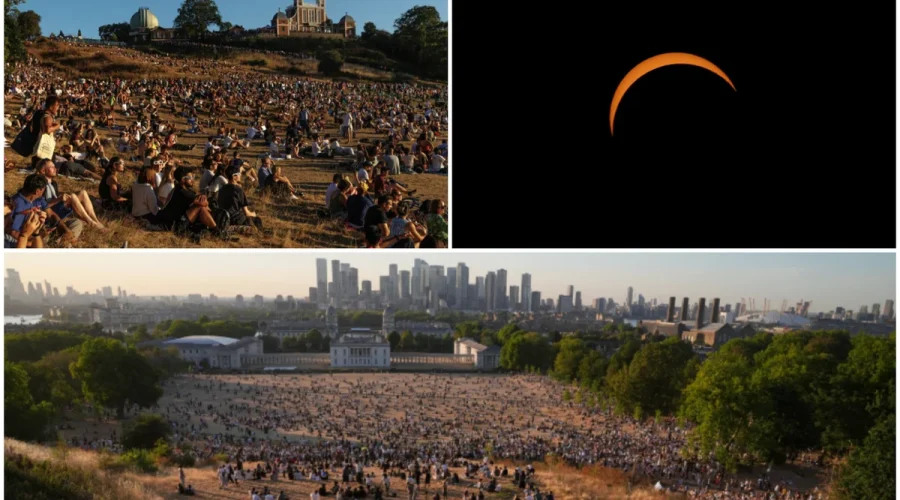
Traveloasisspot.com – Residents and visitors across the British capital gathered on Wednesday evening to observe one of the most significant celestial events in recent memory. The solar eclipse, described as the most comprehensive to grace UK skies in over half a century, drew enormous crowds to vantage points throughout the city. From elevated hills to riverside bridges, Londoners donned protective eyewear and improvised viewing devices to witness the moon gradually cover the sun.
The astronomical phenomenon commenced at 6:17pm local time, building anticipation as the moon began its slow journey across the solar disk. Observers tracked the progress with growing excitement until the moment of maximum coverage arrived at 7:13pm. At this peak, more than ninety percent of the sun’s surface disappeared behind the lunar shadow, creating an eerie twilight atmosphere across the city. The eclipse concluded at 8:06pm, leaving spectators with lasting memories of the celestial dance above.
Popular Viewing Spots Fill with Enthusiasts
The Royal Observatory in Greenwich emerged as a premier destination for eclipse enthusiasts, drawing thousands of visitors eager to observe from its historic grounds. Similarly, Primrose Hill attracted large crowds seeking elevated views of the sky. Local retailers reported extraordinary demand for protective eyewear, with many shops completely selling out of solar viewing glasses within hours of the event’s announcement.
The Royal Greenwich Observatory alone distributed approximately fifteen thousand pairs of specialized eclipse glasses over the preceding month, anticipating the surge in public interest. This substantial sales figure reflects the growing popularity of astronomical events among British citizens and the increasing accessibility of scientific observation tools.
Waterloo Bridge proved equally popular, with visitors from distant countries making the journey specifically for this occasion. Two men who traveled from India shared their enthusiasm with local media, describing the experience as extraordinary. One visitor explained that they had chosen London specifically for its vantage points near Parliament Square, while another emphasized the rarity of such an event, noting that witnessing the sun’s disappearance is not an everyday occurrence.
Improvised Solutions and Scientific Recommendations
While specialized equipment sold rapidly, many Londoners demonstrated creativity by constructing homemade viewing devices. Cereal boxes and kitchen colanders became popular tools for indirect solar observation. The latter gained particular attention after NASA recommended using colanders to project the sun’s image through the holes onto the ground, creating a natural pinhole camera effect.
Retailers confirmed this trend, with one major department store reporting that colander sales increased by nearly forty percent compared to the previous year. This surge in kitchenware purchases demonstrated how scientific events can unexpectedly influence consumer behavior and everyday life.
Personal Stories from the Crowd
Among the spectators was Veronica Orozco, a forty-one-year-old resident originally from Venezuela. She celebrated the occasion by opening a bottle of champagne while seated with neighbors in Greenwich Park, just steps from her home. Orozco described this as her second solar eclipse experience, recalling her childhood observation in Venezuela when she believed the sun might not return. Her father’s reassurance that it was simply science proved correct, and now she finds the experience equally magical at a different stage of life.
“It is my second solar eclipse. I was in Venezuela and I was young and I thought that the Sun would not come back. My dad said ‘it is science, of course it will come back.’ Now sitting here at the age of 41, it is still magical. I am sitting here with my neighbours and we have been telling each other ‘Happy Eclipse Day.'”
Not everyone shared the same level of enthusiasm, however. Some attendees expressed mild disappointment, noting that the darkness did not reach the dramatic levels they had anticipated. One woman explained that she had expected a more profound blackout, even if brief. Another visitor mentioned that while the next comparable eclipse would not occur until 2080, the current event fell slightly short of their expectations for spectacle.
Safety Considerations and Historical Context
Medical professionals emphasized the importance of proper eye protection during solar observations. Following the total solar eclipse of 1999, the Royal College of Ophthalmologists documented approximately seventy cases of individuals experiencing vision problems after viewing the event without adequate protection. This historical precedent underscores the necessity of using certified equipment.
Experts consistently recommended that only solar eclipse glasses meeting the ISO 12312-2 standard provide sufficient protection for safe observation. This certification ensures that the filters block harmful ultraviolet and infrared radiation while allowing viewers to observe the sun without damage to their eyesight.
The significance of this eclipse extends beyond the immediate spectacle. As the most comprehensive solar eclipse to occur in the United Kingdom since 1999, it represents a rare opportunity for public engagement with astronomy. The event also serves as a reminder of humanity’s enduring fascination with celestial phenomena and our ability to predict and understand the movements of celestial bodies with remarkable precision.
For those who missed this occasion, the next opportunity to witness a similar eclipse will not arrive until 2080, making this event particularly meaningful for current generations. The combination of scientific accuracy, public participation, and cultural significance ensures that this eclipse will be remembered as a defining moment in London’s recent history.
Related Reading
Frequently Asked Questions
What is Solar eclipse casts London into darkness?
Solar eclipse casts London into darkness is the main topic of this guide. The article explains the context, practical details, and next steps readers should understand.
Why does Solar eclipse casts London into darkness matter?
Solar eclipse casts London into darkness matters because readers are looking for a useful answer, not just a short summary. Good content should match search intent and help them decide what to do next.