Traveloasisspot.com – “`html
Andy Burnham’s Historic First Day as Britain’s New Prime Minister
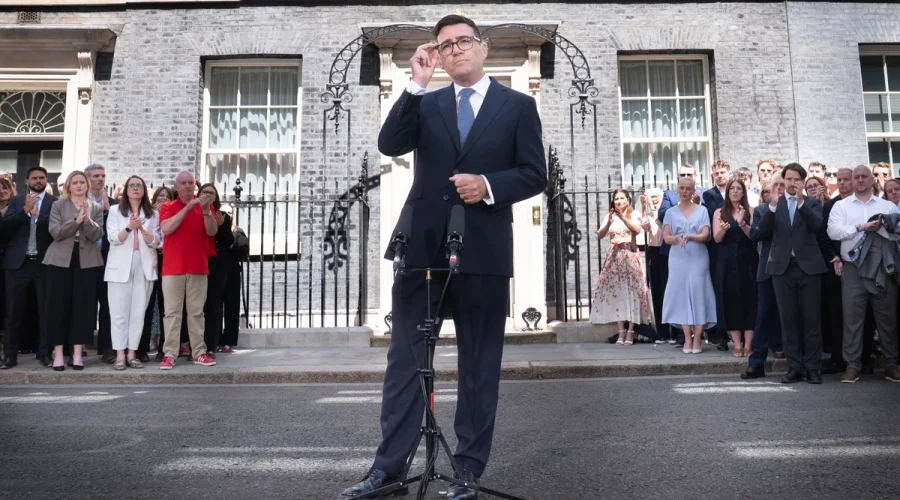
Monday marked a significant turning point in British politics as Andy Burnham assumed the role of the nation’s seventh Prime Minister within a decade. The Makerfield MP wasted no time settling into his new responsibilities, beginning his tenure with ceremonial duties at Buckingham Palace where he received an official audience with the King. Following this traditional ceremony, Burnham stepped outside Number 10 Downing Street to deliver his inaugural address to the public as the country’s new leader.
The transition of power occurred after Sir Keir Starmer formally tendered his resignation, prompting the monarch to invite Burnham to establish a new government. This leadership change followed Burnham’s official election as Labour Party Leader on Friday. His political journey has been remarkable, having returned to Parliament in June after serving as Mayor of Greater Manchester, and now finding himself at the helm of the nation’s executive branch.
Setting the Agenda: Economic and Political Vision
In his opening speech outside Downing Street, Burnham outlined several key priorities for his administration. He committed to providing immediate relief for families facing financial pressures, stating his intention to offer early “breathing space” for households struggling with rising costs. Additionally, he pledged to tackle homelessness by ending rough sleeping and articulated his broader ambition to “reindustrialise Britain.”
“I now pass the baton to Andy Burnham. I wish him every success. He has my full support,” Sir Keir Starmer declared in his resignation address.
Burnham emphasized that his government would introduce “a new political model and a new economic model” for the United Kingdom. Describing the moment as one requiring “reflection and new resolution,” he expressed confidence that Britain could restore its stability on the world stage. Acknowledging public frustration with traditional politics, he offered an honest assessment: “I know people at home are fed up with politics. I hear you and I want to be honest with you – we have not been good enough, and we need to be better. We will be.”
He further characterized his administration’s approach as a “circuit breaker for Britain,” promising to implement the most substantial transformations in four decades.
Cabinet Appointments and Key Changes
Burnham moved swiftly to assemble his team, with Sir John Healey receiving the prominent position of Chancellor of the Exchequer. In a statement shared on social media platform X, Healey expressed his enthusiasm: “It is the greatest privilege to be appointed Chancellor of the Exchequer by the Prime Minister. Together, we will build a new economy, build new hope and advance the working people of this country.”
Several notable reshuffles occurred within the Cabinet. Former Labour leader Ed Miliband transitioned to the role of Foreign Secretary, while Yvette Cooper took charge of health matters. Bridget Phillipson, who lost her position as education secretary, was reappointed as Minister for Women and Equalities. Angela Rayner, the former deputy prime minister, was named Housing Secretary.
Louise Haigh, a crucial ally instrumental in Burnham’s rise to Number 10, received dual appointments as First Secretary of State and Chancellor of the Duchy of Lancaster, positioning her as a central coordinator across government departments. Wes Streeting, who had previously resigned from Starmer’s government and was considered a potential leadership contender before endorsing Burnham, was announced as the new Defence Secretary on Monday evening.
Several senior ministers maintained their positions, including Transport Secretary Heidi Alexander and Home Secretary Shabana Mahmood. Labour veteran Pat McFadden also retained his role as the Work and Pensions Secretary.
International Relations and Global Endorsements
Within an hour of arriving at Downing Street, Burnham held discussions with US President Donald Trump, who subsequently posted a message of support on Truth Social. The American leader expressed confidence in Burnham’s capabilities, noting that while “he has got a big job ahead of him, he will be able to do it,” and committed that “the US will be there to help.”
Burnham also conducted telephone conversations with several international figures on Monday, including Ukrainian President Volodymyr Zelensky, French President Emmanuel Macron, and NATO Secretary General Mark Rutte. EU President Antonio Costa extended congratulations through a post on X, highlighting recent progress in bilateral relations: “In the last two years EU-UK relations gained a new, positive momentum. I look forward to continuing to further deepen our cooperation for the benefit of our citizens and businesses. The United Kingdom and the European Union are stronger together.”
“`