Starmer Defends Cabinet Amid Conservative Criticism During PMQs
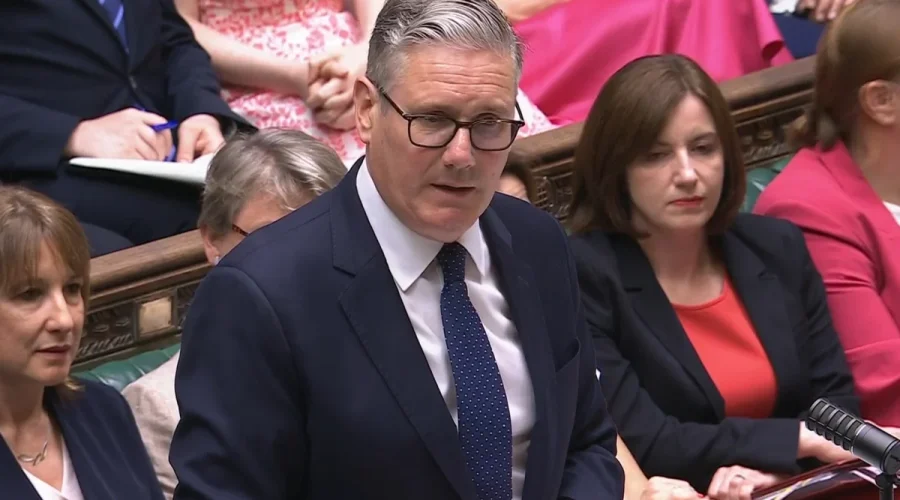
Keir Starmer bats away criticism of front – During the first Prime Minister’s Questions session following Sir Keir Starmer’s announcement of his leadership strategy, the Labour leader faced pointed challenges from the opposition. Kemi Badenoch, leader of the Conservative Party, seized the opportunity to question Starmer’s ability to maintain unity within his team, accusing Labour ministers of betraying the party’s core values.
Opposition Leader’s Barbs at Labour Ministers
Badenoch framed her critique around the recent by-elections, where her party gained traction despite Labour’s recent victories. She questioned whether Starmer felt “betrayed” by the backbenchers who had supported him to power two years prior, suggesting a shift in loyalty might be undermining his leadership.
“Does the Prime Minister believe the Government’s ministers have abandoned the principles that once united them?” Badenoch asked, her tone sharp as she directed her comments at the Labour team.
Speaker Sir Lindsay Hoyle intervened, emphasizing the need for decorum. He warned that the language used in the debate could echo among constituents, urging both leaders to maintain respect for one another.
Badenoch’s focus soon turned to specific policies, highlighting the Labour Party’s triumph in Makerfield. The victory saw Andy Burnham, the former Greater Manchester Mayor, return to Parliament after a nine-year hiatus, signaling a potential path to the Prime Minister’s office. She remarked, “I think I’m much happier with my new MP than he is with his,” referencing Douglas Lumsden, who won Aberdeen South in the recent elections.
Defense Spending and By-Election Analysis
Badenoch drew a stark contrast between Starmer’s assertions of control and the swift resignation of the defence secretary, John Healey, just days after the Prime Minister claimed the government had “everything under control.” The timing of the resignation raised questions about the reliability of Labour’s financial commitments, particularly regarding national defense.
“Two weeks ago, the Prime Minister told the House that the Government was funding defense and everything was under control. The very next day, the defence secretary resigned, saying the Prime Minister was unable and the Treasury unwilling to fund the defense of our country. What changed?”
Starmer countered by citing the by-election results in Gorton and Denton, where the Conservatives secured 1.9% of the vote, and Makerfield, where they gained 2.2%. He dismissed the opposition’s concerns, stating, “At this pace, it would take centuries for the Conservatives to regain power.”
He further emphasized Labour’s record on defense, claiming the party had “delivered the biggest sustained boost to defense spending since the 1980s.” Starmer highlighted the £270 billion increase over the current Parliament, positioning Labour as the party best equipped to secure national interests.
Starmer also mentioned the upcoming NATO summit, where the Government’s defense investment plan would be unveiled. This move was intended to showcase Labour’s commitment to military readiness, despite the recent setbacks in the by-elections.
Economic Policies and Leadership Tensions
Badenoch’s second question targeted Chancellor Rachel Reeves, accusing Starmer of being in a “mess” due to her failure to fund the defense plan. She framed the issue as a personal one, asking, “Does the Prime Minister feel let down by his Chancellor?”
“Sir Keir wouldn’t be in this mess if his Chancellor had found money for the Dip,” Badenoch remarked, using the acronym for the defense investment plan.
Starmer defended Reeves, praising her for ending a decade of austerity and reviving economic growth. He stated, “This is the Chancellor who got the economy growing,” underscoring her role in stabilizing the country’s finances.
Badenoch then shifted her focus to Energy Secretary Ed Miliband, criticizing his policies as “putting up energy bills and killing jobs.” She labeled him a “failed Labour leader,” drawing a personal comparison to his 2010 leadership race, where he chose his brother David over himself.
“When the going got tough, (Mr Miliband) jumped into bed with the mayor of Manchester – it’s not the first time he’s betrayed someone close to him, is it?”
Starmer acknowledged Miliband’s tenure but highlighted the broader achievements of his government, including the reduction of NHS waiting lists and the lifting of half a million children out of poverty. He contrasted these outcomes with the previous Conservative leadership, which he described as a “failed” administration.
In a broader critique, Starmer asserted, “The test for every prime minister is handing over the country in better shape than you found it. I know I can do that, which is more than can be said for her predecessor, her predecessor’s predecessor, and her predecessor’s predecessor’s predecessor.” The statement implicitly criticized Rishi Sunak, Liz Truss, and Boris Johnson for their respective leadership failures.
Personal Attacks and Policy Rebuttals
Badenoch continued her assault, turning to Education Secretary Bridget Phillipson and accusing her of mismanaging school funding. She pointed out that while private schools were taxed to support teacher recruitment, the number of teachers had actually declined.
“It turns out appointing a spiteful class warrior as Education Secretary was a disaster,” Badenoch said, her words carrying a personal jab at Phillipson’s policies.
Starmer, however, defended Phillipson, calling her “a vital figure for poor children” and praising her efforts to improve educational opportunities. He added, “She knows that for poor children, education is absolutely vital,” framing her as a defender of social mobility.
Badenoch’s questioning also touched on the potential elevation of Ed Miliband to the role of chancellor, should Burnham secure the Prime Minister’s office. She framed this as a reward for “treachery,” suggesting that Miliband’s loyalty to Burnham was a betrayal of Labour’s principles.
Throughout the session, Starmer maintained a composed demeanor, countering Badenoch’s claims with data and policy highlights. His emphasis on Labour’s achievements contrasted sharply with the opposition’s focus on perceived inconsistencies and failures.
Broader Implications for the Labour Party
The exchange underscored the internal and external pressures facing Starmer as he seeks to consolidate his leadership. While he defended his ministers and policies, Badenoch’s pointed questions aimed to expose vulnerabilities, particularly in the realm of economic and defense planning.
As the debate unfolded, the stakes for the Labour Party became clear. With the by-elections serving as a litmus test for public support, Starmer’s ability to maintain unity and credibility would be crucial in the months leading to the NATO summit and beyond.
The session concluded with Badenoch’s final remark, which acknowledged Starmer’s commitment to his team: “It is very generous of the Prime Minister to stick by his ministers,” she said. This subtle nod to Labour’s cohesion hinted at the ongoing battle between loyalty and accountability within the party.
Starmer’s responses, though brief, left a strong impression, emphasizing his confidence in the Labour government’s ability to deliver on key promises. The PMQs episode became a microcosm of the broader political dynamics at play, with both leaders vying to shape the narrative around their party’s performance and future prospects.