His Majesty Names Andy Burnham Fourth Prime Minister in Ceremonial Transition
A Smooth Handover of Power at Buckingham Palace
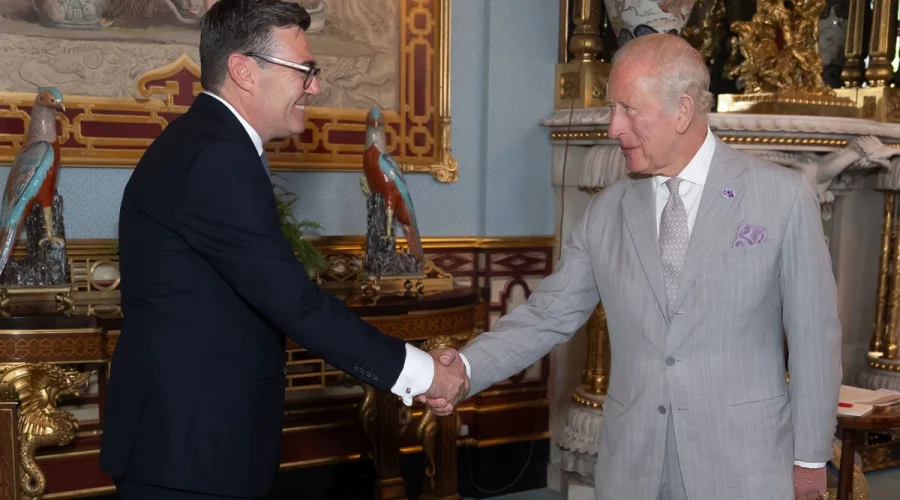
Traveloasisspot.com – In a momentous occasion that underscored the continuity of British governance, King Charles has formally appointed Andy Burnham as the fourth individual to serve as Prime Minister during his reign. The appointment followed established constitutional conventions, ensuring a seamless transfer of executive authority from the outgoing administration. As head of state, the monarch accepted the resignation submitted by Sir Keir Starmer and subsequently invited Mr Burnham, who previously held the position of mayor for Greater Manchester, to assemble a new Government.
The ceremonial proceedings at Buckingham Palace carried a distinctly personal quality, transforming what is typically a formal political event into a family gathering. Sir Keir Starmer attended his final audience with the sovereign accompanied by his wife and children, marking the conclusion of his tenure with loved ones present. In a departure from tradition, the incoming Prime Minister chose to bring his spouse along for the historic meeting, adding warmth to the proceedings.
Official Confirmation and Royal Protocol
The appointment was formally documented in an official statement issued by Buckingham Palace, which will subsequently be recorded in the Court Circular—the authoritative chronicle of royal engagements. The Palace declaration provided detailed insight into the constitutional process:
“His Majesty received in audience the Rt Hon Andrew Burnham MP and requested him to form a new administration.”
“The Rt Hon Andrew Burnham MP accepted the King’s offer and kissed hands upon his appointment as Prime Minister and First Lord of the Treasury.”
“Ms Marie-France van Heel was also received by His Majesty.”
Ceremonial Details and Public Celebration
The day’s schedule required Mr Starmer to visit the King first, and upon his arrival, the changing of the guard ceremony was underway in the palace forecourt. Hundreds of tourists had gathered along the palace gates to witness the military spectacle, creating an atmosphere of national significance. Sir Clive Alderton, serving as the King and Queen’s principal private secretary, welcomed the outgoing prime minister with characteristic warmth, patting his hand twice and placing a reassuring touch on his shoulder. He also greeted Lady Victoria Starmer, kissing her on both cheeks in a gesture of personal courtesy.
Travelling in the vehicle behind the couple were their teenage son and daughter, young members of the Starmer family who are seldom seen in public alongside their parents. They joined the approximately thirty-minute audience with the King toward the conclusion of the meeting, accompanying their mother into the Chinese drawing room.
Shortly following the Starmer family’s departure, Mr Burnham arrived with his Dutch-born wife, Marie-France van Heel. Mrs van Heel has built a distinguished career in marketing and strategy over many years and gained public recognition as a former contestant on Cilla Black’s popular television programme Blind Date. Sir Clive greeted the former mayor of Greater Manchester with the words “welcome back,” then turned to his wife saying “hello, lovely to see you, welcome to Buckingham Palace,” before inviting the couple to proceed to meet the monarch.
The audience with Mr Burnham lasted nearly thirty-five minutes, with the politician’s wife joining the meeting toward its conclusion in the elegant Chinese drawing room. As the new Prime Minister departed the palace, he was warmly cheered by tourists who had gathered on the opposite side of the palace’s quadrangle during the summer opening. A large group of visitors offered a vocal greeting, which Mr Burnham and his partner acknowledged with appreciative waves, marking the beginning of a new chapter in British political leadership.