London Faces Moscow’s Warning After British-Made Drones Reach Russian Heartland
Traveloasisspot.com – For the first time since Moscow launched its full-scale invasion of Ukraine more than four years ago, drones manufactured in Britain have been deployed to hit targets deep inside Russian territory. The revelation has drawn a sharp diplomatic rebuke from the Kremlin, which warned that London will face “consequences” for what it characterised as direct involvement in the war.
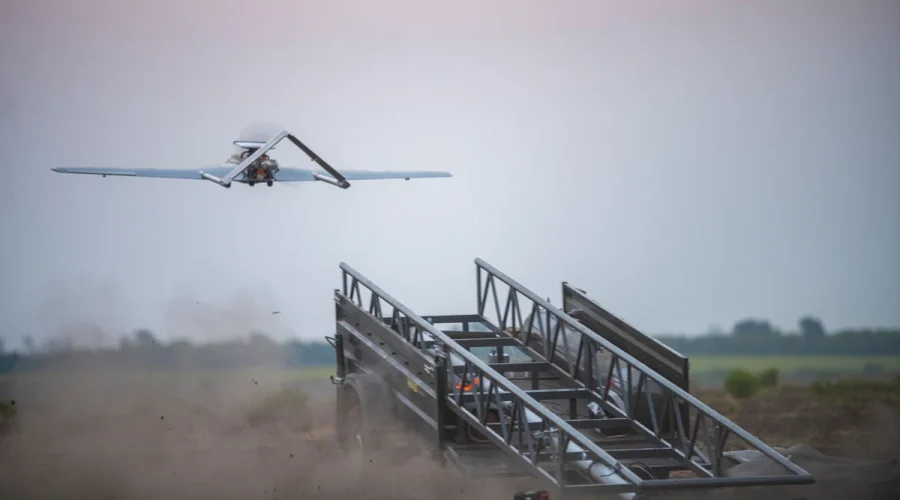
The strikes formed part of an intensified deep-strike campaign carried out by Ukrainian forces, employing unmanned aerial vehicles produced by two separate British manufacturers. Their use marks a notable escalation in the conflict’s geography, pushing the theatre of operations far beyond the Ukrainian border and into regions where ordinary Russians had previously felt comparatively insulated from the fighting.
Kremlin Diplomatic Response
The Russian embassy in London issued a formal statement on Monday, framing the drone deployments as evidence that Britain has chosen a path of deliberate confrontation rather than measured support.
“The reports confirm that London is deliberately opting for an escalation of the Ukraine crisis,” the embassy said, accusing the British government of “seeking to contain Russia and inflict maximum damage on it by proxy.”
The statement went further, issuing what amounted to a direct threat:
“London’s actions will inevitably carry consequences for which it will have to answer. The deeper its involvement in the conflict and the greater its support for Kyiv’s terrorist machinery, the higher the price it will pay.”
The language represents a marked hardening in Moscow’s public tone toward Britain, a country that has not sent combat troops to Ukraine but has become one of Kyiv’s most consistent suppliers of weapons, training, and intelligence. By invoking the word “proxy,” the embassy sought to collapse the distinction between supplying equipment and fighting the war itself — a framing that, if accepted, would place Britain in a far more exposed strategic position.
British Government Pushes Back
A spokesperson for the Ministry of Defence responded swiftly, rejecting the premise that Britain’s support constitutes escalation and reaffirming the government’s commitment to Kyiv.
“Britain stands shoulder to shoulder with Ukraine and we are committed to providing the equipment Ukraine needs to defend itself against Putin’s illegal invasion,” the spokesperson said.
“Russia should be in no doubt about the resolve of this Government to stand against Russian aggression, in Ukraine and against the UK and our allies.”
The phrasing — extending the government’s resolve to protection of British territory and allied states — signals that London is preparing the public for the possibility that Russian retaliation could extend beyond Ukrainian soil. It is a reminder that Britain, while not a belligerent, sits within range of Russian long-range missiles and now operates a defence industry whose products are being consumed on the front line.
The Strategic Logic Behind Ukraine’s Deep Strikes
Kyiv’s long-range campaign is not merely punitive. Analysts and independent monitors assess that its primary objectives are twofold: to erode the revenue streams that finance Moscow’s war machine, and to make the cost of the invasion tangible for Russian citizens who have lived under a steady drumbeat of state media for over four years.
The targeting of enormous distribution depots belonging to Wildberries, Russia’s largest online retailer, illustrates the second aim vividly. Billions of pounds worth of consumer merchandise was reduced to ash, sending images of scorched shopping parcels into Russian living rooms and puncturing the narrative that the war is happening somewhere far away.
The scale of operations has grown sharply. Independent conflict-monitoring data compiled by Acled shows that Ukraine launched roughly three times as many deep strikes in July as it did in January of the same year. Each additional kilometre of penetration forces the Russian military to spread its air-defence assets across a wider frontage, diluting coverage and increasing the cost of every interception.
Scale of the Drone War
On Saturday, Russia’s Ministry of Defence announced that it had shot down 598 Ukrainian drones over a single period spanning 19 Russian regions, the Black Sea, the Sea of Azov, and the annexed Crimean peninsula. The figure underscores both the volume of Ukrainian sorties and the breadth of the area now under threat.
The human toll continued into Monday. Russian officials reported that overnight long-range Ukrainian attacks killed seven people on Russian territory. In Ukraine, five civilians were killed in separate strikes by Moscow’s forces, a reminder that the exchange of blows continues in both directions.
What Comes Next
The diplomatic exchange over British-made drones is unlikely to be an isolated incident. As Ukraine’s industrial partners — Britain included — supply increasingly sophisticated long-range systems, Moscow will face recurring choices about how publicly to register its displeasure. The embassy’s language of “consequences” and “price” leaves little room for ambiguity about what the Kremlin considers acceptable. For London, the challenge is to sustain its support for Kyiv while managing the risk that each new capability handed over becomes a fresh point of friction with a nuclear-armed neighbour that has now explicitly linked British industrial output to its own strategic calculus.
Related Reading
Frequently Asked Questions
What is Russia threatens consequences over use of UK?
Russia threatens consequences over use of UK is the main topic of this guide. The article explains the context, practical details, and next steps readers should understand.
Why does Russia threatens consequences over use of UK matter?
Russia threatens consequences over use of UK matters because readers are looking for a useful answer, not just a short summary. Good content should match search intent and help them decide what to do next.