
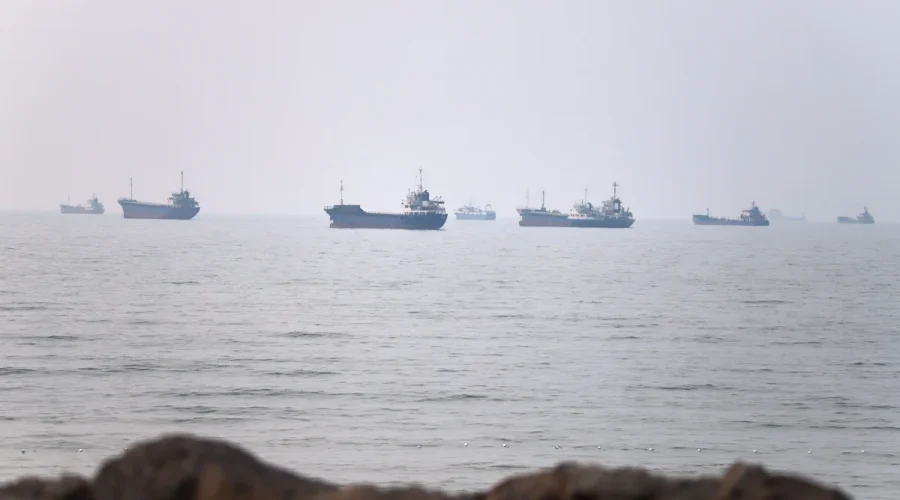
Maritime Traffic Through Strait of Hormuz Collapses Amidst Renewed Iran-US Hostilities
Strait of Hormuz traffic plummets after – Commercial shipping activity across the strategically vital Strait of Hormuz has experienced a dramatic decline following intensified military confrontations between Iran and the United States. According to Lloyd’s List Intelligence, a prominent UK-based maritime analytics company, vessel movements through the American-coordinated passage near Oman have nearly ceased entirely.
The maritime monitoring organization documented that traceable ships navigating the designated corridor have “effectively grinding to a halt” as a direct consequence of the most recent wave of violent exchanges between the two nations. This significant reduction in traffic underscores the severity of the current geopolitical crisis unfolding in the Persian Gulf region.
Escalating Military Confrontations
President Donald Trump issued a stern warning to Tehran, cautioning that the ongoing attacks could intensify considerably. His statement followed the American military’s execution of a second major strike operation late Wednesday evening, which targeted approximately 90 Iranian installations. These coordinated assaults specifically aimed to diminish Iran’s capacity to challenge freedom of navigation through the narrow Gulf waterway.
In response to the American military actions, Iranian forces launched retaliatory strikes against Bahrain, Kuwait, and Qatar. All three nations maintain significant US military presence within their territories, making them strategic targets for Tehran’s counteroffensive.
The renewed hostilities have effectively terminated the interim ceasefire arrangement that President Trump had previously announced with Iran. These fresh clashes erupted on Tuesday when Iranian forces attacked three commercial tankers operating within the strait, a location that has consistently served as a flashpoint during the fragile truce period.
Impact on Global Energy Markets
The latest exchange of military strikes has once again created substantial disruption in the critical waterway, which functions as an essential artery for global oil and gas distribution. Furthermore, the escalating violence has cast considerable uncertainty over efforts to achieve a permanent resolution to the conflict, which was originally initiated by the United States and Israel on February 28.
Lloyd’s List Intelligence provided additional context through a statement published on the social media platform X, noting that “Traffic through the Strait of Hormuz has fallen sharply following the latest escalation between the US and Iran, with traceable vessel transits through the US-co-ordinated Omani lane effectively grinding to a halt.”
Diplomatic Tensions and Economic Concerns
President Trump expressed confidence that Iran desires to reach a comprehensive agreement, stating that the country wants to conclude a deal “so badly.” However, he simultaneously acknowledged concerns about Iranian commitment, remarking: “I don’t know that they’re going to honour the deal. That’s the problem.”
Iranian deputy foreign minister Kazem Gharibabadi responded critically to the president’s assessment, characterizing these remarks as “not a sign of power but an admission of the failure” on the American side.
Meanwhile, British Prime Minister Sir Keir Starmer has called for a restoration of the ceasefire arrangement. He cautioned that UK household energy bills would likely increase unless the regional situation improves significantly, highlighting the domestic economic implications of the international crisis.
Strait Control and Navigation Rights
The United States military has actively worked to counter Iranian state media assertions that navigation through the Strait of Hormuz requires Iranian authorization. US Central Command (Centcom), responsible for overseeing American military operations throughout the Middle East, published a detailed fact-check on X clarifying the situation.
“Iran does not control the Strait of Hormuz. Since early May, US forces have helped facilitate the successful transit of more than 800 commercial vessels and 380 million barrels of crude oil through the vital international trade corridor.”
Despite these efforts, the current volume of traffic represents merely a fraction of pre-conflict levels. Prior to the war, approximately 140 vessels crossed the strait daily on average, demonstrating the substantial reduction in maritime activity.
Securing unrestricted access to the strait, which had previously disrupted worldwide energy supplies and contributed to rising fuel and food costs, emerged as a primary objective during earlier diplomatic negotiations. Nevertheless, the initial agreement between Washington and Tehran guarantees only safe, toll-free passage for an initial 60-day period, pending resolution of Tehran’s contested nuclear program.
The arrangement also delegates authority to Iran and Oman, alongside other Gulf Cooperation Council members, to establish the future governance structure and maritime service provisions for the strategically important waterway. During this transitional period, Iran has persistently attempted to strengthen its position by requiring vessels to obtain permission for passage and threatening potential future tolls.