London’s Enduring Dining Institutions: A Century-Plus Survey of the City’s Most Persistent Tables
Traveloasisspot.com – The return of Simpson’s In The Strand to full operation this year sent ripples through the capital’s food scene, prompting a question that rarely gets asked aloud: what other establishments in London carry the same weight of history, the same gravitational pull of tradition? The answer is not short. What follows is a survey of nine of the city’s longest-tenured dining rooms — places where the menu has outlasted empires, where the plasterwork predates television, and where the clientele still expects a white tablecloth without being asked. These are not the only institutions in London; they are simply the ones that share a particular British sensibility, even when the cuisine on the plate is French, Polish, or otherwise continental.
It is worth noting what this list deliberately excludes. Punjab in Covent Garden, now eighty years old, has shaped the city’s palate as profoundly as any establishment named below. Chinatown’s Lido, operating since 1969, and Giovanni’s, the Italian opened in 1952 just steps from Punjab, have each contributed immeasurably to the texture of London life. They are institutions of a different register, and they deserve their own reckoning. On this occasion, however, the brief called for something else: restaurants that occupy the same cultural shelf as Simpson’s, at a comparable price point, and with a distinctly homegrown character.
Wiltons: The Oyster Cart That Outlived Its Own Century
Founded in 1742 as a modest oyster cart, Wiltons now occupies a dining room that is itself more than fifty years old. The clientele skews older and well-heeled, drawn by seafood plates and dishes that evoke a childhood kitchen long dissolved. The cheese soufflé remains a benchmark, and the oyster — served with the quiet confidence of a house that has been doing this for nearly three centuries — is arguably still the finest in the city. Jackets and ties are not merely encouraged but expected; the dress code has been continuous since the cart era. Beneath the apparent formality, however, there is a mischievous warmth that keeps the room from feeling like a museum exhibit. Franco’s, a neighbouring property under the same ownership, dates only to 1945 and reads, by comparison, as a toddler.
Ognisko: Polish Exile, Pink Walls, and a Thirteen-Year Rebirth
Conceived in 1939 and opened in 1940 as a London anchor for Polish exiles fleeing the war, Ognisko has cycled through numerous incarnations. There was an era of pink walls and gold-trimmed event chairs — a period that invited comparisons to Barbara Cartland set design or supermarket salmon packaging. The transformation began when Jan Woroniecki assumed control thirteen years ago. Since then, the room at 55 Exhibition Road, SW7, has become one of London’s most beautiful dining spaces, pairing what is probably the city’s finest Polish cooking with martinis of exceptional precision and a wine list that has clearly been studied with patience and care. The main dining room commands attention, but the bar carries its own quieter charm.
L’Escargot: Georgian Grandeur and the Proper French Table
Born in 1896 and settled at its present address since 1927, L’Escargot is London’s oldest French restaurant and, by most reckonings, among its finest. The Georgian proportions of the interior convey a sense of settled authority — reassuring, grown-up, unbothered by fashion cycles. Within those walls one finds Tournedos Rossini, lobster thermidor, and confit duck executed to a standard that has held for generations. The wine list is dependable; the cocktails are excellent; late-night and prix fixe menus extend the evening for those who wish. A recent visit prompted an exchange between two diners who, after a disappointing lunch elsewhere, sat down for a drink and exchanged a single verdict:
“Ah. A proper restaurant.”
That word — “proper” — captures something essential about the place. It offers whatever its guests might ask of it, without pretension and without apology.
The Ritz: Two Stars, Twelve Decades, and the Weight of Expectation
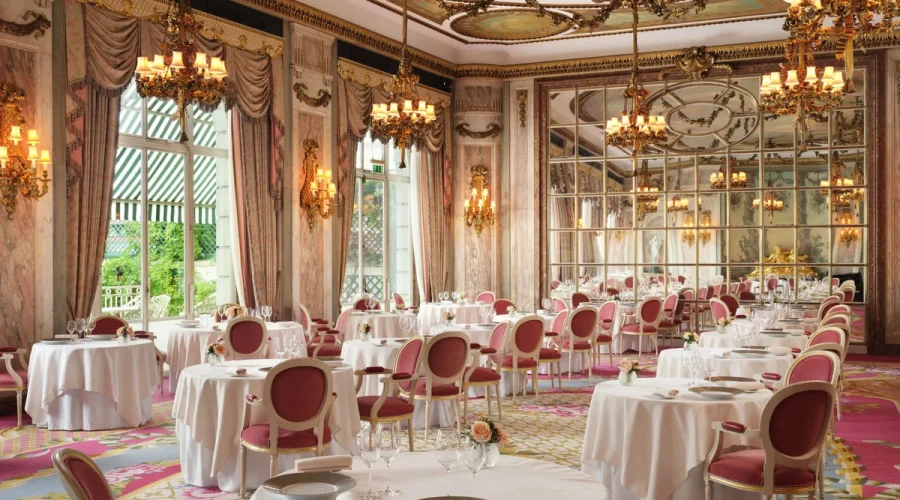
Now one hundred and twenty years old, the Ritz occupies a neoclassical shell that has long served as London’s benchmark for French fine dining. For years it suffered from a peculiar contrarianism: diners who had never set foot inside would dismiss it by reputation alone, much as one might dismiss Restaurant Gordon Ramsay in Chelsea (still brilliant, by the way) simply because the name has become a byword. Chef John Williams presides over a kitchen whose output is not merely extraordinary but genuinely memorable — a distinction that is far harder to achieve than it sounds and far rarer in practice. Two Michelin stars attest to the standard; the century of accumulated habit attests to the endurance.
Rules: 1798 and the Question of Ambition
Opening in 1798, Rules holds the title of London’s oldest restaurant and has traded on that fact for generations. The claim, however, risks obscuring what actually happens in the kitchen: rather good food. Not mind-blowing — unless one regards steak and kidney as an especially avant-garde pairing — but meals cooked with evident competence, presented with a near-reverential care, in surroundings that resemble a child’s drawing of a fancy restaurant. The upstairs bar is solid, and the sheer volume of history on display is enough to sustain any evening. It is one of those restaurants you return to not because the food shocks, but because the room itself has become a kind of civic furniture, as permanent and unremarkable as a park bench, and therefore as comforting.
These establishments share something that no new opening can replicate: continuity. Their creaking bones have walked through two centuries of London, and the prospect of their continued operation is not merely a matter of nostalgia but of cultural infrastructure. They are, in the most literal sense, load-bearing walls in the city’s dining architecture. May they walk on.
Related Reading
Frequently Asked Questions
What is London s greatest restaurants of all time?
London s greatest restaurants of all time is the main topic of this guide. The article explains the context, practical details, and next steps readers should understand.
Why does London s greatest restaurants of all time matter?
London s greatest restaurants of all time matters because readers are looking for a useful answer, not just a short summary. Good content should match search intent and help them decide what to do next.