
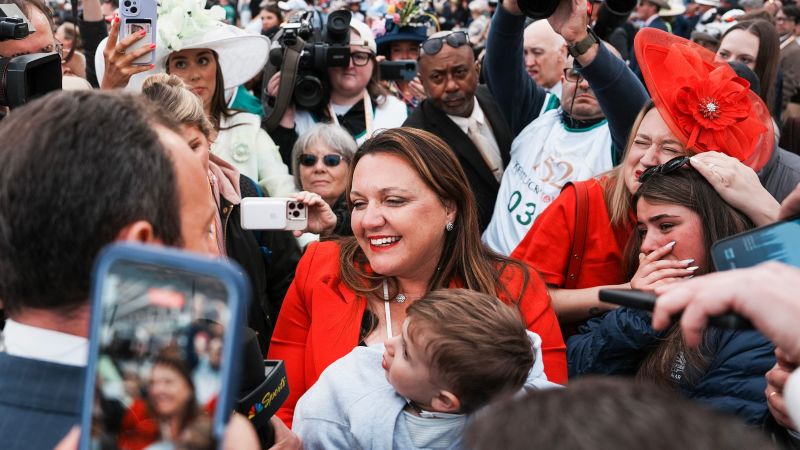
All Cherie DeVaux wanted to do was win the Kentucky Derby. Making history? She’s just glad that part is over
All Cherie DeVaux wanted to do was – Long before the phrase “vision boards” entered popular culture, before the concept of “manifesting” dreams became a household name, Cherie DeVaux turned to a more tangible method to track her ambitions. As a self-proclaimed Type A personality, she meticulously documented her goals on paper, taping them to her bedroom walls like tiny milestones. Whether it was academic achievements, athletic milestones, or life aspirations, DeVaux treated each objective as a contract to be fulfilled. Her mother, Janet, often questioned the realism of her daughter’s ambitions. “Don’t you think that’s a little lofty?” she once asked, prompting DeVaux to respond with a mix of defiance and determination. “OK, mom. Tell me what else I can’t do,” she recalled, her tone carrying the weight of a young woman who refused to let doubt dim her drive.
DeVaux’s journey to the Kentucky Derby was one of quiet persistence. When she created her vision board in January, the focus was singular: victory. The document, a modern take on her childhood goal list, was crafted on a Canva account, blending digital creativity with old-fashioned determination. At the top left corner, a striking image of the rose garland that adorns the winner of the Derby dominated the page. “That was my first vision board ever,” she said, flipping it toward the camera during a Zoom interview with CNN Sports. The photo, she explained, was a symbol of her unyielding pursuit of the race she had dreamed about for years. Yet, as she reflected on the moment, a realization struck her. “Wait,” she paused mid-sentence, her eyes widening. “You just reminded me.” The memory of her mother’s question resurfaced, anchoring her in the moment of her triumph.
“I made that vision board before the LeComte,” DeVaux said, referring to the first stakes race Golden Tempo, the Derby-winning horse she trained, had won. “Do I believe in that stuff? I do now.”
Golden Tempo’s victory at the 152nd Kentucky Derby marked more than just a win for the horse; it was a milestone for DeVaux, who had spent years proving her worth in a field dominated by male trainers. The Derby, one of the longest-running sporting events in the United States, has endured decades of change, from the roar of wartime crowds to the quiet hum of pandemic-era races. Yet, despite its storied history, no female jockey or trainer had claimed the title until DeVaux shattered the glass ceiling, a feat that redefined the narrative around women in the sport.
Now, as the Derby’s legacy fades into the background, DeVaux finds herself in the spotlight. The past week has been a blur of interviews, media appearances, and the kind of whirlwind that follows a major victory. CNN, the Today Show, and even the Yankees, who invited her to throw out the first pitch, have all taken an interest in her story. While the attention is rewarding, DeVaux admits it has been overwhelming. “It’s been a blissfully bleary-eyed week,” she said, laughing at the irony of her schedule. Where once afternoons were reserved for naps, they are now consumed by press conferences and photo sessions.
A Historic Achievement, A Personal Triumph
The Kentucky Derby’s tradition of celebrating excellence has always been a proving ground for athletes, but for DeVaux, it was more than that—it was a personal breakthrough. She described the moment of victory as a mix of elation and relief, the culmination of years spent navigating a male-centric industry. “I’m just glad I don’t have to answer that question anymore,” she quipped, referring to the constant inquiry about her gender. The title of “first female trainer to win the Kentucky Derby” has become inseparable from her name, yet DeVaux prefers to think of it as a label rather than a definition.
While the achievement is historic, DeVaux’s focus remains on the work itself. She emphasized that her initial goal was never about breaking barriers but about securing a win. “I always wanted to focus on my career,” she said, her voice steady with conviction. “Using my gender as part of the conversation never really crossed my mind.” However, she acknowledged the significance of her role in history. “It’s not that I’m unaware of the impact,” she added. “I have a stepdaughter, and I know what it means for a young girl to have someone to look up to.” Her win, she explained, is a beacon for others who might feel underestimated by a system that has long favored men.
Despite her success, DeVaux remains grounded in her pursuit of equality. She wants to be judged by the quality of her training, the results her horses achieve, and the strategies she employs. “I want actual equality,” she said. “With all the benefits and the warts.” To her, recognition should come from merit, not from being the only woman in the room. “You can’t help but stand out in a very masculine crowd,” she noted, reflecting on the challenges of being a female trainer in a male-dominated field. “But I’d rather be measured by the work I do than by the novelty of my presence.”
Breaking Barriers, Building Futures
DeVaux’s journey to the Derby was paved with sacrifices and setbacks. She trained Golden Tempo from the ground up, navigating the complexities of horse racing while proving herself in a profession that often overlooked women. The Derby, with its 152-year history, has seen its share of pioneers, but DeVaux’s victory feels different. It is a culmination of her efforts, a testament to the resilience required to succeed in a world that once seemed stacked against her.
Even for those who have carved their own paths, the gender aspect is never far. DeVaux described the sensation of being recognized not just for her skill, but for being a woman. “There’s a fine line between not taking anyone’s crap and figuring out what is truly offensive,” she said, highlighting the balance she has maintained throughout her career. Her story is one of quiet perseverance, of turning doubt into determination. “I made that vision board before the LeComte,” she repeated, underscoring the clarity of her goals. “But do I believe in that stuff? I do now.”
As the Derby’s legacy fades, DeVaux’s focus shifts to the future. The Preakness Stakes looms on the horizon, and while Golden Tempo will not compete, the spotlight remains on her. She described the upcoming races as a new chapter, one where the focus can return to the sport itself. “I want to be known for how I train my horses, not for being the first woman to do it,” she said. Yet, she also recognizes the importance of her role in inspiring others. “It’s not just about me,” she added. “It’s about creating space for more women to step into this world and take it for themselves.”
DeVaux’s story is a reminder that progress often begins with individual determination. Her vision board, once a personal tool for goal-setting, now symbolizes a broader movement. In a field that has historically favored men, her win is a step toward equality, a validation of her hard work, and a beacon for the next generation. As she reflects on the moment, DeVaux’s words carry both pride and humility. “I wanted to win the Kentucky Derby,” she said. “Making history? That was just the bonus.”
The Kentucky Derby is more than a race—it is a cultural icon, a symbol of tradition and triumph. For DeVaux, it is also a personal milestone, one that reaffirms her place in the sport’s storied history. Yet, as she moves forward, the focus remains on the future. The next race, the next challenge, the next step in her journey. For now, she is content with the achievement, with the recognition, and with the knowledge that she has paved the way for others. “I don’t want to be put in a separate pile,” she said. “I want to be measured by the same standards as everyone else.”





