Table of Contents
ToggleIran War: What Has Been Hit So Far – and the Military Assets in Play
The US and Israel have intensified their aerial assaults on Iran, marking the fourth consecutive day of hostilities since the operation that eliminated its supreme leader began.
With hostilities showing no signs of abating, Sky News has compiled a detailed analysis of the ongoing conflict, tracking both the attacks launched by the US and Israel and the strategic military assets involved.
Explore Strike Locations via Satellite Imagery
Operation Epic Fury commenced on Saturday, resulting in the death of Ayatollah Ali Khamenei at his Tehran residence. Satellite images reveal the locations of strikes, offering a visual breakdown of the campaign’s scope.
Israel escalated the campaign by conducting over 100 air strikes, eliminating numerous high-ranking Iranian military personnel within three days.
“Preliminary analysis shows that the United States and Israel used a variety of precision-guided munitions to strike Iran,” said Nic Jenzen Jones, director at Armament Research Services (ARES). “These included air-delivered weapons such as the AGM-154 Joint Standoff Weapon (JSOW), Blue Sparrow-series air-launched ballistic missiles, and bombs ranging from 500 to 2,000 pounds.”
“In addition, surface-to-surface missiles were also fired, such as Tomahawk-class sea-launched variants and the PrSm land-based system,” added Jones.
Iran has retaliated by launching drones and missiles at Israel, the UAE, Bahrain, Jordan, Oman, and Qatar. The UK’s RAF base in Cyprus was targeted, underscoring Iran’s ability to strike from afar.
The Sajjil missile, Iran’s longest-range weapon, can reach up to 2,000km, according to the International Institute for Strategic Studies. This range allows it to target Moscow or Athens but falls short of enabling strikes on the UK.
The conflict has underscored the strategic role of the US-UK joint base in Cyprus, which Sir Keir Starmer initially hesitated to authorize for US operations against Tehran.
Satellite images captured on Sunday morning revealed 14 aircraft stationed near the runway, including six F-16s and two P-8 Poseidons. The remaining were transport planes like the C-5 Galaxy and KC-135 Stratotankers, as noted by Jane’s Defence Weekly analysts.
Recent flight data highlights the movement of 47 US military aircraft, with 15 passing through British bases such as Diego Garcia in the Indian Ocean. This location, previously a focal point of political debate over the Chagos Islands’ handover to Mauritius, has seen increased activity.
US airbases in Germany have experienced a notable reduction in aircraft, with 246 departing from Spangdahlem and Ramstein since February 23, representing a 52% decrease. Similarly, Al Udeid Air Base in Qatar has seen more departures than arrivals, positioning it as a potential Iranian counterattack target.
Meanwhile, aircraft are gathering at Kuwait, Israeli, and Jordanian bases, indicating shifting strategic priorities.
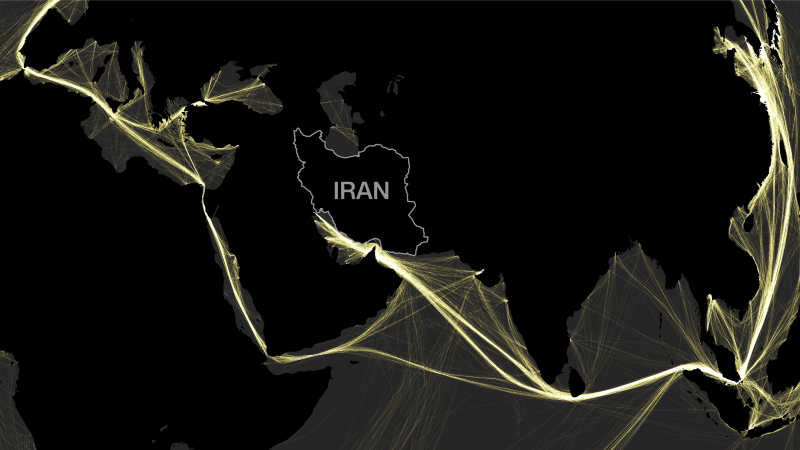
Satellite imagery reveals damage at two Iranian naval installations, including fires at Bandar Abbas, the Navy’s central command post, and the burning of the Makran, a major vessel in the Strait of Hormuz.
Sky News has monitored the Makran among six Iranian ships tracked via TankerTrackers data, stationed near Qeshm Island in the Strait of Hormuz.