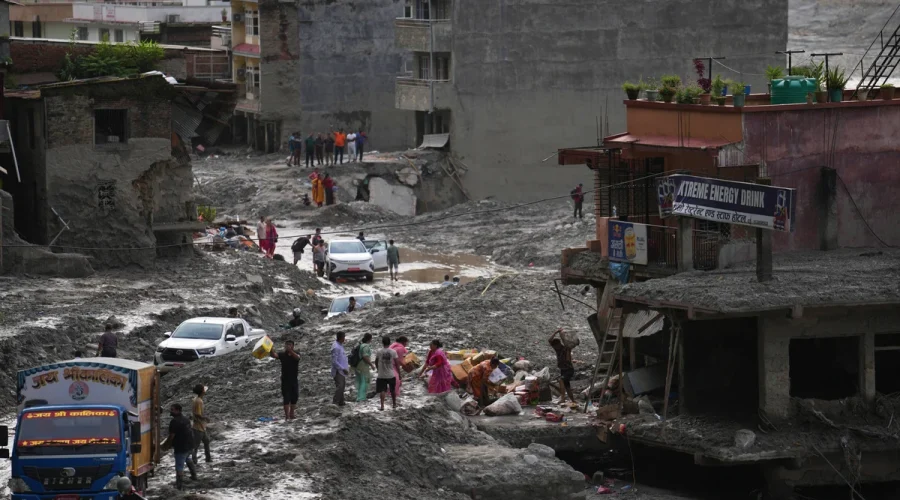
Volunteer in Nepal Flood Zone Told He Was Among the Rescued — But He Was Already Helping
Traveloasisspot.com – When Alastair Chambers stepped out of a humanitarian aid helicopter at an army barracks in Kathmandu and handed his passport details to a waiting police officer, he expected a routine check. What he did not expect was to learn, within minutes, that the Nepali government had already announced his rescue from the Rasuwa region — a place he had been visiting not as a stranded victim, but as a volunteer distributing supplies to communities severed by collapsed bridges and cascading landslides.
The 45-year-old former Gloucester councillor had flown into Nepal the previous week after watching televised footage of flash floods tearing through central districts. Joining a group of other volunteers, he helped deliver sleeping bags, water purification equipment, food, and other essentials to villages cut off from the outside world. His work took him to a settlement near the Trishuli river, where he spent several days assisting with relief operations before boarding a helicopter back to the capital.
The Mix-Up at the Barracks
Chambers described the moment the confusion took hold. He had been dropped at the military installation, and a police officer approached to collect his identification. The officer, working from a list of expected arrivals, assumed the British national had just been extracted from a disaster zone as part of an official rescue operation.
“I gave them my details, just abiding by the rules, and they obviously thought that I’d been rescued. News spreads – I was contacted by about 15 different journalists in the last few hours, just asking how I was and how I’m feeling after being rescued, and I had to say: ‘Well sorry, I haven’t been rescued.'” — Alastair Chambers
The Nepali Army had posted a statement on Facebook confirming that 119 people, including one British citizen, had been brought to safety through the use of air resources. Nepali officials had announced on Tuesday that a British man had been pulled from the Rasuwa region. Chambers clarified that his helicopter ride was a humanitarian aid flight, not a rescue extraction, and that he had been travelling to the affected area to assist, not fleeing from it.
“I thought they seemed very happy when I arrived,” he added, noting the bemused relief on the faces of the officers who believed they had completed a successful rescue.
Conditions on the Ground
The journey into the flood-affected zone was far from straightforward. Chambers described roads blocked by landslides and uprooted trees, turning a drive that should have taken roughly ninety minutes into an eight- or nine-hour ordeal. On one morning, the team received word that another wave of floodwater was approaching and had to climb to higher ground before the torrent passed. Once the water receded, they descended again to help locate bodies and continue delivering aid.
“It’s been quite challenging, but it’s been very rewarding as well,” Chambers said of the days spent working alongside other volunteers in the devastated communities.
He plans to return to the United Kingdom to organise fundraising for the village he helped, then fly back with additional essentials including solar-powered lighting systems to restore basic electricity to households still without power.
Official Response and the Broader Toll
The confusion over Chambers’ status arrived against a backdrop of mounting uncertainty about British nationals in Nepal. Speaking in the House of Lords on Tuesday, Foreign Office minister Lord Wood of Anfield stated that 36 British people remained unaccounted for, an increase from the previous figure of 33. The confirmed death toll, according to Nepal Police on Wednesday, had reached 1,127.
Baroness Winterton, the minister responsible for the Indo-Pacific portfolio, was scheduled to travel to Kathmandu from Wednesday through Thursday to coordinate with Nepali authorities, United Nations representatives, embassy personnel, and members of the UK’s rapid deployment team, which has been assisting families of British nationals affected by the disaster. Separately, Foreign Office minister Stephen Doughty was set to meet members of the British-Nepali community in London on Wednesday to outline the support available to those impacted.
The UK government has committed £5 million in humanitarian funding toward relief and recovery operations in the affected districts. The flash floods, which struck with little warning last week, triggered massive landslides across central Nepal, severing roads and bridges and isolating entire valleys. The scale of the destruction has made air transport the primary means of reaching cut-off communities, a reality that made the helicopter on which Chambers travelled both a lifeline for aid delivery and, inadvertently, the vehicle that triggered the mistaken rescue announcement.
For Chambers, the episode has become an unlikely footnote to a far more serious story: the thousands of Nepali residents still waiting for help to reach them, and the villages where basic services have been wiped out overnight. His next flight home is not an escape but a logistical step toward returning with the tools those communities need most.
Related Reading
Frequently Asked Questions
What is British volunteer aid worker says he was?
British volunteer aid worker says he was is the main topic of this guide. The article explains the context, practical details, and next steps readers should understand.
Why does British volunteer aid worker says he was matter?
British volunteer aid worker says he was matters because readers are looking for a useful answer, not just a short summary. Good content should match search intent and help them decide what to do next.