Power Failure at Birmingham Control Centre Leaves CrossCountry Network in Near-Total Collapse
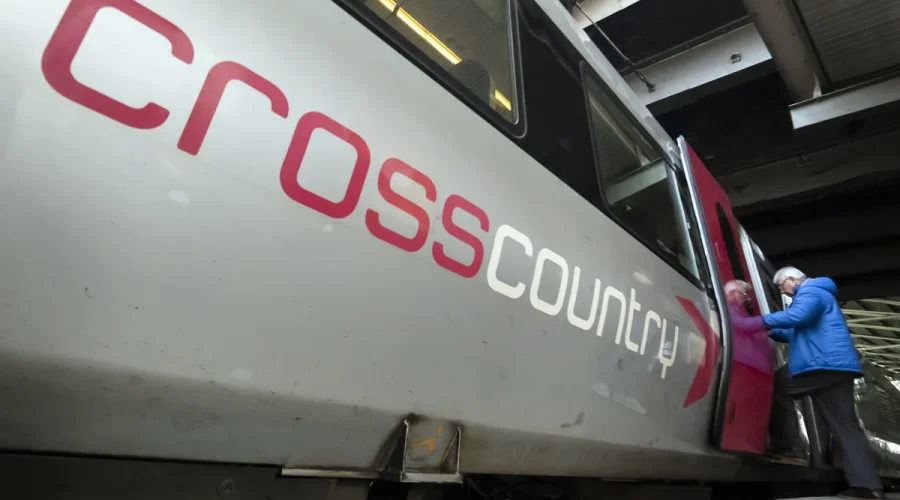
Traveloasisspot.com – A Saturday-evening electricity outage in Birmingham rippled through one of Britain’s longest-distance rail operators, wiping out the majority of CrossCountry’s timetable for an entire day and forcing millions of passengers to scramble for alternative routes. The disruption centred on the company’s operational control centre, which lost access to the digital systems that schedule, track, and authorise train movements across the network.
By Sunday evening, the operator confirmed that “almost all” of its services had been cancelled. Among the routes hit hardest were the Glasgow-to-Edinburgh corridor, the Manchester-to-Birmingham line, the Cheltenham-to-Cardiff service, and the Newcastle-to-Edinburgh connection — all of which carry heavy commuter and leisure traffic on weekends. A rail replacement bus service continued to operate between Leicester and Peterborough as originally planned, while a near-normal timetable persisted between Peterborough, Cambridge, and Stansted Airport, a segment the company attributed to the buffering effect of pre-scheduled engineering works.
Recovery Timeline and Limited Evening Services
CrossCountry announced that a “very limited” number of trains would attempt to run from approximately 6 pm on Sunday, concentrated primarily on routes heading toward Leicester and Derby. Full restoration of the timetable was projected for Monday, contingent on the reinstatement of critical control-room infrastructure.
“Our key priority is now to restore as close to a normal service as possible for our customers tomorrow. With most facilities now reinstated, we are planning to operate a very limited number of services from around 6pm this evening, primarily on routes towards Leicester and Derby. Planning is underway to support a full train service on Monday and we are working closely with National Grid and industry partners as recovery efforts continue. We would like to thank our customers for their patience and understanding during today’s disruption.”
The spokesperson’s remarks acknowledged that National Grid engineers were engaged in restoring supply to the affected site, though no specific timeline for full electrical restoration was disclosed.
Government Response and the Push Toward Public Ownership
Transport Secretary Heidi Alexander addressed the disruption directly, signalling both relief at the partial recovery and a broader political message about the future structure of Britain’s railways.
“Following earlier disruption on CrossCountry services, I am pleased to hear some trains are set to run tonight, and a full timetable expected to resume tomorrow. While passengers should continue to check their journeys before they travel, I’d like to thank engineers who are working tirelessly to minimise disruption as much as possible. We are setting up Great British Railways and nationalising services, including Cross Country next year, to end decades of fragmentation and vulnerability on our network. We are determined to give passengers the reliability they deserve.”
The reference to Great British Railways — the government’s announced successor body to the current patchwork of private operators — and the stated intention to bring CrossCountry into public ownership next year framed the outage as evidence of systemic fragility under the existing model. CrossCountry, owned by Spanish group Arriva, operates long-distance services across England, Scotland, and Wales, making its control centre a single point of failure for a geographically dispersed network.
Union Leaders Demand Structural Reform
The Rail, Maritime and Transport union, the largest rail workers’ organisation in the country, used the incident to press for a comprehensive overhaul of how operational control centres are designed and protected.
“We clearly need a full root and branch review of critical areas of railway operational control centres to ensure they remain unaffected by power outages.”
RMT general secretary Eddie Dempsey argued that passengers and staff should not be subjected to another week of “travel chaos” simply because back-up systems were inadequate. His comments echoed a long-running union critique that private operators have under-invested in resilience infrastructure.
Maryam Eslamdoust, general secretary of the Transport Salaried Staffs Association, went further, attributing the failure directly to corporate cost-cutting.
“Our rail infrastructure has been left creaking by years of underinvestment by private train operating companies. This has allowed total failures like the complete shutdown of the CrossCountry due to Arriva’s failure to invest in failsafe systems to protect their control centre. We need full public ownership immediately and a plan for the vital investment our transport system needs to meet Britain’s growing needs.”
Passengers Stranded: A Weekend Football Trip Ruined
On social media, ticket-holders described the Sunday cancellations as “very frustrating,” and CrossCountry responded to numerous posts on X, offering apologies and suggesting alternative routings. One affected passenger illustrated the personal cost of the outage.
Jeff Prestridge, a semi-retired editor based in Wokingham, Berkshire, had booked a journey through Trainline to attend a West Bromwich Albion match against Burnley at the club’s West Midlands stadium. A season-ticket holder for more than thirty years, Prestridge had planned to arrive before the 12 pm kick-off.
“I woke up this morning to see a kindly message from Trainline, who I booked through, to tell me that the service had been cancelled. I then received another email, subsequent to that, telling me that the return trip was cancelled also. I looked at going to Reading via a service up to Birmingham from there, but I wouldn’t have got there till half-time so, sadly, I’m still in Wokingham.”
Prestridge added: “It’s so frustrating because, you know, CrossCountry, that service is substandard. It truly is.”
Broader Context: Single-Point-of-Failure Risks on the UK Network
The Birmingham outage exposed a vulnerability that rail-safety analysts have flagged for years: the concentration of signalling, scheduling, and customer-information functions in a single physical location. When that location loses power and lacks sufficiently independent backup generation or redundant data-centre links, the entire downstream timetable can collapse within hours. For an operator whose routes span from Scotland to South Wales, the operational blast radius of one control-room failure is correspondingly vast.
The incident also lands amid ongoing industrial relations tensions, planned engineering programmes, and a government transition programme that will see multiple private operators absorbed into a single public entity over the coming years. Whether the promised investment in resilience infrastructure materialises under public ownership, or whether the same single-point-of-failure architecture persists under a new name, remains the central question the disruption has sharpened for passengers, unions, and regulators alike.
Related Reading
Frequently Asked Questions
What is CrossCountry expects return to full service?
CrossCountry expects return to full service is the main topic of this guide. The article explains the context, practical details, and next steps readers should understand.
Why does CrossCountry expects return to full service matter?
CrossCountry expects return to full service matters because readers are looking for a useful answer, not just a short summary. Good content should match search intent and help them decide what to do next.