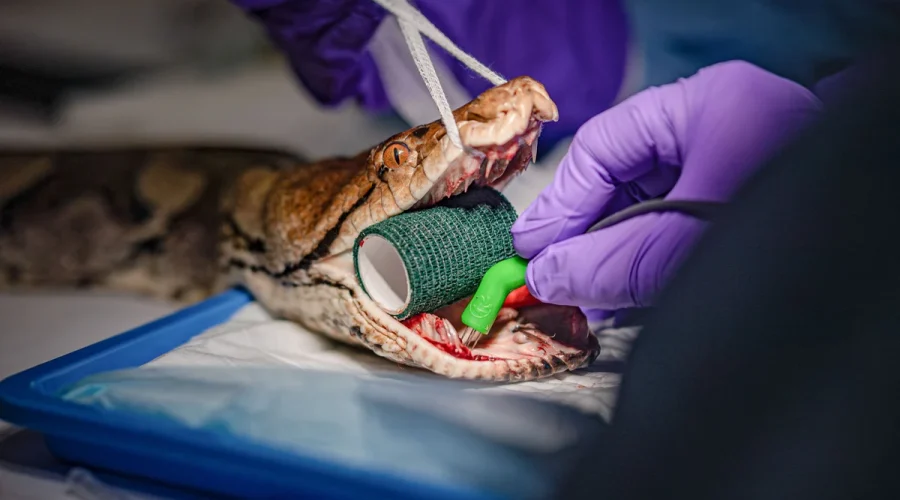
When a Python’s Jawbone Became a Test Case for Human Oncology
Traveloasisspot.com – Veterinary oncology has long trailed behind human medicine, borrowing techniques decades after they reach clinical use in people. That gap may be narrowing faster than expected. At Chester Zoo in Cheshire, a 23-year-old reticulated python weighing roughly 40 kilograms has become what clinicians believe is the very first snake to receive electrochemotherapy — a cancer-fighting protocol developed for human patients. The procedure, carried out in 2024, targeted a malignant fibrosarcoma growing on the reptile’s jawbone, and the outcome has drawn attention from specialists across the field.
A Name Born from a Bureaucratic Coincidence
The python, now 15 feet long, arrived at the zoo approximately two decades ago. Staff reviewing her intake paperwork noticed the initials “JF” — shorthand for “juvenile female” — and, spotting a resemblance to the Oscar-winning actress Jodie Foster, gave her the name. Two decades later, that same animal became the subject of a procedure no one had attempted on a snake before.
The warning signs were subtle. Keepers observed that Jodie was eating less than usual, a behavioural shift that in a large constrictor can indicate pain or difficulty processing food. A veterinary examination revealed a fibrosarcoma, a malignant tumour, anchored to her jawbone. Without intervention, the growing mass would have progressively restricted her ability to feed, a slow and ultimately fatal decline for an animal of her size and age.
Adapting a Human Protocol for a Reptile
Ian Ashpole, the zoo’s veterinary officer, explained the stakes plainly:
“We were facing the possibility of losing her as the tumour made it more and more difficult for her to eat, so we worked with cancer specialists to see whether we could adapt electrochemotherapy for a snake. As far as we’re aware, this is the first time it’s ever been used in one.”
Electrochemotherapy pairs the anticancer agent bleomycin with precisely calibrated electrical pulses applied directly at the tumour site. The pulses temporarily disrupt cell membranes, allowing the drug to penetrate cancer cells far more efficiently than it would through passive diffusion alone. The practical consequence is that lower total doses of bleomycin can achieve therapeutic effect, reducing systemic toxicity — a critical consideration when the patient is a 40-kilogram reptile whose physiology differs markedly from that of a mammal.
Logistics of Operating on a 15-Foot Patient
The surgical environment had to be engineered around the animal’s scale. Jodie was anaesthetised within her own habitat before being transported to the zoo’s veterinary centre. Because standard operating tables could not accommodate her length, staff joined two tables end-to-end, creating a workspace roughly the dimensions of a double bed. Heated blankets and a stream of warmed air maintained her body temperature throughout the procedure, a necessity given that reptiles rely heavily on external thermal input to sustain metabolic function under anaesthesia.
The operation lasted approximately 90 minutes. Surgeons excised the tumour along with a segment of the affected jawbone. Following removal, the electrochemotherapy protocol was administered at the surgical site to target residual microscopic cancer cells that imaging could not reliably exclude.
Recovery and the Broader Scientific Implication
Post-operative checks conducted in the weeks following surgery found no evidence of tumour recurrence. Jodie’s appetite has returned to baseline levels, and the zoo has released footage showing her consuming an entire chicken — a behaviour made possible by the python’s unique ability to unhinge its jaw and swallow prey larger than its own head. That anatomical capacity, Ashpole confirmed, was not compromised by the jawbone resection.
“Seeing her back to her normal bright and feisty self has been incredibly rewarding. A few months ago, we genuinely didn’t know whether she’d survive. Now she’s eating normally, exploring her habitat and behaving exactly as we’d hope. It also shows how much veterinary medicine is advancing. By bringing together zoo vets and cancer specialists, we’ve been able to use a treatment developed for people to save an animal in a way that’s never been done before.”
The collaboration extended beyond the zoo’s own veterinary team. Jose Alvarez Picornell, based in the University of Liverpool’s department of small animal clinical science, contributed oncological expertise to the case. He noted that the full procedural details would be formally published in peer-reviewed literature, enabling veterinary practitioners worldwide to study the protocol and adapt it where appropriate.
“This has been a very special career highlight for me, and a fantastic opportunity to expand the work we do within the department to support high-quality veterinary and translational research.”
Why This Case Matters Beyond One Snake
The significance of Jodie’s treatment extends well past a single zoo enclosure. Electrochemotherapy is already an established option in human oncology, particularly for soft-tissue sarcomas and skin cancers where complete surgical excision carries unacceptable morbidity. Translating that approach to a non-mammalian species required solving problems of anaesthetic depth, thermoregulation, drug pharmacokinetics in a cold-blooded organism, and the precise calibration of electrical pulses to tissue with different conductivity than human skin and muscle. Success in a 40-kilogram python suggests the protocol’s flexibility and opens a pathway toward treating neoplastic disease in other large reptiles — species for which oncological options have historically been limited to surgery alone.
For the broader veterinary community, the case also underscores a structural reality: zoo and wildlife medicine increasingly depends on translational partnerships with human cancer centres. The knowledge flows in both directions. Techniques refined in human oncology find new applications in exotic species, while the unusual biology of those species can, in turn, illuminate questions about tumour microenvironment and drug delivery that remain unresolved in human medicine.
Jodie, for her part, has returned to her habitat at Chester Zoo, feeding normally and displaying the active, curious behaviour her keepers associate with a healthy adult python. The fibrosarcoma that once threatened to silence her appetite has, as of the most recent veterinary assessment, shown no signs of returning. Whether the next chapter of her story involves further oncological challenges or simply the quiet routine of a 23-year-old constrictor in a managed enclosure, the veterinary team’s intervention has already rewritten what was considered possible for her species.
Related Reading
Frequently Asked Questions
What is Snake believed to be first?
Snake believed to be first is the main topic of this guide. The article explains the context, practical details, and next steps readers should understand.
Why does Snake believed to be first matter?
Snake believed to be first matters because readers are looking for a useful answer, not just a short summary. Good content should match search intent and help them decide what to do next.