
London’s Underrated Neighborhoods: Where Quality Living Meets Smart Investment
Best value spots to buy a London – Buyers seeking both tranquility and connectivity are increasingly turning to overlooked London neighborhoods that offer exceptional value. Ruth Bloomfield explores these hidden gems where residents enjoy peaceful surroundings without sacrificing urban convenience.
Purley: Croydon’s Sophisticated Counterpart
Located approximately 13 miles from central London, Purley represents the more refined side of the Croydon borough. Its relative affordability stems largely from its distance from the city center, yet residents benefit from outstanding commuter connections. Trains to either London Bridge or Victoria stations take roughly 25 minutes, making daily travel manageable for professionals working in central locations.
During the early pandemic period, Dan and Molly Stevenson joined the growing movement toward suburban living. The couple, along with their chow chow named Bear, were residing in a three-bedroom flat in Brixton when they decided to pursue more space. “We wanted somewhere greener, we wanted a house and a better quality of life,” Dan explained, reflecting on their decision to relocate.
Molly, now 31, is employed by a property technology startup headquartered in Shoreditch. She sought a workable commute, and her current journey takes under an hour—only marginally longer than her previous south London route. The financial mathematics were compelling: Brixton properties meeting their requirements would have cost approximately £1.2 million. Instead, the couple purchased a four-bedroom Edwardian home in Purley for £675,000.
“It is too big for just the two of us but it means that we won’t have to move again if we have a family,” Dan noted, emphasizing their forward-thinking approach to housing.
Education prospects also factored into their decision. Molly and Dan researched local schools thoroughly and found that nearly all institutions held good or outstanding Ofsted ratings. The highly sought-after grammar schools in Wallington remained conveniently accessible as well.
Hidden Value Across London
A comprehensive study conducted by estate agency Savills has identified neighborhoods where property values lag significantly behind neighboring areas. The research pinpointed locations where local house prices sit at least 20 percent below comparable properties in adjacent districts. Savills characterizes these zones as pockets of “hidden value” within an increasingly expensive capital city.
“They look underpriced relative to potential, pointing to where future growth has the greatest scope to catch up,” the agency observed in its analysis. This assessment suggests that these neighborhoods offer investors and homeowners alike substantial opportunities for capital appreciation.
Purley’s Property Landscape
According to Savills data, the average house price in Purley stands at £486,000—a figure that masks considerable diversity in both property types and pricing tiers. At the premium end, the Webb Estate encompasses a 260-acre private conservation area featuring expansive gated residences along tree-lined streets, with valuations reaching up to £3 million.
More modest options abound as well. Prospective buyers can acquire a three-bedroom semi-detached property from the 1930s or a period terrace in the town center for approximately £500,000. Two-bedroom flats, whether modern or period properties, typically command around £350,000.
Despite some mild snobbery stemming from Purley’s proximity to Croydon, Dan—who serves as director of Haboodle estate agents—argues that the area shares more characteristics with Surrey than with its neighbor. “There are lots of beautiful walks, if you are a dog owner it is amazing, and there are lots of beautiful places to go for a pub lunch, like Botley Hill Farmhouse and the Rambler’s Rest,” he remarked.
While acknowledging that the high street “could be better,” Dan highlighted upcoming improvements, including a new Marks & Spencer store and a leisure center currently under construction.
The Isle of Dogs: Rugby and Riverside Living
Rachel Beech’s connection to the Isle of Dogs began nearly two decades ago through her passion for rugby. After establishing a women’s rugby club, she encountered difficulties securing a suitable playing venue. A club member suggested Millwall Rugby Club, which agreed to host her team. The squad, still active today, carries the name Millwall Venus.
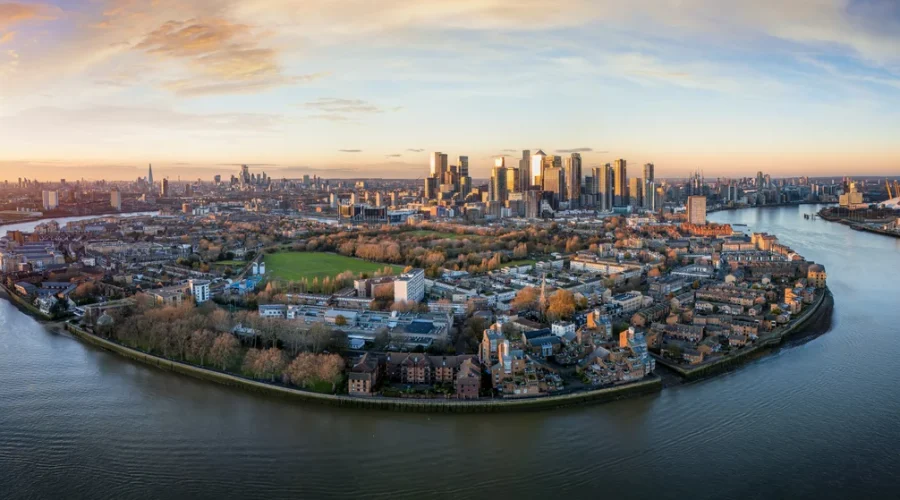
Beech, now 45, relocated to the area to remain close to the club. She subsequently met her husband there, and twenty years later she remains committed to the neighborhood. When she first arrived she found there was a distinct character to the island—sheep and donkeys grazing peacefully beneath towering skyscrapers at the local city farm. Situated on a peninsula along the north bank of the River Thames, the Isle of Dogs lies just 1.5 miles from Canary Wharf yet feels worlds apart.
With water bordering three sides, through traffic remains minimal, creating an atmosphere of calm. “It is incredibly quiet for central London,” Beech affirmed. Transport connections, however, prove excellent for those needing to venture beyond the island. Savills’ research confirms that the Isle of Dogs—once considered the less glamorous sibling to Canary Wharf—has emerged as one of London’s most compelling value propositions for homebuyers.
“They look underpriced relative to potential, pointing to where future growth has the greatest scope to catch up,” Savills stated in its findings.