Argentina’s Falklands Banner Sparks Debate Following England Victory
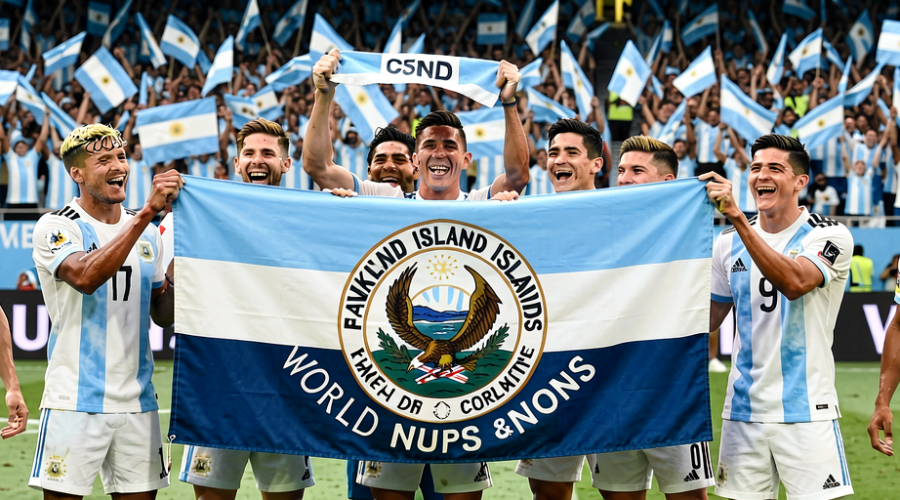
Argentina players brandish controversial Falkland Islands – Argentina’s national football team has drawn international attention after displaying a politically charged banner celebrating their claim to the Falkland Islands. The gesture came during their semi-final clash against England, a match that ended with a dramatic 2-1 victory for the South American side after they overturned a deficit in stoppage time.
The banner, held aloft by several squad members including Lisandro Martinez and Giovanni Lo Celso, bore the inscription “Las Malvinas son Argentinas.” This phrase translates directly to “The Falkland Islands belong to Argentina,” serving as a bold statement of territorial sovereignty that resonates deeply with Argentine national identity.
A Historical Dispute Rekindled
The Falkland Islands remain one of the most enduring colonial disputes of the modern era. Argentina launched an invasion of the archipelago in 1982, an action that precipitated a brief but intense military conflict with the United Kingdom. While British forces successfully repelled the invasion and reasserted control, Buenos Aires has never relinquished its territorial claims to the islands.
The human cost of that conflict was substantial. Official records indicate that 649 Argentine military personnel perished during the war, alongside 255 British servicemen. Three civilians from the Falkland Islands also lost their lives in the fighting. These numbers continue to be commemorated annually in Argentina as part of the nation’s collective memory.
Security Concerns and Fan Tensions
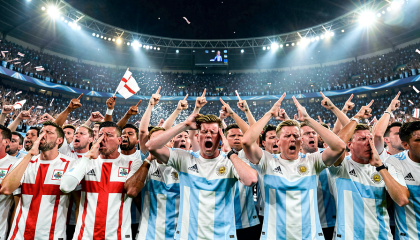
The Atlanta venue witnessed heightened security measures throughout the tournament, with officials implementing the strictest protocols to date due to anticipated disturbances between supporters. These concerns proved well-founded, as altercations erupted between fans following the final whistle. Multiple arrests were conducted in the vicinity of the stadium as authorities worked to restore order.
The political dimension of the match extended beyond the pitch. Argentina’s squad was captured in the dressing room after their quarter-final triumph over Switzerland, singing a song that referenced Lionel Messi, Diego Maradona, and “the Malvinas.” This recording, subsequently shared across the team’s social media platforms, demonstrated how football and national identity remain intertwined in Argentine culture.
Chants and Celebrations
During their semi-final celebrations, the Argentine players were overheard chanting: “Por Malvinas, por el Diego, por la ultima de Leo.” This rallying cry translates to “For the Malvinas, for Diego, for Leo’s last one,” referring to what many consider Lionel Messi’s final World Cup tournament.
Supporters outside the stadium joined in with their own refrain. As fans bounced rhythmically, they sang “Y ya lo ve, y ya lo ve,” before adding “El que no salta, Es un ingles!” This translates to “And now you see, and now you see, whoever doesn’t jump is English!” The chant playfully targeted English supporters while reinforcing Argentine solidarity.
FIFA Regulations and Potential Consequences
The banner display could potentially place Argentina in conflict with FIFA’s regulations. The governing body maintains strict guidelines prohibiting teams from using matches as platforms for political messaging. While sporting events have historically provided opportunities for diplomatic expression, FIFA has increasingly emphasized the separation of football from political statements.
A Deep-Rooted Connection
The Falklands War occupies a prominent position in Argentine patriotism, and its relationship with football runs particularly deep. The conflict occurred on either side of Argentina’s two World Cup triumphs, with victories in 1978 and 1986. When Argentina defeated England in the 1986 quarter-finals en route to lifting the trophy in Mexico, Diego Maradona dedicated his controversial “Hand of God” goal to the Argentine soldiers who had fallen during the Falklands War.
This historical connection ensures that every encounter between Argentina and England carries additional weight beyond the sporting contest itself. The banner displayed in Atlanta serves as a reminder that football in Argentina is never merely about the game—it is about identity, history, and national pride.