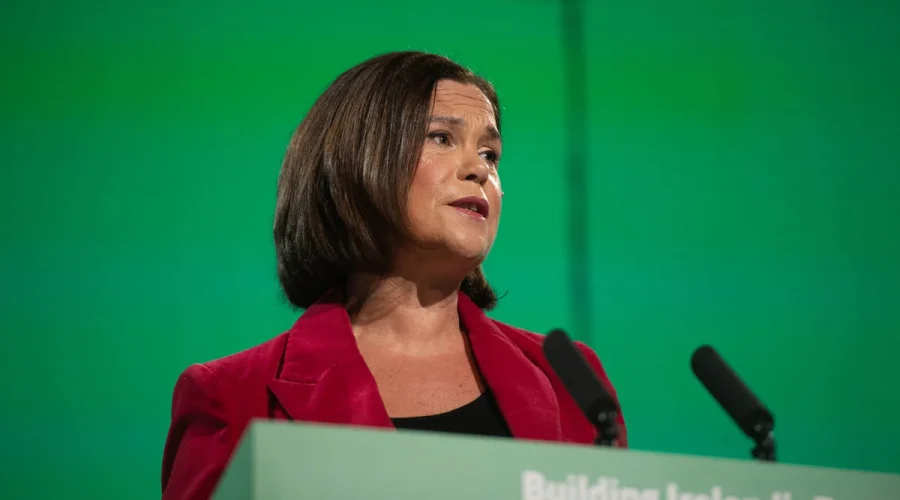
Mary Lou McDonald warns issue of Irish unity is ‘not going away’
Traveloasisspot.com – The debate over Irish unity intensified as Sinn Féin’s leader, Mary Lou McDonald, stressed that the topic would remain central to political discourse. She highlighted the urgency of the matter, insisting that the issue is persistent and will not be resolved easily. Meanwhile, Irish premier Micheál Martin dismissed a proposed unity Bill as “not credible,” expressing skepticism about its viability as a solution.
Proposal for Green Paper and Citizens’ Assembly
Mary Lou McDonald introduced legislation that mandates the publication of a Green Paper on Irish unity within 18 months. This document would serve as a foundational step, laying out key considerations for the reunification process. The Bill also calls for the establishment of a Citizens’ Assembly, aimed at gathering public input and shaping the future of the island. McDonald framed this initiative as a necessary move to “write the next chapter” of Irish history, emphasizing the need for a comprehensive approach to unification.
Despite the Sinn Féin-led proposal, the Irish Government has announced its opposition to the Planning for Constitutional Change Bill. The vote, scheduled for Wednesday, marks a pivotal moment in the ongoing discussion. Sinn Féin described the government’s stance as a “political test” for coalition parties, suggesting it reflects deeper ideological divides. Tánaiste and Fine Gael leader Simon Harris acknowledged the sincerity of McDonald’s efforts but cautioned that constitutional reform cannot be rushed. He argued that deadlines and arbitrary timelines would undermine the progress made through decades of peace agreements.
Historical Context and Criticism of the Bill
McDonald asserted that the time is ripe for a new deal that unites all people of Ireland, including Protestants and unionists. In her address, she underscored the importance of creating a framework that respects British identity while addressing historical grievances. “Reunification is about more than just removing the border,” she stated. “It’s about ensuring inclusion, real ownership, and a stake in the future for every citizen.”
“Listening to the speeches across the chamber today and talking to colleagues, to be honest, the only conclusion I can arrive at is that we wouldn’t even have a division tonight except for the views of one man,” said Sinn Féin TD Donnchadh Ó Laoghaire. He accused Micheál Martin of delivering a “familiar, hackneyed, un-serious” response, arguing that the government was failing to take proactive steps toward unification.
McDonald also warned that the government was underestimating public sentiment on the issue. “People are more aware of the challenges and opportunities than you realize,” she emphasized. This sentiment was echoed by Martin, who criticized the Bill for setting unrealistic timelines. “The approach of ‘one more push’ or ‘demography is destiny’ has consistently failed over the past century,” he remarked. He argued that the Bill’s demand for rapid progress overlooks the complexity of historical and cultural divisions.
During the debate, Martin challenged the idea that a single policy statement could drive constitutional change. “We need people to be open about the obstacles and the spirit of the peace agreement,” he said. “Otherwise, we’ll just be repeating the same rhetoric without substance.” His comments highlighted concerns that the Bill’s proposals might not address the deep-rooted issues of identity and legacy, which he described as “deepened” by sectarian violence and political neglect.
Political Dynamics and By-Election Bid
The political landscape in Ireland has also seen other developments. For instance, Nigel Farage’s Conservative Party gained support in Clacton after his resignation triggered a by-election. This shift in the UK political scene was noted as a potential influence on the ongoing discussions about Irish unity. Meanwhile, London stocks experienced mixed performance, with technology sectors underperforming, though the FTSE 100 showed slight gains.
Further, the City of London faced a reported incident of a man stabbing his ex-partner on a city street, marking a tense moment in the capital. These events, while unrelated to the unity Bill, underscored the broader context of social and political dynamics in the UK and Ireland. Art After Dark, a cultural initiative, also announced an exciting lineup of events, highlighting the vibrant cultural scene amid political challenges.
Response to Historical Comparisons
McDonald’s stance was reinforced by Sinn Féin’s chief whip, who drew a parallel between Micheál Martin’s current position and past leaders. “He’s no Albert Reynolds and no Bertie Ahern,” the whip remarked, invoking the words of Charles Stewart Parnell. “No man has a right to fix the boundary of the march of a nation,” Parnell’s quote was used to challenge Martin’s dismissal of the unity Bill, suggesting that the government’s reluctance might hinder progress.
Ó Laoghaire took the opportunity to question the government’s commitment, asking Martin to reflect on the implications of his stance. “Where is your plan for constitutional change?” he demanded, implying that the opposition’s lack of a clear strategy leaves the door open for further debate. The Irish Government, after a Fianna Fáil TD raised concerns about a free vote on the matter, confirmed its position to oppose the Bill. This decision reflects the coalition’s cautious approach, prioritizing stability over rapid unification.
McDonald, undeterred by the government’s opposition, reiterated her call for support of the legislation. She argued that the Bill represents a vital step in addressing the needs of all Irish people, regardless of their political leanings. “We must move beyond slogans and expectations,” she said. “A real conversation about the future requires concrete steps, not just empty promises.”
As the debate progresses, the challenge remains to balance the aspirations of unification with the realities of political and social division. McDonald’s vision of a united Ireland, with inclusive policies and shared ownership, contrasts sharply with Martin’s emphasis on pragmatic timelines and historical precedents. The outcome of Wednesday’s vote will likely shape the trajectory of this critical discussion, determining whether the path to Irish unity gains momentum or continues to face resistance.