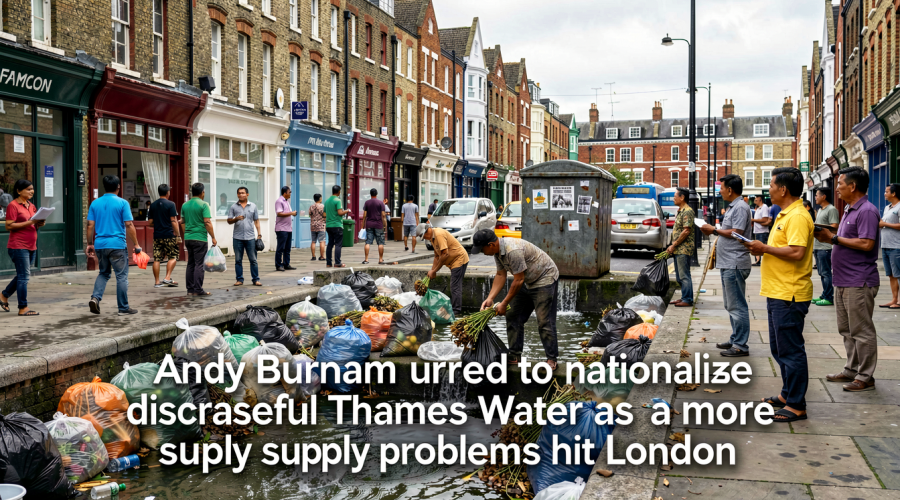
Burnham Under Pressure to Bring Thames Water Under Public Ownership Amid Supply Crisis
Traveloasisspot.com – Andy Burnham is encountering mounting demands to move quickly on nationalising Thames Water as he prepares to assume the role of Prime Minister on Monday. The incoming leader has consistently expressed his desire for enhanced public oversight of utilities, particularly water and energy sectors, and has indicated his preference for direct government ownership of the heavily indebted Thames Water company.
Following additional water supply disruptions affecting London households, Rupa Huq, the Labour Member of Parliament for Ealing Central and Acton, called on Burnham to accelerate his nationalisation plans. On Saturday, she took to social media platform X to voice her frustration with the utility provider’s ongoing failures.
Hey @thameswater last week it was W3, W4 and W12 residents up the spout. Today you are punishing W5, W13 and W7 and leaving us with no running water. You’re a disgrace and the sooner @andyburnham nationalises you the better.
The prospect of bringing Thames Water into public ownership presents a significant financial consideration for taxpayers. Estimates suggest the move could require billions of pounds in public investment, highlighting the complex challenges Burnham faces in translating his ambitious campaign promises into practical policy outcomes.
Political Responses and Government Options
Lucy Powell, Labour’s Deputy Leader and Member of Parliament for Manchester Central, offered a measured response when questioned about potential nationalisation. Speaking on Sky News’ Sunday Morning with Trevor Phillips, she indicated that while the government possesses authority to place struggling water companies under special measures, further assessment is needed.
Well, look, let’s see. This has been an ongoing issue and concern in Government. The Government has powers to bring a distressed water company under special measures, and let’s see if the Government needs to, want to use those powers.
Powell emphasised that the privatisation model for water services has failed to deliver competitive pricing or adequate service levels. She noted that customer bills have risen continuously while water companies have accumulated substantial profits, potentially leaving taxpayers to cover future failures.
Thames Water’s Financial Position and Customer Impact
As Britain’s largest water utility, Thames Water serves approximately 16 million customers throughout London and the South East region. The company has been operating under a £20 billion debt burden, raising concerns about its long-term viability without intervention.
Company executives have requested urgent clarification from Burnham regarding his sector plans, warning that Thames Water could exhaust its cash reserves within months without a funding agreement. Reports suggest the firm may enter a special administration regime (SAR), a mechanism designed to maintain service continuity while identifying potential buyers or investors.
Mike McTighe, an experienced City turnaround specialist collaborating with 100 creditors, expressed readiness to support the company’s financial restructuring. He stated that creditors remain willing to discuss enhanced public control arrangements while pursuing a path toward investment-grade status.
We remain ready and willing to recapitalise Thames Water, return it to investment grade, and begin the long process of turning it around. We urgently need Government engagement to begin that process.
Management Compensation Controversy
Customer frustration has intensified following revelations about executive compensation at Thames Water. Despite implementing a 40% increase in customer bills, the company distributed over £4 million in bonuses and raised its chief executive’s remuneration to £1.2 million.
The annual report disclosed that £4.09 million in bonuses were awarded to key management personnel under the company’s management retention plan. These payments, distributed to board members and senior executives for the year ending March 31, represented an increase from £2.8 million the previous year and included both performance-related and retention awards.
Chief executive Chris Weston’s total compensation increased to £1.16 million for the year to March 31, rising from £1.04 million in the 2024-45 period, following a £99,000 deferred retention payment from the prior year.
Service Restoration and Ongoing Challenges
Thames Water issued a statement to households in the Mountfield Road area of Ealing, west London, confirming that repairs to the damaged water main had been completed and supplies fully restored. The company apologised for the disruption and thanked residents for their patience during the repair process.
While creditors have indicated openness to public control discussions, it remains uncertain whether government ministers will view the latest proposals as sufficiently viable. The situation underscores the delicate balance Burnham must strike between addressing immediate service failures and implementing structural reforms that benefit both consumers and the broader economy.
As the new Prime Minister prepares to take office, the Thames Water situation exemplifies the broader challenges facing the Labour government in delivering on its commitments while managing complex financial and operational realities across multiple sectors.