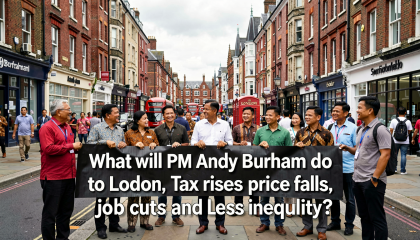
London Business Leaders Call for Caution as Burnham’s Economic Vision Takes Shape
Traveloasisspot.com – Business executives across the capital have issued a collective plea to Andy Burnham, cautioning against policies that could inadvertently damage London’s economic standing. As the anticipated successor to the Prime Minister’s office, Burnham is preparing to implement sweeping changes designed to redistribute wealth and opportunity throughout Britain’s regions. These reforms, however, have sparked concerns among London’s commercial community that the capital may bear disproportionate costs during this national rebalancing effort.
The former Greater Manchester Mayor has positioned himself as a champion of regional development, promising to direct billions in additional public expenditure toward areas outside the capital. This ambitious agenda has prompted Sir Sadiq Khan, the Mayor of London, to voice his own reservations about potential reductions in investment flowing to the capital. Meanwhile, Burnham has attempted to reassure Londoners by highlighting how his policies could benefit the city, particularly through measures aimed at moderating the upward trajectory of residential property values by curbing migration patterns into the capital.
Concerns Over Funding and Taxation
Despite outlining numerous initiatives, Burnham has remained somewhat vague regarding the financial mechanisms that will support his proposals. This ambiguity has generated anxiety among business leaders who fear a fresh wave of taxation could emerge to fund these commitments. Of particular concern is Burnham’s earlier endorsement of a comprehensive property tax system that would supplant both council tax and stamp duty—a transformation estimated to impose an additional £7.5 billion annual burden on London’s economy.
Karim Fatehi, who serves as chief executive of the London Chamber of Commerce and Industry, acknowledged the merit in Burnham’s vision while emphasizing the need for balanced decision-making. “Andy Burnham is right that Britain needs growth in every postcode,” Fatehi observed. “London is the world’s greatest capital city, and we know that when London’s economy grows, the whole country benefits.” He went on to stress that “it is vital the new Prime Minister does not make policy and funding decisions for political reasons that harm the capital.”
The LCCI’s Ten-Point Blueprint
In anticipation of Burnham’s potential assumption of the premiership on July 20, pending any unexpected developments in the Labour leadership contest, the LCCI has unveiled a comprehensive ten-point strategy designed to safeguard and enhance London’s competitive position. The first pillar of this proposal commits to maintaining current levels of taxation, regulatory requirements, and employment-related expenses for businesses operating within the capital.
Another critical element involves reversing Chancellor Rachel Reeves’ decision to increase National Insurance contributions by £20 billion for employers—an adjustment that has been widely attributed to negative impacts on commercial enterprises, high street retailers, and the broader national economy. The plan also calls for substantial modifications to business rates, including reducing the multiplier to a minimum of 45 pence, while acknowledging that existing thresholds fail to adequately account for London’s elevated property valuations.
Infrastructure and Innovation Priorities
The LCCI’s recommendations extend beyond fiscal matters to encompass infrastructure development and technological advancement. One proposal designates King’s Cross as a dedicated AI Investment Zone, aiming to establish regulatory frameworks and market conditions that would position the Elizabeth Line technology corridor as Europe’s premier destination for next-generation artificial intelligence investment, thereby generating thousands of high-skilled employment opportunities.
Transport infrastructure receives equal attention, with the plan advocating for expanded capacity at Heathrow, Gatwick, and Luton airports, alongside extensions to both the Bakerloo Line and the Docklands Light Railway. Additionally, the proposal recommends eliminating what it terms a “tourism tax” by reinstating VAT-free shopping privileges and modifying the non-domestic tax system, positioning London as the preferred destination for international visitors, capital investment, and global talent.
Broader Economic Reforms
Further recommendations address housing development through streamlining the planning system, fostering a “pragmatic” relationship with the European Union to facilitate skilled worker mobility and cross-border commercial operations, and strengthening enforcement against business crime through improved funding allocations for the Metropolitan Police. The plan also calls for prompt implementation of findings from the Milburn Review concerning individuals excluded from education, employment, or training programs, with particular attention to reducing recruitment costs for younger workers.
Mr. Fatehi concluded by noting that “firms across London have been left bruised from recent tax increases and an unsustainable increase in the cost of doing business.” He emphasized that businesses require “certainty, stability, and a clear plan for growth,” asserting that the priorities outlined by the LCCI would not only stimulate London’s expansion but also contribute to national prosperity and economic development.