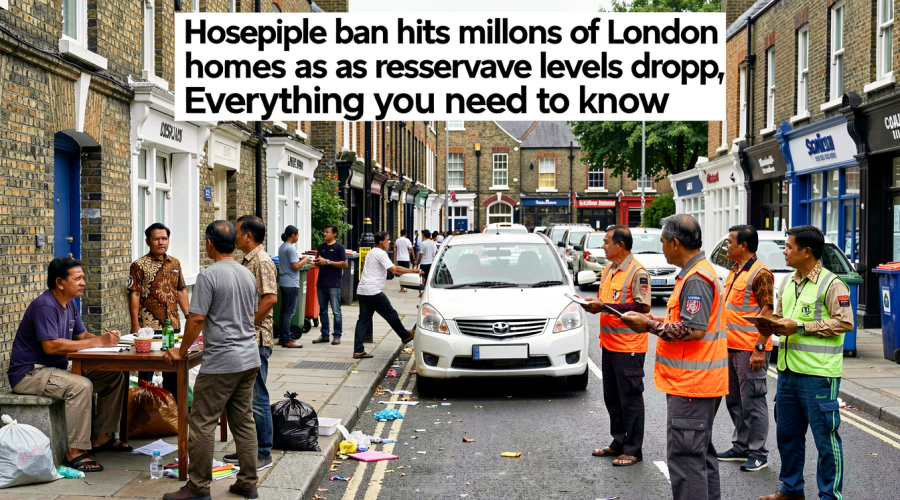
Hosepipe ban hits millions of London: Millions Face Water Restrictions as Thames Water Implements Hosepipe Ban Traveloasisspot.com – A significant water
Millions Face Water Restrictions as Thames Water Implements Hosepipe Ban
Traveloasisspot.com – A significant water conservation measure has officially begun affecting approximately ten million households and commercial establishments throughout London and the surrounding South East region. The Temporary Use Ban, commonly referred to as the TUB, was activated precisely at 00.01am on Thursday morning by Thames Water, the primary water utility serving the area.
This comprehensive restriction was formally communicated through an official statement published on the utility company’s website. The announcement clarified that the temporary hosepipe ban specifically targets customers receiving their primary water supply from Thames Water. Importantly, the regulation does not extend to those who receive only wastewater services from the same provider, though individual water suppliers may maintain their own separate limitations.
Company representatives emphasized that this decision was not made hastily, describing it as a measure they are not taking lightly given the circumstances. The primary drivers behind this intervention include extended periods of dry conditions combined with intense heatwaves, alongside water consumption rates that have exceeded typical expectations. Additionally, forecasted rainfall has failed to materialize as anticipated, further straining available resources.
Usage Patterns and Regional Impact
Current consumption data reveals that water usage stands approximately ten percent above normal levels within the Thames Valley and the Home Counties region. Meanwhile, London itself is experiencing seven percent higher than average demand. These elevated figures translate to customers utilizing an additional one hundred million litres of water each day compared to standard patterns.
Government officials have reported that twenty-three million residents across England are either currently subject to or approaching water restrictions. These limitations arrive during a period of sustained high temperatures that followed three remarkable heatwaves occurring within a single three-month span. The situation is further complicated by what has been recorded as the driest spring season in England and Wales history.
The combination of hot weather is accelerating pressure on water resources through multiple channels. Residents are consuming more water to remain cool, gardeners are watering plants more frequently, agricultural operations are sustaining crops, and infrastructure protection measures are being implemented to prevent damage.
Environmental Conditions and Reservoir Status
The Environment Agency has officially declared prolonged dry weather conditions across eight distinct regions: East Anglia, the West Midlands, Devon, Cornwall, Lincolnshire, Northamptonshire, Hertfordshire and London, Wessex, Thames, Solent, and the South Downs. These eight areas now sit just one stage away from achieving official drought status.
Regarding reservoir capacity, six facilities have been classified as having notably low water levels. These include Wimbleball in Somerset, Grafham in Cambridgeshire, and Hanningfield in Essex. River conditions are similarly concerning, with only thirteen percent of waterways classified at normal levels for this time of year. The Avon in Hampshire, the Cam, the Derwent in Yorkshire, the Swale, the Tone, the Wye, and the Yare are all experiencing exceptionally low levels.
“We would not be taking this step unless it was necessary to protect water supplies for everyone and the environment,” explained Nevil Muncaster, director of strategic water resources at Thames Water.
“While there is enough water for essential use, we need to reduce non-essential outdoor demand to keep taps flowing. Many customers have already reduced their water use and that support has made a difference. Thank you to everyone who has already changed their daily habits.”
What Activities Are Restricted?
The current restrictions prohibit the use of hosepipes, sprinklers, and pressure washers for various non-essential outdoor activities. Specifically, the following uses are now limited:
- Cleaning a private motor-vehicle (and trailers) using a hosepipe
- Watering plants on domestic or other non-commercial premises using a hosepipe
- Cleaning a private leisure boat using a hosepipe
- Filling or maintaining a domestic swimming or paddling pool
- Drawing water, using a hosepipe, for domestic recreational use
- Filling or maintaining a domestic pond using a hosepipe
- Filling or maintaining an ornamental fountain
- Cleaning walls or windows of domestic premises using a hosepipe
- Cleaning paths or patios using a hosepipe
- Cleaning other artificial outdoor surfaces using a hosepipe
Residents are encouraged to utilize alternative methods such as watering cans, buckets, and water butts for their outdoor needs. Mr. Muncaster noted that Thames Water teams are operating around the clock to maintain water flow, repair leaks, and assist customers throughout this period.
Looking ahead, meteorological forecasts suggest that more extreme weather conditions may be approaching, with a fourth heatwave predicted for London next week. The capital has not experienced rainfall since June 27, though a weather pattern change is anticipated to bring precipitation to the wider UK this weekend. However, current projections indicate that London may miss out on this relief.
“We will keep the situation under close review and lift restrictions as soon as it is safe to do so,” Mr. Muncaster concluded, reassuring the public that the measures are temporary and will be adjusted based on evolving conditions.
Related SEO Topics
- Home
- Artikel terkait Hosepipe ban hits millions of London
- Arsenal FC: Leaked images of new Adidas away kit and release date as fans praise ‘absolutely incredible’ offer
- Christos Tzolis: Arsenal FC shirt number options as formalities completed for third summer signing
- Trainspotting The Musical: Woefully misconceived
- Tottenham 1-0 MK Dons: Mateus Fernandes marks debut with screamer as Spurs open pre-season with a win
Frequently Asked Questions
What is Hosepipe ban hits millions of London?
Hosepipe ban hits millions of London is the main topic covered in this article, with practical context to help readers understand the subject clearly.
Why does Hosepipe ban hits millions of London matter?
Hosepipe ban hits millions of London matters because it helps readers compare options, avoid common mistakes, and make a more informed decision.
How should readers use this Hosepipe ban hits millions of London guide?
Use the key points, examples, and related links in this page as a starting point, then review the latest details before making a final decision.