A Norman Treasure’s Royal Journey: From Shropshire Chapel to Gordonstoun and Back
Traveloasisspot.com – Within the quiet hamlet of Upton Cressett in Shropshire rests a remarkable piece of history that once embarked on an extraordinary voyage northward. This 12th-century Norman font, now housed once more in St Michael’s Church, completed a remarkable circuit that connected the English countryside with Scotland’s educational institutions during a pivotal period in British royal history.
The Font’s Unusual Migration
When Prince Charles began his education at Gordonstoun school in Moray in 1962, his father, Prince Philip, took a personal interest in ensuring the young prince would feel connected to England’s rich heritage. The Duke of Edinburgh arranged for this particular Norman font to be transported from its original home in Shropshire to the Scottish boarding school. His intention was clear: he wanted his son to be surrounded by ancient objects of English beauty during his formative years.
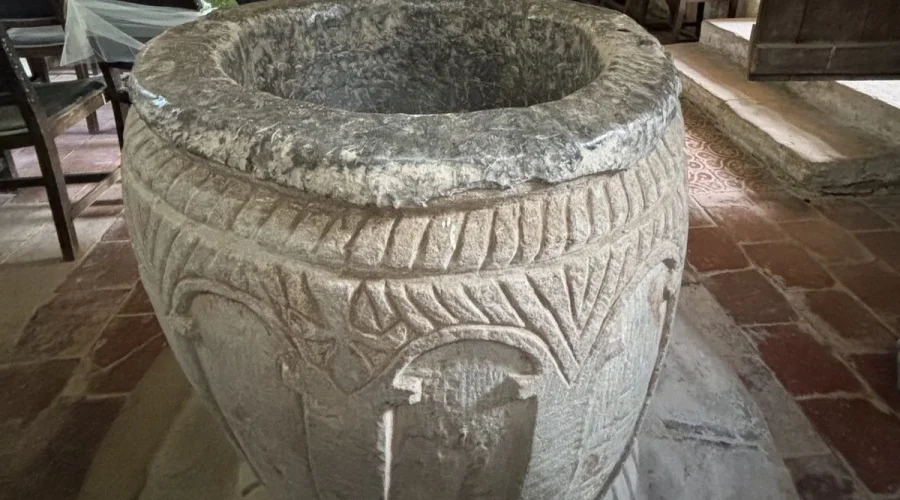
The font, which resembles a large stone barrel in shape, represents a classic example of Norman tub font design. Its exterior features ornate carvings that speak to the craftsmanship of the medieval period, while its interior is lined with lead, a practical feature that has helped preserve it through the centuries. The journey from Shropshire to Scotland was no small feat, given the font’s considerable size and weight.
Discovery and Conservation
The font’s rediscovery came through an unexpected connection. Prince Philip had been working alongside former MP Ivor Bulmer-Thomas on an initiative to protect historic church buildings that had fallen into disuse. During one of their visits to St Michael’s Church in the 1960s, Philip noticed the font sitting in what had become a neglected space.
St Michael’s had ceased regular services in 1958 and was described as being in a “terrible state.” The church had been selected specifically to demonstrate to Philip the plight of dilapidated country churches that desperately needed rescue. William Cash’s parents had relocated to the Upton Cressett estate, where the grade one listed church stands, during the 1970s, establishing a family connection to this historic building.
“They went to see it, and Prince Philip apparently said (of the font), ‘I think that would be really good if it was moved to Gordonstoun, because I want my son to be surrounded by ancient objects of English beauty’.”
Mr Bulmer-Thomas subsequently established the Redundant Churches Fund, an organization that would eventually evolve into the Churches Conservation Trust. Today, King Charles III serves as patron of this trust, maintaining a connection to the conservation movement that began with his father’s interest in preserving these architectural treasures.
Return to Its Roots
After spending several years in the modern chapel at Gordonstoun during Charles’s time there, the font made its way back to Upton Cressett in the 1970s. William Cash, one of the font’s current custodians, shared insights into this remarkable story with the Press Association. He recounted how the building had been locked when Philip visited, with its contents—including the font—scheduled for storage.
“I think Philip thought, ‘What a waste to have it just sitting in a storage unit’. It’s quite large – how they got it up to Gordonstoun I really do not know. This is a strange story that to this day most people don’t know about.”
While St Michael’s no longer conducts regular services, the font remains in active use. Mr Cash noted that he and other members of his family were baptized using this very font, creating a personal connection that spans generations. Visitors to the church today often express astonishment when they learn of the font’s royal associations, particularly given its remote location in what Mr Cash describes as “the middle of nowhere in Shropshire.”
An Arthurian Legacy
The font’s journey has earned it a place in local lore that feels almost mythical. Mr Cash reflected on how the experience of learning about the font’s history evokes a sense of wonder.
“Frankly they find it almost impossible to believe that this font has moved so many hundreds of miles for the King’s aesthetic benefit. It always feels like something out of an Arthurian legend, like this was a font that was fit for a king, a Norman font with roots going back pretty much to the age of William the Conqueror.”
Steve Tarling, a community officer at the Churches Conservation Trust, which now oversees St Michael’s, described the church as a picturesque, almost fairy-tale chapel. He noted that visitors often imagine characters from the Brothers Grimm tales having weddings within its walls. The community felt honored that Philip selected their font for his son, yet grateful that it eventually returned home.
“I think it would just miss something there without it. I think it completes the picture. It’s like the cherry on top of the cake.”
Today, this Norman font continues to serve as a tangible link between England’s medieval past and its modern monarchy, a piece of history that traveled hundreds of miles for the aesthetic pleasure of a young prince and returned to bless future generations with its presence.
Related Reading
Frequently Asked Questions
What is Like an Arthurian legend?
Like an Arthurian legend is the main topic of this guide. The article explains the context, practical details, and next steps readers should understand.
Why does Like an Arthurian legend matter?
Like an Arthurian legend matters because readers are looking for a useful answer, not just a short summary. Good content should match search intent and help them decide what to do next.