
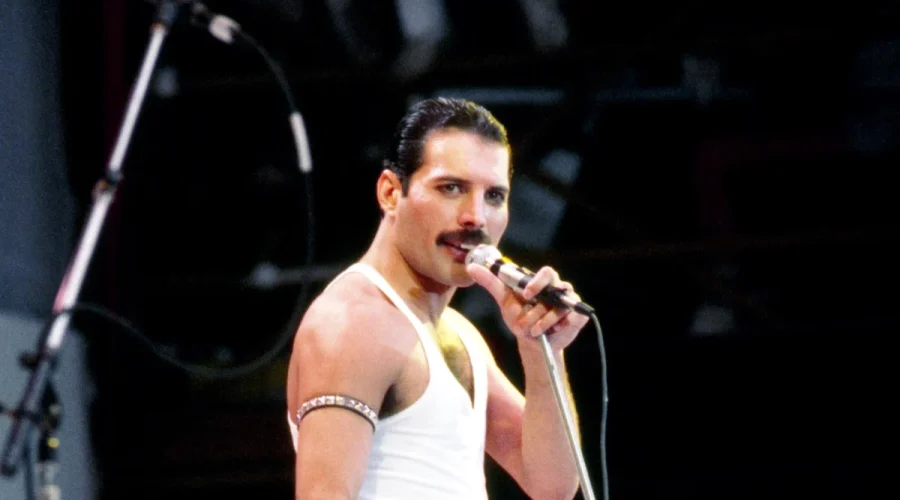
Freddie Mercury’s Munich Piano and Studio Microphone Head to Auction
Traveloasisspot.com – Two of the most tangible links to Freddie Mercury’s creative life — a grand piano and a studio microphone — are set to change hands at a two-day auction in October, carrying combined pre-sale estimates that could push well past half a million pounds. The items form part of an 82-lot archive assembled by Reinhold Mack, the German record producer behind much of Queen’s mid-1980s output, and his son Freddie Jr, who was Mercury’s only godson.
The collection represents the most significant Mercury-related material to reach the open market since the 2023 dispersal of the singer’s own personal effects. For collectors and fans who have followed the afterlife of Queen’s catalogue, the provenance here is particularly compelling: these are not replicas or later acquisitions but working instruments and documents that passed through Mercury’s hands during the height of his songwriting career.
The Yamaha C3 Grand Piano
At the centre of the archive sits a Yamaha C3 Grand Piano that resided in Munich’s Musicland Studios for decades. Mercury played the instrument extensively while composing both his solo material and several of Queen’s most enduring singles, among them “Crazy Little Thing Called Love.” The piano also featured during the sessions for three consecutive Queen studio albums: The Game, Hot Space, and The Works.
Musicland Studios was far from exclusive to Queen. Over the years the Yamaha C3 was played by a remarkable roster of visiting artists, including Leonard Cohen, The Rolling Stones, Deep Purple, Black Sabbath, Led Zeppelin, Donna Summer, and Bryan Ferry. That shared history adds a layer of cultural weight to the instrument beyond any single band’s association.
The piano carries a pre-sale estimate of £200,000 to £400,000, a figure that reflects both its musical significance and its rarity as a Mercury artefact with documented studio provenance.
The AKG C414 EB Microphone
Equally central to the collection is an AKG C414 EB condenser microphone, the specific unit Mack favoured for capturing Mercury’s lead and backing vocals at Musicland. Mack selected the microphone for its ability to render the full breadth of Mercury’s vocal range and the intricate layered harmonies that became a signature of the band’s production style. It saw continuous use throughout the producer’s tenure with Queen.
The microphone is offered together with its original Sennheiser carrying bag and the red XLR cable that ran from the mic to the console at Musicland Studios. Its pre-sale estimate stands at £40,000 to £80,000.
Handwritten Songwriting Drafts
Beyond the hardware, the archive includes early working lyrics penned by Mercury’s own hand for two tracks from his 1985 debut solo album, Mr. Bad Guy: “My Love Is Dangerous” and “Let’s Turn It On.” Both sets contain alternate lines and unused passages that diverge substantially from the versions that ultimately reached record, offering a rare window into the singer’s iterative compositional process.
The “My Love Is Dangerous” sheet is headed with the earlier working title “Dangerous” and carries handwritten chord arrangements on its reverse. The “Let’s Turn It On” draft appears under the shortened title “Turn It On.” The two lyric sets are estimated at £3,000 to £6,000 and £1,500 to £3,000 respectively.
A Teddy Bear and a Family Bond
Among the more personal lots is a teddy bear that Mercury presented to the Mack family. Its estimate sits at £800 to £1,600, but its sentimental value to the family clearly transcends any market figure.
Public Exhibition Before the Sale
Before the hammer falls, the items — along with several additional lots from the archive — will be displayed to the public at a free-to-enter exhibition held at The Cumberland Hotel in London from September 23 to 27, 2026. The showing gives fans and researchers a chance to examine the instruments and manuscripts up close before they are dispersed to private collections.
The auction itself, conducted by Propstore, takes place on October 1 and 2.
Mack on Preserving the Memory
In a statement accompanying the sale, Mack reflected on what the objects meant to his family beyond their monetary worth:
“Freddie was not only a colleague and close friend; in many ways, he was part of our family.”
“Away from the countless hours we spent creating music together at Musicland Studios, our home in Munich became a place where he could escape the pressures of fame, relax and simply be himself.”
“To us, he was never a celebrity; he was Uncle Freddie—spending time with his godson Freddie Jr, playing table tennis with (his eldest son) Julian and celebrating family birthdays with us.”
“We have carefully preserved these items for decades, not because of their value, but because of the memories they hold.”
“We now feel the time has come for others to enjoy and appreciate them, and we hope they offer fans a connection not only to Freddie’s extraordinary artistry, but also to the warm, funny and kind-hearted man we were privileged to know.”
“The memories we shared can never be auctioned; they will remain with our family forever.”
For the broader Queen fanbase, the auction marks another chapter in the posthumous stewardship of Mercury’s legacy. Since his death in 1991, artefacts connected to his life have periodically surfaced at auction, each sale drawing renewed attention to the creative partnerships that shaped one of rock’s most recognisable vocal identities. The Musicland connection, in particular, anchors Mercury’s story to a specific room, a specific city, and a specific decade of collaboration — details that no biography can replicate with the immediacy of a worn piano key or a frayed XLR cable.
Related Reading
Frequently Asked Questions
What is Freddie Mercury piano and microphone to go?
Freddie Mercury piano and microphone to go is the main topic of this guide. The article explains the context, practical details, and next steps readers should understand.
Why does Freddie Mercury piano and microphone to go matter?
Freddie Mercury piano and microphone to go matters because readers are looking for a useful answer, not just a short summary. Good content should match search intent and help them decide what to do next.