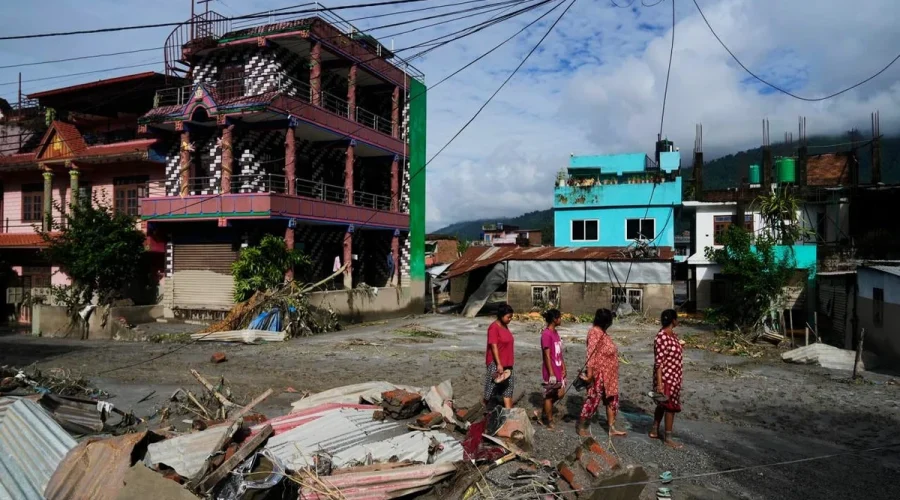
£5 Million Pledge as Nepal Grapples with Catastrophic Flash Floods and a Looming Second Disaster
Traveloasisspot.com – Britain has committed £5 million in emergency aid to Nepal as the South Asian nation reels from flash floods that have buried entire communities in mud and left hundreds dead or missing. Prime Minister Andy Burnham described the unfolding catastrophe as producing “a devastating picture” of a scale the country has rarely witnessed, and confirmed that consular support teams are being dispatched to the affected region around the clock.
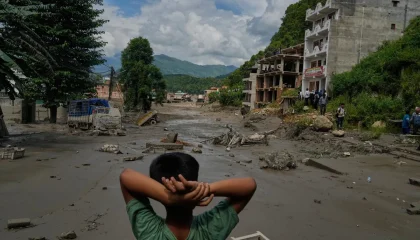
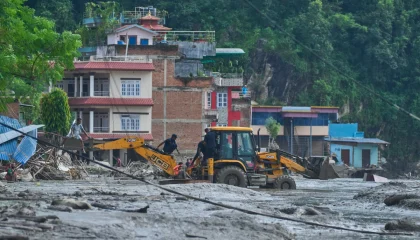
The floods struck the Rasuwa district, a remote corridor along the Nepal–China border adjacent to Tibet’s autonomous region. Rivers burst their banks with such force that populated valleys were submerged under thick sediment, swallowing homes and severing every major road and bridge. Rescue operations continued through Thursday, but the terrain made ground access nearly impossible.
Human Toll and British Nationals Missing
Nepal Police confirmed on Thursday evening that 389 bodies had been recovered, while the combined number of injured and rescued individuals stood at 466. Among those still unaccounted for are more than 30 British nationals, including two teenagers — a 13-year-old girl and a 14-year-old boy — bringing the total of Britons believed missing to at least 33.
One of the missing is Sarada Simkhada, a senior nurse at Darent Valley Hospital in Kent, according to a local councillor. Her disappearance has drawn particular attention given her role in a community hospital serving a densely populated part of southeast London.
In Uckfield, East Sussex, Pramod Poudel told the BBC he was boarding a flight to Nepal at 8 pm Thursday to try to reach his wife, mother, brother, and uncle, all caught up in the flooding. Communication had collapsed in the affected zone.
“There is no proper communication so I can’t communicate with them. I guess there is no power so they can’t charge their phones – so be honest, it’s a very hard and difficult time at the moment.”
In an emotional continuation of the interview, Poudel described seeing images of his hometown reduced to rubble.
“I have seen pictures of where my home town used to be… and there is nothing there now. Where my family used to live – my mum, my dad, my wife, where everyone used to live – there’s nothing there.”
A Second Wave: The Barrier Lake Threat
Even as rescue crews work through the initial devastation, officials warn that a second, potentially worse catastrophe is building upstream. A barrier lake has formed at the confluence of the Tsogyal and Purupqiangzangbu rivers, where a landslide or debris dam has blocked the watercourse. China has issued a warning that the lake is overflowing and could burst, sending a wall of water downstream into already devastated Nepali valleys.
Nepal’s National Disaster Risk Reduction and Management Authority confirmed that satellite imagery supplied by China showed the river “blocked” and a lake accumulating near the flood site. In a social media statement, the authority added that the water level was still rising and urged residents to “exercise special caution” and keep well clear of river banks.
The implication is stark: if the dammed water releases suddenly, communities that have already lost homes and loved ones could face a second inundation within hours or days. Evacuation planning in the Rasuwa corridor is now being conducted under that assumption.
UK Government Response
Burnham, speaking to journalists during a visit to South Wales, outlined the layers of British support being mobilised. Consular officers are being deployed so that affected nationals can access assistance around the clock. An offer of emergency responders has been extended to the Nepalese government, though deployment ultimately rests with Kathmandu’s approval. The £5 million package is earmarked for the broader response effort — search and rescue, medical aid, and infrastructure repair.
“It’s a devastating picture that is emerging from what has happened in Nepal. Scenes that we’ve never seen the like before, I don’t think, certainly the scale of the devastation. So there is immediate action being taken. We are deploying consular support staff to the region so that British nationals will be able to access support 24/7.”
The Prime Minister added that families of missing Britons would receive “all the support we can” during what he called “a very distressing and devastating situation.”
Royal Family Reaction
The King and Queen said they were “heartbroken” and conveyed their “most profound sympathy” to those affected, noting that many people in the United Kingdom maintain “strong, deep and personal ties to this part of the world.” The Prince and Princess of Wales separately expressed their shock, saying: “We are thinking of everyone caught up in this terrible disaster.”
On the Ground: Infrastructure in Ruin
Bishal Nath Upreti, president of the Nepal Centre for Disaster Management, described the scene to BBC Radio 4’s Today programme as resembling a “tsunami from the sky,” adding that villages had been “completely wiped out.” He stressed that damage to roads and bridges was so extensive that only helicopters could reach the disaster zone, severely limiting the pace of rescue and recovery operations.
Social media footage captured the moment of impact: enormous surges of muddy water tearing through narrow valleys, bridges snapping and collapsing, and residents scrambling uphill in panic. The imagery underscored why ground-based rescue teams have been unable to reach many affected settlements within the critical first hours.
Nepal’s geography makes such events especially lethal. The country’s steep Himalayan terrain channels meltwater and monsoon rain into fast-rising rivers with little warning. Rasuwa sits in a narrow valley where even a modest increase in flow can transform a stream into a wall of debris-laden water within minutes. The combination of heavy seasonal rainfall, glacial melt, and seismic instability in the region means that barrier-lake events of the kind now threatening a second wave are not unprecedented, though their scale this time has caught even experienced disaster managers by surprise.
As night fell on Thursday, the focus shifted from rescue to containment: keeping the rising barrier lake from becoming a second catastrophe, and ensuring that the families of the missing receive accurate, timely information in what remains an extraordinarily fluid and uncertain situation.
Related Reading
Frequently Asked Questions
What is UK offers 5m to Nepal following?
UK offers 5m to Nepal following is the main topic of this guide. The article explains the context, practical details, and next steps readers should understand.
Why does UK offers 5m to Nepal following matter?
UK offers 5m to Nepal following matters because readers are looking for a useful answer, not just a short summary. Good content should match search intent and help them decide what to do next.