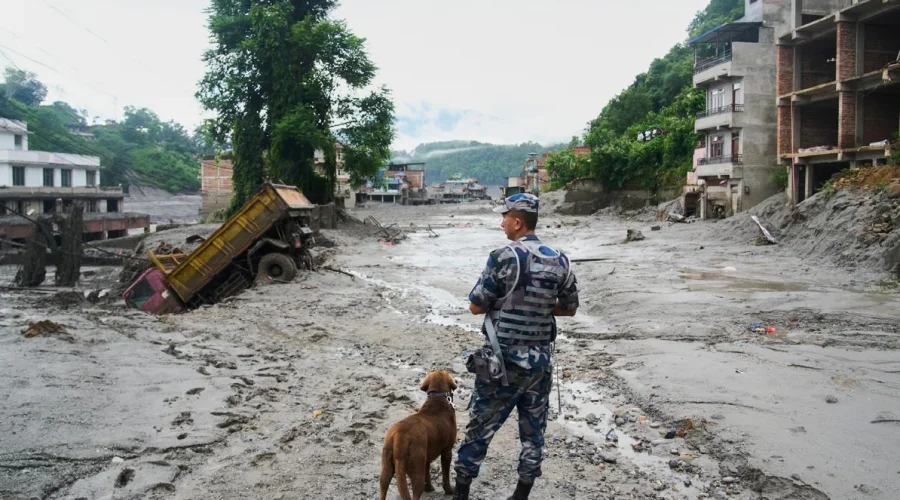
Rescue efforts after Nepal flash floods reach critical stage
Traveloasisspot.com – Rescue efforts after Nepal flash floods have entered what Chinese officials call a “critical stage,” as water levels in a landslide-dammed lake in the Rasuwa district continue to rise. The district borders China’s Tibet autonomous region, and authorities on both sides of the line are bracing for a possible secondary breach of the already-compromised natural dam. More than 1,500 people across the two countries remain unaccounted for, and Nepal’s confirmed death toll has reached 547.
Nepalese Police spokesperson Abi Narayan Kafle confirmed on Friday that search teams have not stood down, though personnel received explicit orders to relocate to higher ground the moment conditions worsen. The Nepal army also sent a team to the border to inspect the Bhotekoshi River, the principal waterway draining the affected highland terrain into the broader river systems shared by both nations.
Hydraulic pressure builds on a failing structure
The most immediate threat is not the aftermath of Wednesday’s initial surge but the prospect of a second, potentially larger release. Chinese officials flagged the dam as carrying “a risk of a further breach” and instructed downstream residents to “remain highly vigilant” and to “make preparations for prevention and emergency response in advance.”
China’s Ministry of Water Resources projected that the lake would absorb roughly three million cubic metres of additional water over the following three days — a volume placing enormous hydraulic stress on a structure already weakened by the first overtopping.
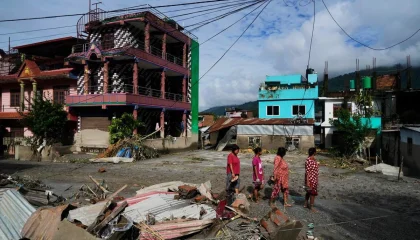
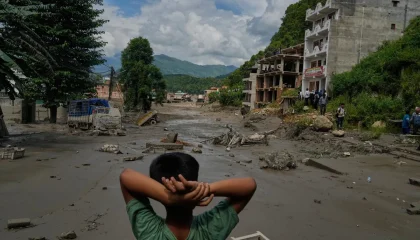
Rescue efforts after Nepal flash floods are being complicated by the sheer scale of the destruction. Rivers burst their banks and deposited thick mud over populated areas, burying homes and rendering roads impassable. Social-media footage captured floodwater surging through narrow valleys while residents screamed; bridges were swept away entirely, and people scrambled uphill to escape churning, debris-laden water.
Human toll and international response
Nepal’s National Disaster Risk Reduction and Management Authority (NDRRMA) reported 977 individuals still unaccounted for at its latest update, while more than 3,000 survivors had been recovered since the floods struck. Of those missing, 517 are foreign nationals. Fourteen thousand, eight hundred and twenty-nine security personnel have been mobilised across the affected zones. China’s state-run Xinhua News Agency separately reported 558 people unaccounted for within the Tibet region itself.
At least 33 British citizens are believed missing, including a 13-year-old girl and a 14-year-old boy. Foreign Secretary Ed Miliband said on Thursday that the Foreign, Commonwealth and Development Office’s crisis centre was operating “around the clock” to trace affected Britons. The British Red Cross’s Asia-region head, Rajesh Srivastava, told Times Radio on Friday that the situation was “very challenging,” with essential infrastructure destroyed and every element of the relief effort complicated.
On Thursday the Prime Minister announced a £5 million aid package for the Nepalese government, calling the scene a “very distressing and devastating situation.” The King and Queen added that they were “heartbroken” and conveyed their “most profound sympathy” to affected families.
Bishal Nath Upreti, president of the Nepal Centre for Disaster Management, likened the event to a “tsunami from the sky,” stating that entire villages had been “completely wiped out.” Officials confirmed that bridges were destroyed and nearly 25 miles of road network damaged, severely hampering ground-based operations.
Mount Kailash pilgrims among the missing
A significant number of those unaccounted for had been undertaking a pilgrimage to Mount Kailash, the sacred Hindu peak in Tibet. Nepalese tour operator The Trekkers’ Society identified nine British nationals on one of its tours: four males aged 14, 50, 50 and 54, and five women aged 40, 46, 50, 50 and 53. Separate travel logs indicate three men aged 65, 64 and 52, and seven women aged 44, 47, 51, 60, 63, 63 and 65, are also among the missing. Another operator, Kailash Journeys, said it could not account for seven UK nationals — five women and two men aged between 18 and 55.
Frequently asked questions
Where exactly did the floods strike? The Rasuwa district in northwestern Nepal, which shares a border with China’s Tibet autonomous region, was the primary impact zone. The Bhotekoshi River basin and surrounding highland valleys were hardest hit.
How many people are confirmed dead or missing? Nepal’s confirmed death toll stands at 547. More than 1,500 people across both countries remain missing, including 517 foreign nationals in Nepal and 558 within the Tibet region.
What is the secondary-dam risk? A landslide-dammed lake upstream of affected communities has already overtopped once. Chinese authorities warn that an additional three million cubic metres of inflow over three days could trigger a further breach, prompting evacuation advisories for downstream residents.
What aid has the UK committed? The Prime Minister announced a £5 million package for the Nepalese government. The Foreign Office crisis centre is operating around the clock to assist missing British nationals, and the British Red Cross is coordinating on-the-ground relief.