Twenty-Seven Riders Left Hanging 50 Feet Above the Ground When Lowestoft Rollercoaster Halts Mid-Track
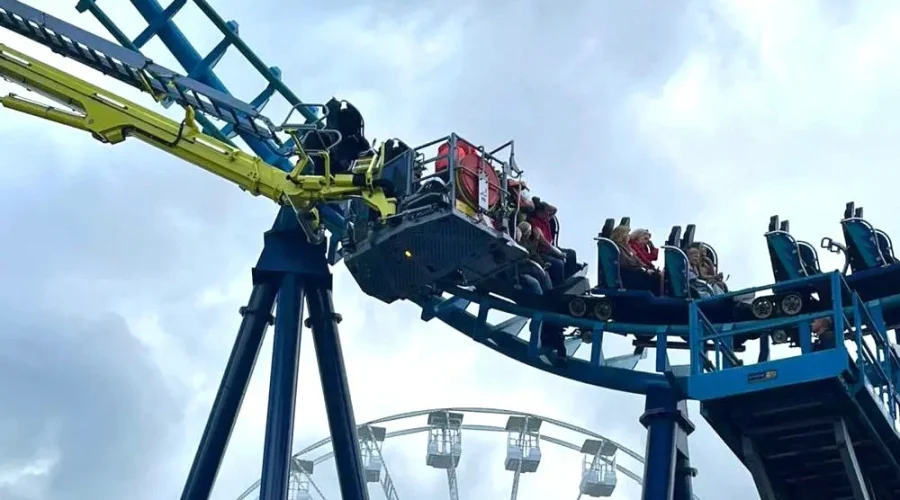
Traveloasisspot.com – A group of 27 amusement park visitors found themselves stranded in mid-air on a steel rollercoaster when the ride ground to an unexpected halt roughly 50 feet above the ground at Pleasurewood Hills, a family theme park situated on the coast of Lowestoft in East Suffolk. Suffolk Fire and Rescue Service dispatched crews to the site, where they deployed specialized equipment to lower each passenger safely from the suspended carriages back to ground level.
The Stoppage and Rescue Operation
The incident occurred on a Monday, and photographs captured at the scene show uniformed firefighters working alongside the track, reaching into individual carriages to assist riders who had been frozen in place by the mechanical failure. The ride appears to have come to rest within a dip section of the track — a downward-curving segment where the carriages sit at a lower elevation than the surrounding structure. Although the stoppage left some passengers tilted at an angle within one of the ride’s twisting elements, none were inverted or upside down at the moment the mechanism locked up.
Firefighters used ladders, harnesses, and other rescue apparatus to extract each of the 27 individuals. The operation required careful coordination given the height involved and the fact that riders were still strapped into their seats, meaning each person had to be unbuckled and lowered individually rather than simply walking away from the track.
About the Wipeout Coaster
The ride at the centre of the incident is called Wipeout, and it holds a prominent position within Pleasurewood Hills’ lineup. The park’s own online description markets the attraction as the
“ultimate thrill”
featuring
“twists, turns, a loop, and two cobra rolls.”
Standing at 130 feet tall, Wipeout is promoted as the park’s
“flagship rollercoaster”
and is identified as the largest rollercoaster in the East Anglia region.
Cobra rolls — the specific element referenced in the park’s description — are a type of vertical inversion where the track curves sharply upward and then folds back over itself, giving riders a sensation of being thrown over the top of a loop without completing a full 360-degree rotation. They are more intense than standard banked turns but less disorienting than a complete loop, and they place significant mechanical stress on the train’s wheels and the track’s support structure.
Pleasurewood Hills and Its Regional Role
Pleasurewood Hills occupies a stretch of coastline in Lowestoft, a town in Suffolk that has long relied on seaside tourism for a meaningful share of its local economy. The park has operated since the 1930s and has undergone several phases of redevelopment over the decades. For families travelling from across East Anglia — including visitors from Norfolk, Cambridgeshire, and northern Essex — it represents one of the few large-scale theme park options within a reasonable driving distance, particularly during the summer holiday season when school-age children are home from term.
The fact that Wipeout is the region’s tallest and most complex coaster means that any mechanical fault on the ride draws disproportionate attention. A stalled coaster at 50 feet is not merely an inconvenience; it is a scenario that tests the park’s emergency protocols, the local fire service’s response times, and the psychological composure of riders who may have been expecting a smooth, continuous descent and instead found themselves locked in place with the sea visible far below.
What Happens When a Coaster Stops Mid-Track
Modern rollercoasters are equipped with multiple redundant braking systems, including magnetic brakes, friction brakes, and a backup power supply designed to keep trains moving to a safe stopping point if the main drive fails. When all of those systems are overwhelmed or when a fault occurs in the track geometry itself, the ride simply halts. At that point, the park’s operational team typically attempts a restart from the control room. If the restart is not possible within a short window, or if riders show signs of distress, the park activates its evacuation plan — which, for elevated sections, means calling in the local fire and rescue service.
Suffolk Fire and Rescue Service maintains standing agreements with theme parks in its jurisdiction, including pre-surveyed access routes, designated staging areas for ladders and aerial platforms, and trained personnel who understand the specific geometry of each ride. The Monday operation at Pleasurewood Hills appears to have followed that established protocol, with crews arriving, assessing the track position, and systematically clearing each carriage.
Passenger Experience and Aftermath
For the 27 individuals caught in the stoppage, the experience would have shifted abruptly from the adrenaline of high-speed twisting to a prolonged period of stillness at considerable height. Sitting at an angle in a twist section — as the Monday photographs appear to show — means riders were not in a comfortable upright posture, and the straps that normally secure them for inversions would have been the only thing keeping them in place. The absence of any upside-down positioning at the moment of failure likely reduced the immediate panic factor, though the psychological impact of being suspended 50 feet above the ground with no forward motion is significant regardless of orientation.
No injuries were reported in connection with the rescue. The park’s management would be expected to investigate the mechanical cause of the stoppage before returning Wipeout to public operation, a process that typically involves a full inspection of the drive system, brake assemblies, and track alignment before any test runs are authorised.
The episode underscores a point that theme park visitors rarely contemplate: the engineering that keeps a steel train moving smoothly along a 130-foot structure is also the engineering that, when it falters, leaves dozens of people dependent on external rescue. The fact that Suffolk Fire and Rescue Service was able to clear all 27 riders safely is a testament to preparedness on both sides of the operation — the park’s emergency planning and the fire service’s rapid deployment of appropriate equipment.
Related Reading
Frequently Asked Questions
What is Thrill seekers rescued from rollercoaster that?
Thrill seekers rescued from rollercoaster that is the main topic of this guide. The article explains the context, practical details, and next steps readers should understand.
Why does Thrill seekers rescued from rollercoaster that matter?
Thrill seekers rescued from rollercoaster that matters because readers are looking for a useful answer, not just a short summary. Good content should match search intent and help them decide what to do next.