Markets Navigate Tech Turbulence Amid Middle East Tensions
Utility stocks support FTSE 100 in nervy – London’s premier stock index managed to outshine its international counterparts on Friday, despite widespread unease within the technology sector. Chip manufacturers faced particular pressure, while ongoing developments in the Middle East continued to temper investor optimism. The FTSE 100 Index ultimately finished the session with a gain of 28.13 points, representing a 0.3% increase to reach 10,600.37.
Smaller-cap stocks experienced more difficulty, with the FTSE 250 declining by 111.00 points or 0.5% to settle at 23,604.83. Meanwhile, the AIM All-Share index surrendered 6.87 points, dropping 0.9% to close at 759.31. Looking at the broader weekly picture, both the FTSE 100 and FTSE 250 managed to accumulate gains of 1.0% each, though the AIM All-Share experienced a slight decline of 0.6% over the same period.
Global Market Performance
European equity markets showed mixed results on Friday. Paris’s CAC 40 finished the day down 0.5%, while Frankfurt’s DAX 40 experienced a smaller decline of 0.3%. Across the Atlantic, American markets also posted modest losses. The Dow Jones Industrial Average slipped 0.1%, the S&P 500 fell 0.7%, and the Nasdaq Composite declined by 1.3%.
Government bond yields in the United States showed some compression. The US 10-year Treasury yield stood at 4.53% when London equities closed, down from 4.57%. The longer-dated US 30-year Treasury yield similarly narrowed to 5.06% from 5.10%.
Analyst Perspectives on Market Volatility
It is a risk off end to the week, as the global chip sell-off shows no sign of abating. For now, the sell-off is not turning into a threat to financial markets, and the S&P 500 is only 1% below its all-time high. However, there could be further losses and price action in July suggests that the Q2 rally is now in the rear view mirror.
XTB analyst Kathleen Brooks provided this assessment of current market conditions. She further noted that while investors anticipated Iran-US tensions would increase volatility, the semiconductor sector’s decline remained the dominant narrative. The geopolitical situation certainly matters, but chip stocks continue to drive market sentiment without showing signs of recovery.
Technology Sector Leadership Shifts
Apple briefly surpassed Nvidia to become the world’s most valuable corporation before the latter recovered some ground. Nvidia had fallen below Apple following the latest wave of semiconductor share selling. At the London closing bell, Nvidia held a market capitalization of approximately 4.94 trillion US dollars, marginally exceeding Apple’s 4.92 trillion dollars valuation.
Nvidia shares declined 1.5% on the day, though they had experienced a steeper drop of more than 4% earlier in Friday’s trading. Apple shares, by contrast, gained 0.5% during the session.
Commodities and Currency Movements
Gold prices remained essentially stable on Friday, quoted at 4,014.29 dollars per ounce compared to 4,014.58 dollars on Thursday. Brent crude oil prices rose to 86.53 dollars per barrel from 84.75 dollars late on Thursday.
Currency markets showed modest movements. The pound strengthened to 1.3453 dollars from 1.3431 dollars at Thursday’s London close. Against the euro, sterling traded at 1.1753 euros, down from 1.1791 euros. The euro weakened to 1.1441 dollars from 1.1444 dollars, while the dollar eased slightly to 162.37 yen from 162.39 yen.
Geopolitical Developments
Iran’s Aerospace Force commander, Majid Mousavi, declared on Friday that Tehran would maintain its regional attacks until the United States ceased striking Iran’s southern coastline and the Strait of Hormuz. In a social media statement, Mousavi emphasized that “Tehran and the south are one and indivisible as Iran,” promising that “effective and targeted strikes from across Iran against the enemy will continue” until attacks on key southern areas stop.
Iran’s chief negotiator, Mohammad Bagher Ghalibaf, cautioned that any potential war-ending agreement “only has meaning when its clauses are valid and being implemented.” White House press secretary Karoline Leavitt indicated on Thursday that President Donald Trump would hold Iran “accountable” for reneging on commitments while remaining “always open to diplomacy at the very same time.”
Trump had previously threatened to target Iranian power plants and bridges unless Tehran returned to negotiations, telling Fox News: “Next week it gets really bad for them.”
Political Developments in Britain
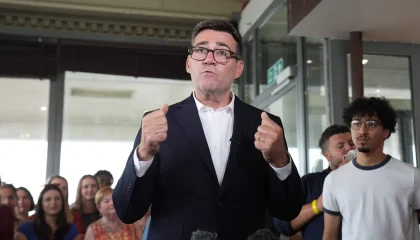
Meanwhile, Andy Burnham has officially assumed leadership of the Labour Party, vowing to restore “hope back” and “the Labour they once knew” to the British public. Speaking at a special conference held at the Trades Union Congress headquarters in central London on Friday, Burnham declared himself “ready to lead” as he took control of the governing party. This appointment represents the final stage before he is expected to replace Sir Keir Starmer as UK prime minister next week. In his acceptance address, Mr. Burnham promised to offer “hope” to the nation, noting that the Labour movement which supported him “heard the call from the people of Makerfield on behalf of forgotten p”