
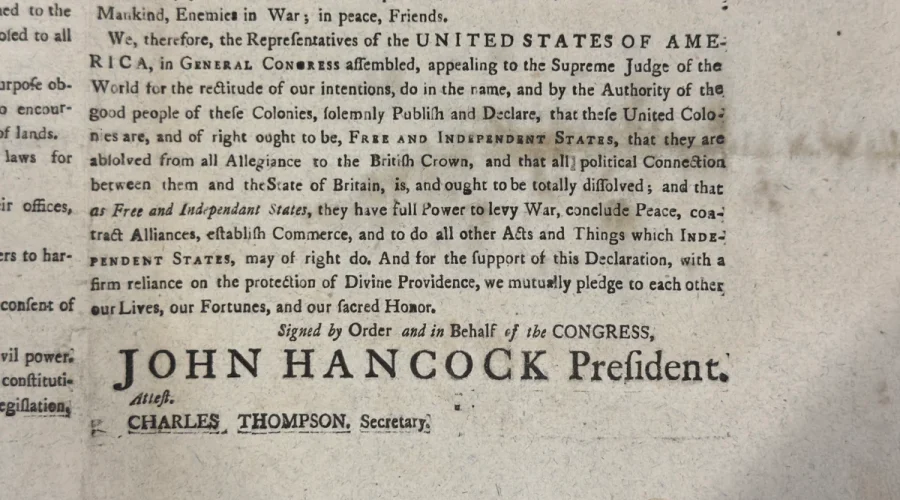
Volunteer Unearths Rare US Declaration of Independence Copy at Kew Archives
National Archives volunteer unearths vanishingly rare – A retired insurance broker has made a groundbreaking discovery at the National Archives in Kew, west London, revealing a “virtually unseen” edition of the United States Declaration of Independence. This unique copy, the only known version outside the U.S., has been tucked away in the archives for centuries, waiting to be rediscovered.
Accidental Breakthrough During Routine Work
Michael Scurr, the volunteer who stumbled upon the document, was performing his usual tasks when the find occurred. “It was just a typical Thursday morning,” he recalled, until his attention was drawn to a letter that seemed unusually dense with attachments. Initially, he anticipated a long morning of work, but what he uncovered would soon shift his perspective.
“I started reading a particular letter, which seemed to have an awful lot of enclosures, and I thought, ‘oh, I’m going to be here all morning with this letter,’” he said.
While examining the enclosures, Scurr’s curiosity led him to a folded parchment that bore the bold words “Declaration” at the top. This moment marked the beginning of an unexpected historical revelation. He immediately alerted his supervisor, Bruno, who confirmed the significance of the find and advised him to maintain discretion.
The National Archives has since kept the discovery confidential for over a month, allowing historians to analyze the document’s provenance. Scurr’s ability to remain silent during this period ensured that the excitement of the find was preserved until the moment of unveiling.
A Transatlantic Relic from 1776
The document, dated 1776, originated from Exeter, New Hampshire, and is one of just 11 surviving copies globally. Its journey to the UK began when it was seized by the Royal Navy on Christmas Eve of that year, during the capture of an American vessel. This copy was likely used to propagate news of independence among other British colonies, a critical step in the revolutionary movement.
Such printings were essential for spreading the message of American autonomy swiftly. They were often transported on ships to inspire support in distant territories. This particular version, however, remained hidden in the archives, its presence unknown until Scurr’s meticulous work uncovered it.
“He initially kept the momentous find concealed from his friends and family,” Scurr explained.
His dedication to the archives over 11 years proved invaluable. During his routine sorting of old captains’ papers in May, he noticed something extraordinary. The discovery not only highlighted his persistence but also underscored the importance of volunteer efforts in uncovering historical treasures.
Historical Significance and Conservation Efforts
Dr. Graham Moore, a curator at the National Archives, emphasized the document’s importance. “This is one of the few,” he noted, as the rare Exeter Declaration joins the collection of three official printings already housed in the institution. The unique copy’s survival is remarkable, given its age and the conditions it endured.
The National Archives has since initiated conservation efforts to preserve the document. Creases and wear were carefully addressed to ensure its display in the upcoming Revolution 250 exhibition, which explores the history of America’s independence from 1763 to 1783. The exhibit will showcase how the document’s dissemination shaped transatlantic history.
“This is an extraordinary discovery,” said Saul Nassé, chief executive of the National Archives. “It’s a vanishingly rare surviving copy of the Declaration of Independence, found not in America, but here in the UK.”
Nassé described the document as a “powerful reminder” of the interconnectedness of the American Revolution with British history. The fact that it was preserved in the UK’s state records adds a unique layer to its significance, bridging the gap between the colonies and the mother country.
A Hidden Gem in the Archives
The Exeter Declaration’s rarity makes it a prized addition to the National Archives’ collection. Unlike the more common printings, this copy’s journey to the UK highlights the role of maritime capture in the spread of revolutionary ideas. It was likely carried across the Atlantic as part of a broader effort to communicate the cause of independence to other British territories.
Scurr’s discovery also sheds light on the value of archival work. By sifting through decades of historical records, volunteers like him play a crucial role in bringing forgotten artifacts to light. The process of unearthing the document required patience and attention to detail, as it was buried within layers of older documents.
More Than a Document: A Symbol of Revolution
While the primary focus of the article is Scurr’s find, the National Archives’ website also features other news, such as updates on football transfers and recent events like a pop star’s tragic performance. These elements provide context to the broader media landscape, contrasting the historical weight of the Declaration with contemporary stories.
For the archives, the Exeter Declaration represents a rare opportunity to connect with the public. “It’s so interesting to me because not only is it new to us and it’s a rare one, there’s only 11 now of this Exeter Declaration in the world,” Moore added. The document’s journey from New Hampshire to London underscores the transatlantic nature of the American Revolution, a theme central to the upcoming exhibition.
The discovery has sparked interest beyond the archives. Scurr expressed hope that his family and fellow volunteers would share in the excitement of the find. “I think my family will be really interested to hear about it, and my friends, and particularly… my fellow volunteers,” he said, highlighting the communal nature of such historical revelations.
A Legacy Preserved in the National Archives
The conservation of the document has ensured its longevity for future generations. By smoothing out creases and stabilizing the parchment, the archives have prepared it for display, making it accessible to the public. This effort reflects the organization’s commitment to preserving history for educational and cultural purposes.
Scurr’s role in the discovery exemplifies the impact of individual contributions to collective historical knowledge. His work, often overlooked, has now become a pivotal moment in the archives’ history. The Exeter Declaration stands as a testament to the enduring legacy of the American Revolution, even in its transatlantic context.
The National Archives continues to highlight such finds, drawing attention to the importance of historical preservation. From the Exeter Declaration to other notable artifacts, these stories remind us that history is not static—it is continually rediscovered and reinterpreted. Scurr’s accidental breakthrough serves as a reminder that even in the most mundane tasks, moments of historical significance can emerge.
As the Revolution 250 exhibition approaches, the Exeter Declaration will take its place among other artifacts, offering visitors a tangible link to a pivotal moment in history. The document’s presence in the UK adds a new dimension to the narrative, reinforcing the idea that the American Revolution was a shared experience between the colonies and the British Empire.