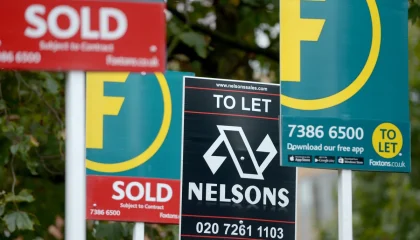

Home-selling times diverge sharply across Britain as mortgage costs reshape buyer behaviour
Traveloasisspot.com – The gap between the quickest and slowest housing markets in the UK has stretched to almost sevenfold, according to new data compiled by property platform Zoopla. In the slowest local authority areas, a typical home now sits on the market for roughly 76 days before a sale is agreed, while in the fastest pockets the figure drops to as little as 11 days. The national average of 42 days has held steady over the past twelve months, yet that headline number conceals a widening split between regions where homes are moving quickly and those where they are stagnating.
A widening regional divide
Zoopla’s analysis, covering the period from initial listing through to estate agents confirming a sale, examined 363 local authority areas. Of those, 180 recorded a longer average selling time than they did in July 2025. The platform attributed much of the slowdown to elevated average mortgage rates, which have pushed prospective purchasers into a cautious,观望 posture. Buyers who once moved swiftly are now waiting for rates to fall, stretching out the period between listing and agreed sale across numerous regional and local markets.
The contrast is starkest in the East Midlands. In Melton, a small market town in Leicestershire, the average time to sell climbed to 76 days – a 21-day deterioration compared with the same month a year earlier. Just a short drive away, neighbouring authorities are seeing their selling clocks tick faster, underscoring how quickly conditions can shift over a matter of miles.
Scotland’s structural advantage
At the opposite end of the spectrum sits Falkirk in Scotland, where the average selling time compressed to 11 days – one day quicker than in July 2025. Zoopla noted that a disproportionate share of the fastest-selling areas fall within Scotland, and pointed to structural differences in how the Scottish transaction works. Scottish sellers typically advertise properties at an “offers over” price, backed by a professional valuation and a completed home survey before the listing goes live. That pre-transaction diligence narrows the pool of viable buyers and accelerates the path to completion, a mechanism absent from most of the rest of Britain where properties are marketed at asking prices without mandatory pre-sale surveys.
Affordability also plays a role. Scottish price points tend to sit lower than comparable English markets, keeping more buyers within reach of mortgage criteria even at current interest-rate levels.
What the data says by region
Zoopla’s July 2026 figures, broken down by nation and region, illustrate the spread:
East Midlands: Melton at 76 days versus North West Leicestershire at 32. East of England: South Norfolk at 58 against Rochford at 33. London: Westminster at 63 compared with Waltham Forest at 33. North East: Middlesbrough at 54 versus North Tyneside at 26. Scotland: Aberdeenshire at 45 against Falkirk at 11. South East: Isle of Wight and Thanet at 60 compared with Basingstoke and Deane at 29. South West: Teignbridge at 63 versus Plymouth at 33. Wales: Pembrokeshire at 50 against Neath Port Talbot at 29. West Midlands: Wyre Forest and Shropshire at 49 compared with Newcastle-under-Lyme at 27. Yorkshire and the Humber: North East Lincolnshire at 57 versus Barnsley at 23.
Among the areas accelerating most noticeably, Barnsley sellers experienced a 13-day reduction in average selling time year-on-year, while Newcastle-under-Lyme saw an 11-day speed-up. These gains suggest that even within slower regions, pockets of demand are reasserting themselves.
Advice for sellers in cooling markets
Richard Donnell, executive director at Zoopla, framed the national stability as a mask over local turbulence:
“While the national time to sell has barely moved, that stability is masking a real divide opening up between local markets. In areas like Melton in Leicestershire, homes are taking noticeably longer to sell than a year ago, while markets just a short drive away are speeding up.”
Donnell urged homeowners in slower areas to avoid mirroring the buyer-side caution that is dragging down transaction speed. His recommendation was to engage a local agent with granular, street-level knowledge of current demand and to price the property competitively from the outset rather than testing the market at an aspirational figure.
Methodology and caveats
The “time to sell” metric tracks the interval between a property’s first appearance on the open market and the point at which an estate agent reports a sale has been agreed. It does not measure completion or exchange of contracts. A number of local authorities were excluded from the analysis because their transaction volumes over the measurement window were too small to yield statistically reliable averages. Readers should treat the figures as directional indicators of market momentum rather than precise forecasts of individual selling timelines.
For homeowners weighing when to list, the data reinforces a straightforward point: location-specific conditions now matter far more than the national headline suggests. A seller in a cooling pocket may face a two-month wait where a seller twenty miles away closes in under a month, and the difference is driven less by the property itself than by local buyer confidence, mortgage affordability, and the structural mechanics of the regional sales process.
Related Reading
Frequently Asked Questions
What is Britain s fastest home selling hotspots?
Britain s fastest home selling hotspots is the main topic of this guide. The article explains the context, practical details, and next steps readers should understand.
Why does Britain s fastest home selling hotspots matter?
Britain s fastest home selling hotspots matters because readers are looking for a useful answer, not just a short summary. Good content should match search intent and help them decide what to do next.