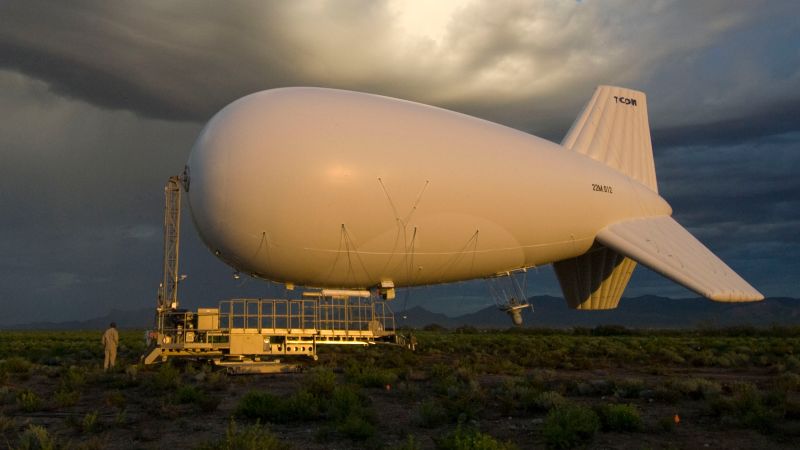
US Military Surveillance Blimp Supporting CBP Lost at the Southern Border, Wreckage Discovered in Mexico
US military surveillance blimp supporting CBP is – A U.S. military surveillance blimp, operated by external contractors near Laredo, Texas, detached from its anchoring system on Monday evening and eventually crashed into Mexican territory. The incident occurred during intense weather conditions, with the blimp’s tether cable becoming entangled with other lines, according to a statement released by the Joint Task Force-Southern Border. Despite the dramatic loss, no personnel were on board the unmanned aircraft, and no ground injuries were reported. The blimp, measuring 66 feet in length, was described as a “medium aerostat” in the task force’s official communication.
Storm-Related Tether Tangle Led to Unplanned Deployment
Heavy thunderstorms at a nearby airport on Monday generated wind gusts exceeding 44 miles per hour, as documented by the National Weather Service. These conditions likely contributed to the blimp’s tether cable becoming dislodged. Operators attempted to resolve the tangle, but the helium-filled balloon ultimately lost its connection and drifted into Mexico. The exact model of the lost blimp remains unspecified, though it is part of the systems deployed by Pentagon contractors to assist the Customs and Border Protection (CBP) agency.
“The blimp’s tether became entangled with other cables during the storm, leading to its detachment,” stated a spokesperson for the Joint Task Force-Southern Border. “This was an unforeseen event, and the aircraft floated away without any crew on board.”
The CBP has relied on contractor-operated surveillance blimps for years as part of its broader strategy to monitor the U.S.-Mexico border. These aerial platforms vary in capabilities, with some equipped to capture high-resolution imagery and others incorporating radar technology to track drones and smuggling aircraft. While the recent incident involved a smaller blimp, its loss underscores the challenges of maintaining such systems in unpredictable environments.
Border Patrol’s Blimp Program Faces Funding Challenges
Since 2012, the Border Patrol has utilized small tactical blimps as part of its surveillance initiatives. However, the program has encountered financial hurdles, with funding lapses forcing periodic pauses in operations. The Department of Defense, which invested over $5 billion during the Iraq and Afghanistan wars, played a key role in developing and supplying more than 140 surveillance blimps to the agency, as noted in a 2012 Government Accountability Office report.
Despite these efforts, the loss of the blimp on Monday highlights the vulnerability of even advanced systems to weather-related disruptions. The wreckage was found in a remote area southwest of Laredo by Mexican military forces, prompting coordinated efforts between U.S. and Mexican troops to retrieve the device. This collaboration reflects the shared responsibility of securing the border and managing incidents that cross national boundaries.
Historical Context: A Larger Blimp Incident in 2025
Earlier this year, in March 2025, CBP experienced a more significant loss when a 200-foot aerostat operating over South Padre Island, Texas, broke free from its tether. The balloon traveled nearly 600 miles before colliding with power lines near Dallas, marking a notable event in the agency’s use of aerial surveillance. The current incident, however, involved a blimp managed by Pentagon contractors, emphasizing the continued integration of military assets into CBP’s operations.
CBP, which is responsible for overseeing the Border Patrol, has been a central component of President Donald Trump’s initiatives to strengthen border security and limit illegal immigration. Trump’s push for enhanced border defenses has resulted in the deployment of substantial military resources, including specialized equipment like the high-energy anti-drone laser system. This system, provided by the Pentagon, was instrumental in targeting balloons during earlier operations but also led to an unexpected consequence: the Federal Aviation Administration temporarily halting civilian airspace over El Paso in February. The FAA’s decision followed concerns about the laser’s interference with commercial aircraft.
Broader Implications of Military Integration
The recent loss of the blimp raises questions about the reliability of aerial surveillance in border operations. While these systems offer strategic advantages, such as extended monitoring capabilities and real-time data collection, their dependence on stable weather conditions and complex tethering mechanisms can lead to unintended outcomes. The incident also underscores the shared logistical and operational challenges between U.S. and Mexican authorities in managing border security.
For the Joint Task Force-Southern Border, the event serves as a reminder of the delicate balance required in deploying military technology for civil purposes. The task force spokesperson acknowledged the need for improved protocols to prevent such occurrences, particularly in regions prone to severe weather. Meanwhile, the CBP continues to leverage these assets as part of its multifaceted approach to border control, blending cutting-edge technology with traditional methods of surveillance and enforcement.
The U.S.-Mexico border has long been a focal point for national security strategies, and the use of surveillance blimps represents a modern adaptation to this challenge. However, the loss of the blimp and its aftermath illustrate the complexities of integrating military capabilities into civilian operations. While the immediate impact of the incident is limited, it highlights the broader implications of relying on such systems for border monitoring. As the coordination between U.S. and Mexican forces continues, the incident may prompt further discussions on the role of aerial surveillance in the region’s security framework.
Editor’s Note: This story and headline were revised to clarify that the blimp in question was operated by military contractors. The work of Davis Winkie at CNN is supported by a partnership between the Outrider Foundation and Journalism Funding Partners (JFP). CNN maintains full editorial authority over all reporting.