
In the neon-drenched world of ‘I Love Boosters,’ fashion is for the people
In the neon drenched world of I – Boots Riley’s latest comedic endeavor, I Love Boosters, is a vibrant exploration of consumerism and identity, where color becomes a central force in storytelling. The film follows a group of friends who engage in a high-stakes clothing heist, blending humor with sharp commentary on the fashion industry’s relentless demand for novelty. At the heart of this sartorial spectacle is the work of Oscar-nominated costume designer Shirley Kurata, whose creative vision transforms the characters into living expressions of the film’s themes. The trio of girlfriends—Corvette, Sade, and Mariah, portrayed by Keke Palmer, Naomi Ackie, and Taylour Paige respectively—alongside Demi Moore as the antagonist Christie Smith, embody a chaotic yet stylish narrative that challenges traditional notions of fashion and ownership.
Color as a Narrative Force
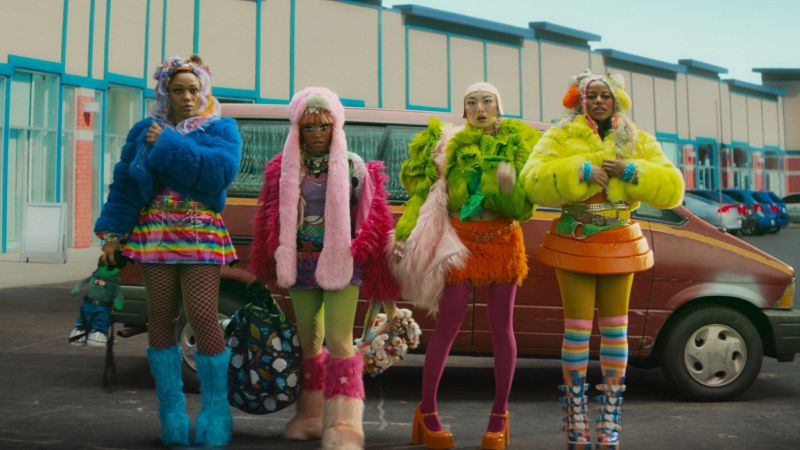
Kurata’s design choices are not merely aesthetic but deeply symbolic. The film’s neon palette, which dominates its visual language, reflects both the energy of the characters and the excess of the fashion world they critique. “The color was my way of giving the story a pulse,” she said, emphasizing how hues like electric yellows and vibrant greens become characters in their own right. “It’s not just about looking flashy—it’s about creating a sense of movement and urgency.” This approach aligns with Riley’s focus on the frenetic energy of the characters’ actions, as they navigate a world where clothes are as disposable as they are desirable.
“It was kind of my dream script to be asked to work on. I could really do all the fun fashion that I’ve always wanted to do but haven’t had the chance,” Kurata explained. “We were shooting in the fall and winter which is usually devoid of color in the stores. They don’t have a ton of yellows and bright greens and all that.”
Despite the seasonal constraints, Kurata embraced the challenge, drawing inspiration from the raw, unpolished spirit of the characters. Her process involved quick decision-making and a willingness to embrace spontaneity, which she believes contributed to the film’s distinctive energy. “We didn’t have a ton of prep time either and a lot was done last minute—sometimes it works well that way because then you’re not overthinking things,” she added. The result is a visual feast that feels both chaotic and purposeful, a reflection of the characters’ lives and the world they inhabit.
The Strip Mall as a Fashion Stage
The film’s setting—a metropolitan strip mall—serves as a microcosm of the fashion industry’s commercial machinery. The chain of stores known simply as “Metro Designer” is the brainchild of Christie Smith, a retail mogul played by Demi Moore. Each outlet is a fleeting spectacle, its color schemes shifting with the seasons and consumer trends. Kurata described the store as “a symbol of the trend cycle within fashion and the fleeting nature of consumer taste,” highlighting how its design mirrors the characters’ own transformations.
Inside the store, the contrast between the glossy, aspirational displays and the underpaid, overworked employees is stark. Violeta, a glam goth sales associate turned labor organizer (played by Eiza Gonzalez), and Grayson, a hilariously uptight manager (Will Poulter), embody the tension between commercialism and individuality. “The store’s aesthetic is both a trap and a release,” Kurata noted, “because it lures customers with its shine while masking the labor behind it.” This duality is central to the film’s message, as it questions the cost of the fast fashion world the characters are both part of and challenging.
“I had to consider all of the varying character personalities and from there create this closet for them,” Kurata said, reflecting on the process of designing for the Velvet Gang. “It’s not just about what they wear—it’s about how their styles evolve as they move through different scenarios.”
Styling the Characters: A Fusion of Realism and Fantasy
Kurata’s collaboration with the cast involved a blend of practicality and imagination, particularly for the Velvet Gang. For Corvette, an aspiring fashion designer, her wardrobe needed to balance authenticity with theatricality. “I wanted her clothes to feel like they could have been made in a real-world studio, but also like they had a story behind them,” Kurata explained. This approach was evident in her creation of a skirt made from men’s ties and a top crafted from athletic tube socks, which subtly highlight the characters’ resourcefulness.
Similarly, Sade and Mariah’s styles reflect their personalities while allowing room for transformation. “Sade’s look is more streetwear, but she also borrows from Corvette’s designs,” Kurata said, noting the interconnectedness of the characters. “Mariah’s style is punk-inspired, rooted in Oakland’s art scene, but it’s also practical—she needs to be ready for anything, including heists.” The costumes, she added, were designed to move with the characters, adapting to their moods and roles without sacrificing the film’s vibrant tone.
“There also had to be a resourceful element,” Kurata said, detailing her process for Corvette. “One of the tops she wears is made from athletic tube socks, and in the opening scene you don’t get to see much of her bottom half, but she’s wearing a skirt made of a bunch of men’s ties.”
To achieve the film’s eclectic look, Kurata sourced clothing from thrift stores and borrowed pieces from young student designers at The Savannah College of Art and Design in Georgia. This approach not only added authenticity but also underscored the film’s theme of reinvention. “Thrift stores were a goldmine,” she remarked. “They gave us a raw, unfiltered look that felt real, even when the characters were playing dress-up.” The use of recycled and upcycled materials also serves as a metaphor for the characters’ lives, where discarded items are given new purpose and meaning.
Christie Smith: The Fashion Villain with a Flair
The antagonist, Christie Smith, is a masterclass in visual storytelling, her wardrobe reflecting her duality as both a power figure and a morally ambiguous character. Kurata drew from classic fashion villain tropes, such as the platinum-hued bob and aviator reading glasses, but added a modern twist. “I studied a lot of prominent female designers to understand how their styles translate to power,” she said, referencing figures like Jenna Lyons. “Christie’s look needed to be sharp, but also slightly off-kilter to show her unpredictability.”
“There’s something off-kilter about her, so I wanted her attire to be a little bit off-kilter too,” Kurata said, explaining her approach to the villain’s style. “I thought it would be so Christie to be devoid of color—she wouldn’t be caught dead wearing it.”
Moore’s insistence on shopping for her own pieces during filming added another layer to the character’s authenticity. “She got some selects that she thought were perfect for Christie’s image,” Kurata recalled, noting how Moore’s personal choices enhanced the film’s critique of fashion’s aspirational nature. The result is a character who is both a symbol of excess and a reflection of the industry’s internal contradictions.
Kurata’s work on I Love Boosters is a testament to her ability to blend the whimsical with the serious. The film’s color-saturated world, its mix of Gen-Z rave aesthetics and Bay-area grunge, and its sharp social commentary all come together in a visual narrative that is as bold as it is insightful. “This was a chance to make something that’s fun but also has a deeper message,” she said, highlighting how the costumes serve as both a character’s mask and a statement about the fashion industry’s role in society. The final product is a celebration of individuality, a critique of consumerism, and a reminder that fashion, at its core, is about more than just appearance—it’s about identity, rebellion, and the power of reinvention.
As the film’s characters navigate their world of stolen styles and bold choices, Kurata’s designs ensure that their journey is as visually compelling as it is thematically rich. Whether it’s the Velvet Gang’s high-energy outfits or Christie Smith’s calculated wardrobe, each piece contributes to the film’s larger narrative. In a world where fashion is often seen as a luxury, I Love Boosters redefines it as a tool for empowerment and a mirror to our consumer habits. The result is a film that is as much about the clothes as it is about the people who wear them, proving that style can be both a statement and a revolution.





