Royal Visit Marks Grand Opening of Oxford’s Humanities Hub
Traveloasisspot.com – Members of the public witnessed a special occasion as King Charles III arrived at the University of Oxford to formally inaugurate a significant new academic facility. The Stephen A Schwarzman Centre for the Humanities received a warm reception, with young students providing a musical greeting for the monarch during the ceremony.
The royal tour of the prestigious institution proved to be a memorable experience for everyone involved. The King described his time at the newly constructed venue as genuinely enjoyable, noting that it offered him the opportunity to see how the university’s humanities disciplines have been brought together under one roof.
A Ceremonial Welcome
Friday’s proceedings began with a formal welcome extended by Lord William Hague, who serves as the university’s Chancellor. Following this introduction, a group of local secondary school pupils delivered a performance of Claudio Monteverdi’s Cantate Domino, creating an appropriate atmosphere for the royal visit.
Also present to receive the King was Stephen Schwarzman, the American entrepreneur and head of the investment company Blackstone. His generous contribution of £185 million made the construction of this impressive building possible, and he stood alongside the monarch during the commemorative events.
Unveiling and Reflections
The ceremonial unveiling involved the King removing a blue cloth to reveal a commemorative plaque. Speaking during this moment, Charles expressed his delight at being present to mark the occasion. He remarked that nothing could bring him more satisfaction than sharing this brief celebration with those gathered to honor the building’s completion.
“Nothing could give me greater pleasure than to be with you today just for a short moment to celebrate this remarkable building, which I now discover has all the humanities departments in one place.”
The monarch also drew a comparison between his own student days and the current state of Oxford. He recalled that more than six decades earlier, when he was studying at Cambridge, he had to cycle a considerable distance to reach his classes. He expressed confidence that the new facility would significantly benefit the university community.
“I was saying when I was at Cambridge 60-something years ago I had to bicycle a very long way to get here. So I’m sure this will make an enormous difference to the university.”
Exploring the Facilities
Within the building’s Great Hall, the King engaged with teaching personnel from various humanities departments alongside representatives from nearby community organizations. Both Lord Hague and Mr Schwarzman accompanied him during these conversations.
The royal tour continued to the Sohmen Concert Hall, a 500-seat performance space that holds the distinction of being the world’s inaugural Passivhaus-standard concert venue. This designation indicates that the auditorium operates with exceptional energy efficiency. While observing from an elevated balcony, Charles watched a student musical ensemble conduct their rehearsal. The King was dressed in a distinguished suit complemented by a pink tie during this portion of his visit.
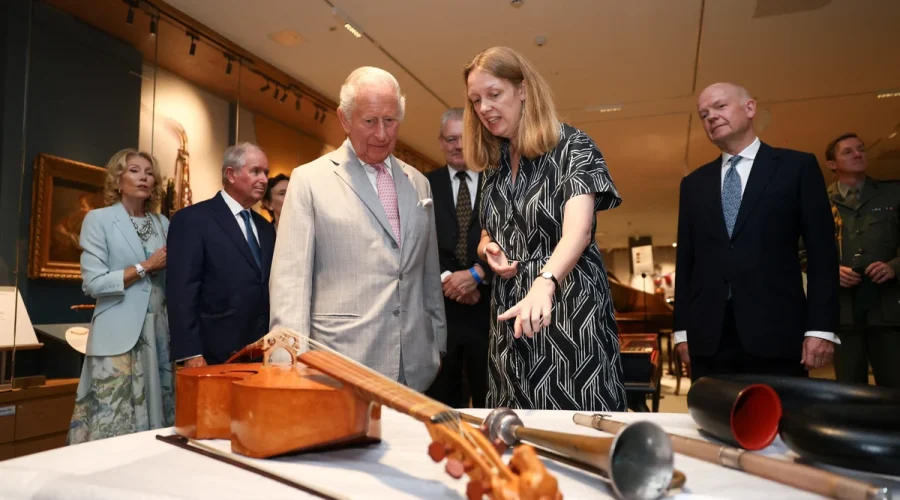
Another highlight of the tour was a visit to the Bate Collection, where the monarch was presented with an impressive array of musical instruments spanning the Renaissance and Baroque eras. These included wind, string, and percussion pieces that demonstrated the breadth of the collection.
A Musical Connection to Bach
Among the treasures displayed was a manuscript of Auf Christi Himmelfahrt Allein, composed by the renowned German musician Johann Sebastian Bach. This particular document represents one of merely four autograph manuscripts by the composer housed within the United Kingdom. Richard Ovenden, librarian for the Bodleian Libraries, noted that the King showed considerable interest in this historical artifact.
During their conversation, Charles mentioned that he had previously read a well-known biography of Bach written by John Eliot Gardiner, demonstrating his appreciation for classical music and its historical significance.
Mr Ovenden shared his thoughts with the Press Association, expressing that hosting the current monarch represented a substantial honor. He emphasized that the plaque unveiling and the formal opening ceremony marked an important milestone for the institution.
A Memorable Departure
As the King prepared to leave the building, a group of primary school students gathered in the warm weather to wave Union flags in his honor. Observers also noted that Charles appeared to have a bloodshot eye during the event, a condition he occasionally experiences due to a leaky vessel in his eyeball.
The visit successfully combined tradition with celebration, bringing together students, faculty, community members, and distinguished guests to mark the opening of a facility that will serve Oxford’s humanities disciplines for years to come.