Third Runway at Heathrow Would Push UK Past Its Carbon Budget, Tyndall Centre Modelling Finds
Traveloasisspot.com – With summer 2026 provisionally confirmed as the hottest ever recorded in Britain — a season marked by widespread drought and wildfires sweeping multiple regions — a fresh modelling exercise has sharpened the argument against adding a third runway to London’s busiest airport. The analysis, produced by the Tyndall Centre for Climate Change Research at the University of Manchester and commissioned by environmental campaign group Friends of the Earth, concludes that the UK aviation sector is already on track to breach the legally binding ceiling set under the seventh carbon budget, a component of the national pathway toward net zero by 2050. That projection holds true even before any new Heathrow infrastructure enters the equation, and even after accounting for recently approved capacity increases at Gatwick, Stansted, and Luton.
The Carbon Budget Problem
The Tyndall Centre’s modelling examined every aviation growth scenario the UK Government has published to date. In each case, projected emissions exceed the carbon budget Parliament has legislated. Research fellow Lois Pennington, who led the analysis, framed the finding bluntly:
“Every aviation scenario the UK Government has published overshoots the carbon budget Parliament has legislated, before a third runway at Heathrow is even taken into account. Our analysis shows that aviation cannot continue to grow if the sector is to make a proportionate contribution to meeting the UK’s carbon budgets.”
Pennington added that while sustainable aviation fuels and carbon-removal technologies could play a role in curbing aviation emissions, no current evidence supports their deployment at the scale required to underwrite the level of expansion the Government envisions.
Fuels Cannot Bridge the Gap
A particular focus of the report is the often-cited role of sustainable aviation fuels — including biofuels derived from used cooking oil. The modelling indicates these alternatives, based on existing evidence, would be insufficient to close the widening gap between projected aviation emissions and statutory targets. In practical terms, the sector’s growth trajectory and its decarbonisation toolkit are misaligned, and the shortfall grows larger with every additional runway approved.
What the Expansion Would Mean
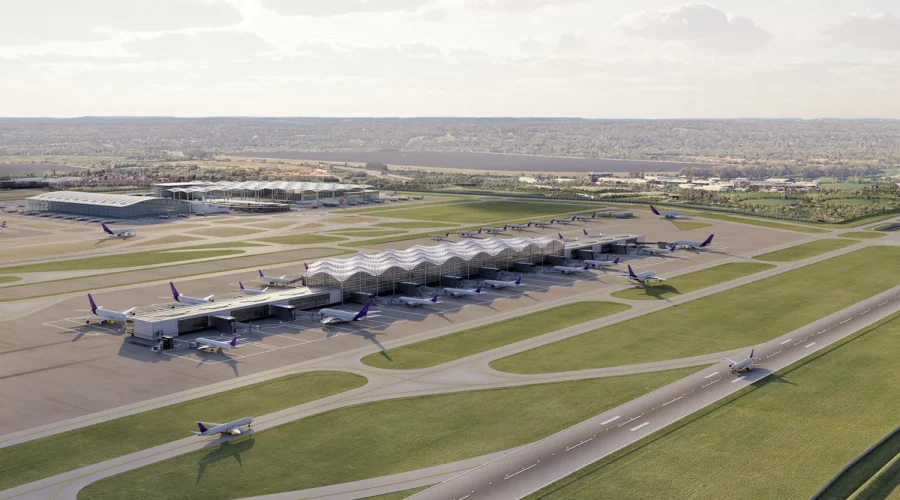
The proposed scheme would raise Heathrow’s annual capacity to 756,000 flights and 150 million passengers. Total cost is estimated at £33 billion, of which roughly £1.5 billion would be allocated to relocating the M25 motorway to make physical space for the new runway. The project is expected to be financed entirely by private capital, meaning no direct taxpayer outlay for construction.
The airport’s own case rests on competitive pressure. After Istanbul overtook Heathrow as Europe’s busiest airport in July, the west London hub argued that “the case for expansion has never been clearer,” describing itself as “operating at capacity” and asserting that the new runway “will ensure the country gets the infrastructure it needs to stay competitive and will deliver all-important economic growth.”
Opposition Intensifies
Mike Childs, head of policy, science and research at Friends of the Earth, drew a direct parallel between the runway proposal and the climate emergency unfolding across the country:
“After this summer of record-breaking heat and nearly 3,000 excess deaths, adding a third runway at Heathrow is the climate equivalent of pouring petrol on a raging wildfire. The evidence is clear: there is no route where expansion at Heathrow can be in line with our legally binding climate targets. The Government has a choice: commit to taking action on the climate seriously, reject Heathrow expansion and constrain excessive flying, or abandon the UK’s climate targets and future generations by giving the third runway the go-ahead.”
Lord Sadiq Khan, Mayor of London, has been a persistent critic of the plan since its earliest iterations. Following the report’s publication, he described himself as “deeply concerned” about potential adverse impacts spanning air quality, noise pollution, local ecosystems, and pressure on other transport networks. He went further, arguing that the entire business case for expansion rests on outdated evidence that fails to grapple with the urgent challenges now facing the country.
The Consultation and Government Position
The public consultation on the Government’s Heathrow Expansion National Policy Statement (HENPS) closed on Tuesday. When the consultation opened in June, Transport Secretary Heidi Alexander stated that the Government considers the development “critical to national growth” and intends to designate the expansion as critical national growth infrastructure — a formal designation that would streamline planning and reduce the scope for local objections.
Friends of the Earth and Lord Khan are once again urging ministers to reject the proposals outright. Their argument, reinforced by the Tyndall Centre’s modelling, is that approving a £33 billion infrastructure project whose emissions trajectory already breaches statutory limits would effectively nullify the legal architecture of the UK’s climate commitments. The seventh carbon budget, which covers the period through to 2035, sets a hard ceiling on total emissions across all sectors. Aviation’s share of that budget, the report argues, is already overcommitted without any new runway.
Broader Implications
The finding lands at a moment when public appetite for long-haul flying is being tested by visible climate impacts. A summer in which thousands of excess deaths were attributed to extreme heat, and in which drought conditions triggered wildfires across multiple English regions, reframes the cost-benefit calculus that underpinned earlier expansion decisions. For policymakers, the Tyndall Centre’s modelling removes a key defence: the claim that aviation growth can be reconciled with carbon budgets through future technological fixes. Until such fixes are demonstrated at scale — and the report finds no current evidence they can be — the sector’s growth path and its statutory limits remain incompatible.
The decision now rests with ministers. Whether they treat the seventh carbon budget as a binding constraint on aviation infrastructure, or treat it as a flexible aspiration subordinate to economic growth, will define the next decade of UK climate policy as much as any single piece of legislation.
Related Reading
Frequently Asked Questions
What is Heathrow expansion would make UK overshoot?
Heathrow expansion would make UK overshoot is the main topic of this guide. The article explains the context, practical details, and next steps readers should understand.
Why does Heathrow expansion would make UK overshoot matter?
Heathrow expansion would make UK overshoot matters because readers are looking for a useful answer, not just a short summary. Good content should match search intent and help them decide what to do next.