
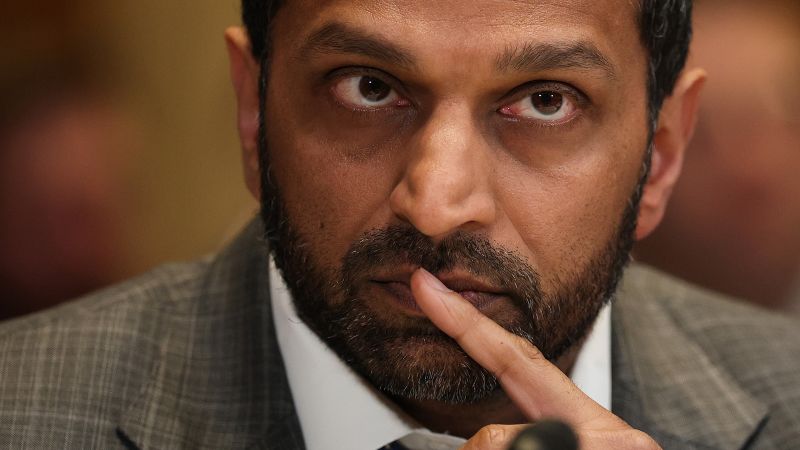
Kash Patel and the Trump administration’s mockery of congressional hearings
The administration’s dismissive attitude toward accountability
Kash Patel and the Trump administration – From the outset, senior members of the Trump administration have demonstrated a dismissive attitude toward Congress, often treating legislative hearings as mere platforms for political theater rather than opportunities for transparency. This approach has been evident in the actions of figures like former Attorney General Pam Bondi, whose public “burn book” of critics and Defense Secretary Pete Hegseth’s aggressive, combative style during recent testimonies underscore a pattern of undermining congressional oversight. The strategy seems to prioritize attacking lawmakers—regardless of party affiliation—to deflect from difficult questions about contentious policies. Yet, the FBI Director’s appearance before a Senate Appropriations subcommittee on Tuesday stands out as a particularly egregious display of this disdain for accountability.
A testy exchange with Maryland’s Chris Van Hollen
The hearing took a sharp turn when Democratic Senator Chris Van Hollen of Maryland delivered an opening statement sharply critical of Kash Patel and the allegations surrounding his alleged excessive drinking habits. Patel, tasked with defending the FBI’s conduct, seized the moment to counterattack. He dismissed Van Hollen’s scrutiny with a barrage of accusations, including a claim that the senator had been “slinging margaritas in El Salvador on the taxpayer dollar” with a “convicted gangbanging rapist.” This came as part of a four-part indictment that Patel squeezed into just 20 seconds of testimony, all aimed at shifting blame away from himself and onto Van Hollen.
“The only person that was slinging margaritas in El Salvador on the taxpayer dollar with a convicted gangbanging rapist was you,” Patel said to Van Hollen. “The only person that ran up a $7,000 bar tab in Washington, DC, at the Lobby Bar was you. The only individual in this room that has been drinking on the taxpayer dime during the day is you.”
Patel’s remarks were met with approval from Trump’s allies, who quickly shared the exchange on social media. However, the accuracy of his claims has come under scrutiny, as they hinge on a specific reference to Van Hollen’s 2025 visit to El Salvador, where he met with Kilmar Abrego Garcia, an undocumented immigrant from his home state. The senator had been accused of illegally deporting Abrego Garcia to a harsh prison environment, and Patel used this as a backdrop to accuse Van Hollen of wasteful spending. But the details of the $7,128 bill from December 2025 at the Lobby Bar, which Patel cited, may not support his interpretation.
Clarifying the $7,000 tab and its source
Van Hollen clarified on Tuesday that the $7,128 expense was for a staff holiday party, not personal indulgence. This distinction is critical, as it highlights a common practice among lawmakers to charge large catering bills to campaign funds. While such spending can be controversial, it does not equate to misuse of taxpayer money, as Patel suggested. The FBI director’s implication that Van Hollen had spent public funds on drinks during the day appears to misrepresent the context, even if the senator had previously faced criticism for his own spending habits.
Moreover, Patel’s reference to Van Hollen’s El Salvador trip lacks direct evidence. The senator admitted that neither he nor Abrego Garcia consumed the drinks during the meeting, which Patel claimed were paid for with taxpayer money. This contradiction raises questions about the validity of Patel’s argument, particularly given that the $7,000 tab was for a different event entirely. Van Hollen’s frustration with the administration’s tactics was clear when he labeled Patel’s claims as an “urban legend in right-wing media,” pointing to the lack of substantiation behind the accusations.
The broader context of Abrego Garcia’s case
The debate over Abrego Garcia’s fate has been a central focus of the Trump administration’s efforts to delegitimize Democratic support for immigration reform. Despite claims that the undocumented immigrant was a “bad guy” involved in gang activities and non-immigration crimes, the evidence remains inconclusive. Abrego Garcia was indicted for alleged human trafficking, but charges of rape—previously used to justify his deportation—have yet to be formally levied. This selective emphasis on certain offenses has been a recurring theme in the administration’s narrative, with officials repeatedly asserting that Abrego Garcia was guilty of actions not even mentioned in the indictment.
Van Hollen’s criticism of Patel’s testimony reflects a broader concern about the administration’s willingness to distort facts. The senator’s ability to host a holiday party and spend campaign funds on catering is a routine practice, yet Patel framed it as a violation of public trust. This kind of rhetorical maneuvering has become a hallmark of the administration’s approach, where accountability is often sacrificed for political advantage. The FBI director’s choice to weaponize Van Hollen’s past expenses against him underscores a strategy of undermining credibility rather than addressing the substance of the questions.
Justice Department ethics under scrutiny
Patel’s remarks during the hearing have drawn attention to the Justice Department’s ethical standards, which require officials to avoid making false statements or prejudging someone’s guilt. By accusing Van Hollen of “drinking on the taxpayer dime,” Patel not only questioned the senator’s behavior but also implied a broader pattern of misconduct. This is especially problematic given that Patel was testifying under penalty of perjury, meaning his words carry legal weight. The administration’s ability to justify such statements highlights a potential erosion of ethical norms, as officials increasingly use congressional hearings to attack opponents rather than defend their own policies.
Bondi, too, has faced similar allegations for her role in the Abrego Garcia case. During a June press conference, she cited claims of other “heinous crimes” not included in the indictment, effectively painting the immigrant as a criminal without evidence. This tactic mirrors Patel’s approach, where the focus is on creating a narrative that aligns with the administration’s agenda. The combination of these incidents suggests a coordinated effort to cast doubt on Democratic legislators while deflecting scrutiny from their own actions.
The hearing has thus become a microcosm of the Trump administration’s broader strategy: to use congressional proceedings as a battleground for political messaging, often at the expense of factual clarity. While Van Hollen’s spending habits may have warranted some critique, the way Patel framed them as taxpayer abuse has been seen as an attempt to muddy the waters and shift focus. The contrast between the senator’s staff event and the FBI director’s public accusation reveals a deliberate choice to emphasize personal conduct over policy implications, a pattern that has characterized the administration’s approach throughout its tenure.
As the debate over Abrego Garcia’s case continues, the administration’s repeated efforts to portray Democrats as overly sympathetic to undocumented immigrants have come under fire. Patel’s testimony, with its mix of personal attacks and selective facts, exemplifies how accountability can be redefined to serve political ends. This behavior, if left unchecked, risks undermining the very purpose of congressional oversight, transforming hearings into arenas for partisan sniping rather than meaningful scrutiny. The implications for public trust and the integrity of the judicial process are clear: when officials prioritize rhetoric over truth, the consequences extend far beyond individual lawmakers, affecting the entire system of checks and balances.





