
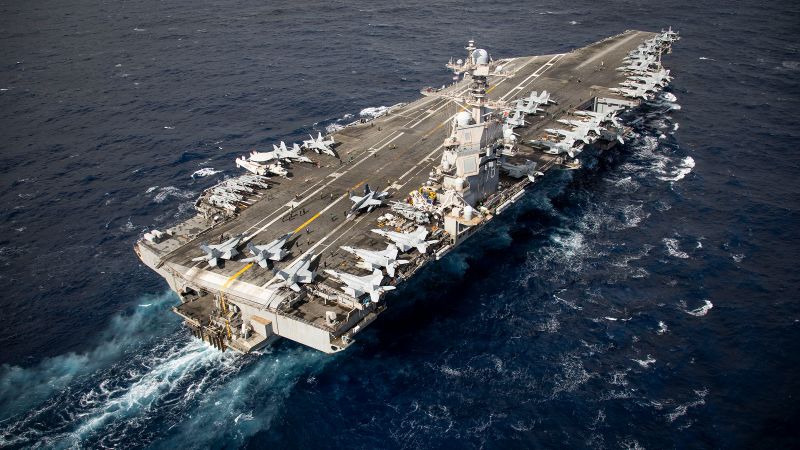
US Aircraft Carrier Returns Home After Record Deployment
US aircraft carrier returns home after – The US aircraft carrier returns home after an unprecedented 11-month deployment that reshaped global military strategy. The USS Gerald R. Ford, America’s largest and most advanced carrier, has now completed its extended mission, docking in Norfolk, Virginia, following a series of high-stakes operations. This record-breaking time at sea included pivotal interventions in the Iran conflict and the capture of former Venezuelan President Nicolás Maduro, marking a significant chapter in the carrier’s operational history. Families of the crew, who endured relentless service for over a year, gathered at the port to celebrate the sailors’ return, highlighting the endurance of both the ship and its personnel.
Extended Mission: A Test of Endurance
The Ford’s deployment exceeded the typical 7-month timeframe for US aircraft carriers, becoming the longest sustained operation since the Vietnam War era. Throughout the mission, the carrier served as a strategic asset under President Donald Trump’s administration, operating across the Mediterranean, Caribbean, and Atlantic. While its role in the Iran conflict and the Maduro capture showcased its capabilities, the extended period also tested the crew’s resilience. The ship’s ability to adapt quickly to changing priorities—such as shifting focus from the Atlantic to the Caribbean—demonstrated its importance in modern warfare.
Despite the challenges, the US aircraft carrier’s mission was marked by notable achievements. Its presence in key regions helped deter aggression and support allied forces, while its advanced technology allowed for rapid response to evolving situations. However, the lengthy deployment also brought logistical hurdles, including the need for mid-port repairs due to mechanical issues. The crew’s dedication to maintaining operational readiness, even amid setbacks, underscored their commitment to national security.
Technical Trials: Fire and System Failures
During the deployment, the US aircraft carrier faced technical challenges that tested its systems. A fire broke out in the laundry area in March, forcing the ship to halt operations for over 30 hours. Crew members worked around the clock to restore functionality, ensuring the safety of the ship and its personnel. The incident left approximately 600 sailors unable to use their bunks, creating additional strain on the crew’s daily routines. Yet, no serious injuries were reported, and the ship’s resilience was evident in its swift recovery.
Recurrent issues with the carrier’s onboard plumbing systems further complicated its mission. These malfunctions required the Ford to pause its schedule for repairs, highlighting the balance between technological innovation and maintenance demands. “The fire is still under investigation,” noted Admiral Daryl Caudle, emphasizing the complexity of the ship’s operations. While the US aircraft carrier’s design was intended to reduce such disruptions, its extended deployment revealed the challenges of pushing the vessel beyond standard operational limits.
“The Ford’s deployment demonstrated both its strategic value and the physical and emotional toll on its crew,” said Defense Secretary Pete Hegseth, who joined families in welcoming the sailors back. The remarks reflected the broader significance of the US aircraft carrier’s mission, which included critical actions in the Iran conflict and the Maduro capture.
Families’ Perspective: Balancing Duty and Life
The return of the US aircraft carrier also brought relief to the families of its sailors, who had navigated the demands of prolonged service. Victoria Dobson, a mother of a 2-year-old daughter, expressed deep emotion as she reunited with her family in Norfolk. “I’m very excited, I’m very relieved,” Dobson said, acknowledging the stress of a year without her husband’s presence. The transition from infancy to early childhood, she noted, had been a challenge, with her daughter growing up without constant parental care.
Other families shared similar sentiments. Amini Osias, whose daughter served as an aviation electrician on the carrier, described the mission as a test of patience and strength. “Now I can actually relax and breathe,” Osias remarked, anticipating the chance to return to a normal routine. Despite the US aircraft carrier’s cutting-edge technology, the crew’s families remained concerned about the risks of extended service. “Families still had those doubts,” Osias added, citing the fire as a source of lingering anxiety.
Legacy of the Deployment
The US aircraft carrier’s record deployment has left a lasting impact on military operations and international relations. Its involvement in the Iran conflict and the capture of Maduro signaled a shift in US military strategy, emphasizing swift, decisive action in contested regions. The carrier’s ability to maintain operations for over a year, despite technical and logistical challenges, highlighted its role as a mobile command center. Analysts suggest that this deployment may set a precedent for future extended missions, balancing strategic objectives with the well-being of the crew.
As the USS Gerald R. Ford docks in Norfolk, its return marks the end of a historic chapter for the US aircraft carrier. The mission’s success, coupled with its challenges, underscores the vessel’s importance in projecting power and maintaining global stability. While the crew’s families celebrate the return, the lessons learned from this deployment will likely shape future naval operations, ensuring that the US aircraft carrier remains a cornerstone of American military might.





